Can you actually afford LASIK without dropping $5,000 at once? For most people, yes — through financing that spreads the cost to roughly $100–$200 a month. The catch is the fine print on interest, because “interest-free for 24 months” only stays free if you pay it off on schedule.
Let’s break down what LASIK financing really costs and how to avoid the traps.
LASIK Financing Cost Examples
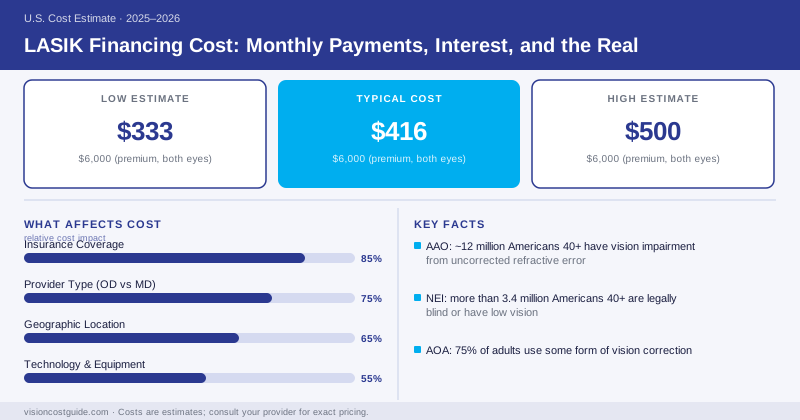
| Total LASIK Cost | 12-Month Plan | 24-Month Plan |
|---|---|---|
| $4,000 (both eyes) | ~$333/mo | ~$167/mo |
| $5,000 (both eyes) | ~$417/mo | ~$208/mo |
| $6,000 (premium, both eyes) | ~$500/mo | ~$250/mo |
These assume an interest-free promotional plan. The base LASIK procedure runs $2,000–$3,500 per eye, so both eyes typically land between $4,000 and $7,000 before any premium upgrades.
How LASIK Financing Works
Most LASIK centers partner with medical credit lenders — CareCredit is the dominant one — offering promotional periods of 6, 12, 18, or 24 months with no interest if paid in full during that window. You apply, get approved (often instantly), and the clinic gets paid upfront while you pay the lender monthly.
The appeal is obvious: no interest and predictable payments. The risk is the deferred-interest structure.
Understand deferred interest before you sign. Most LASIK promo plans use “deferred interest,” meaning if you don’t pay the entire balance within the promo period, interest gets charged retroactively from day one — often at 25–30% APR. Pay $4,900 of a $5,000 balance one day late, and you can be billed interest on the full $5,000 from the start. Set up autopay to clear the balance with time to spare, and an interest-free plan stays genuinely free.
The Smartest Way to Pay: HSA/FSA
Before financing, look at tax-advantaged accounts. LASIK is an IRS-qualified medical expense, so you can pay with pre-tax HSA or FSA dollars. If you’re in a 24% tax bracket, paying $5,000 of LASIK with pre-tax money effectively saves you about $1,200 versus paying with after-tax income.
Strategy that stacks savings:
- Front-load an FSA at open enrollment to cover the year’s procedure pre-tax
- Use an HSA if you have a high-deductible plan — funds roll over and grow
- Combine HSA/FSA for the bulk of the cost and finance any remainder interest-free
What About Discounts and Timing?
Be skeptical of bargain-basement LASIK ads quoting prices far below the $2,000-per-eye norm. Those teaser prices often apply only to the mildest prescriptions and balloon once astigmatism, your actual prescription, or premium technology is added. Get a full written quote for your specific eyes before assuming a low advertised rate applies to you. The cheapest provider is rarely the right way to economize on eye surgery.
Some clinics offer end-of-year or seasonal promotions and small discounts for paying cash upfront. Always ask. But weigh a cash discount against the value of keeping your money in an interest-free plan or paying pre-tax through an FSA.
Is LASIK Worth Financing?
The long-term math often favors LASIK. Over 10–20 years, the cost of glasses, contacts, lens solutions, and exams frequently exceeds a one-time LASIK fee. Our deep dive on whether LASIK is worth the money compares lifetime contact-lens spending against the procedure. If LASIK isn’t right for your eyes, PRK finances the same way and costs about the same.
Bottom Line
LASIK financing typically means $100–$200 a month over two years for a $4,000–$5,000 procedure, and it can be genuinely interest-free if you respect the promo deadline. The single best money move is paying with pre-tax HSA or FSA dollars, which trims 20–30% off the real cost. Combine that with an interest-free plan, set autopay, and LASIK becomes affordable without a lump-sum hit.
Frequently Asked Questions
For a typical $4,000–$5,000 both-eyes LASIK, monthly payments run roughly $100–$200 over 24 months, or about $170–$420 over 12 months.
Often yes. Many LASIK centers offer 12 to 24 month interest-free CareCredit plans, but interest applies retroactively if you don't pay the full balance within the promo period.
Rarely, since LASIK is elective. But HSA and FSA pre-tax funds can cover the full cost and effectively cut your out-of-pocket by your tax rate, around 20 to 30%.