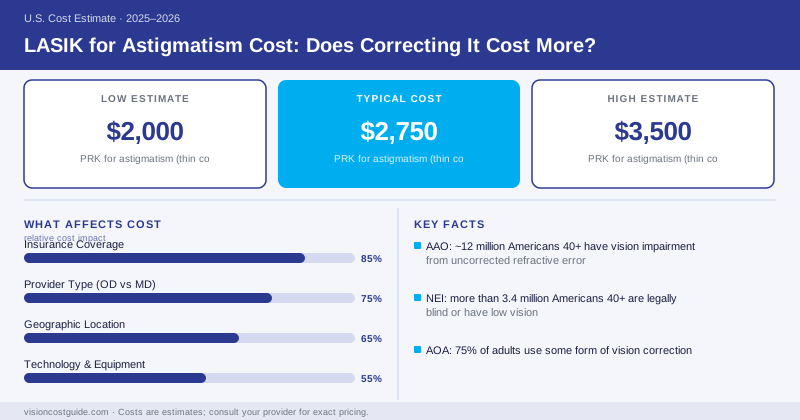
Most people with astigmatism assume LASIK will cost them extra. Wrong. At the large majority of LASIK centers, the price is the same — $2,000–$3,500 per eye — whether your prescription includes astigmatism or not. Modern excimer lasers correct astigmatism within the same treatment, so there’s no separate “astigmatism fee.”
What astigmatism does affect is your candidacy and the type of treatment, not usually the bill.
LASIK for Astigmatism Cost
| Treatment | Cost Per Eye | Both Eyes |
|---|---|---|
| Standard LASIK (with or without astigmatism) | $2,000–$3,500 | $4,000–$7,000 |
| Topography-guided LASIK (Contoura) | $2,500–$4,000 | $5,000–$8,000 |
| PRK for astigmatism (thin corneas) | $2,000–$3,500 | $4,000–$7,000 |
The base LASIK price typically already includes astigmatism correction. You’d only pay more if you choose a premium treatment like topography-guided Contoura, which some surgeons recommend for higher or irregular astigmatism.
What Astigmatism Actually Is
Astigmatism means your cornea is shaped more like a football than a basketball — curved more in one direction than the other. That uneven curve scatters light and blurs vision at all distances. It’s extremely common: the National Eye Institute notes astigmatism affects a large share of the population, often alongside nearsightedness or farsightedness.
LASIK corrects it by reshaping the cornea into a more uniformly curved surface, smoothing out that football shape. The laser is programmed to remove tissue asymmetrically, flattening the steep meridian.
LASIK handles astigmatism well within limits. It reliably corrects regular astigmatism up to roughly 5 to 6 diopters, and FDA-approved lasers treat astigmatism routinely as part of standard treatment. Most patients with typical astigmatism reach 20/20 or close to it. The catch is irregular astigmatism — from conditions like keratoconus — which LASIK can’t fix and which requires entirely different treatment.
Will My Astigmatism Affect Candidacy?
Possibly. Higher astigmatism means the laser removes more corneal tissue, so your corneal thickness matters more. A thorough candidacy exam measures your cornea and maps its shape to confirm you have enough tissue for safe correction.
If your cornea is too thin for LASIK, PRK is the usual alternative — it corrects the same astigmatism without creating a flap, preserving more structural tissue. Our LASIK vs. PRK guide covers when each is the safer pick.
Be cautious if a clinic diagnoses unusually high or irregular astigmatism. Irregular astigmatism can be a sign of keratoconus, a progressive corneal condition that makes standard LASIK unsafe — operating on it can worsen the disease. A responsible surgeon screens for this with corneal topography during your candidacy exam. If irregular astigmatism turns up, ask about alternatives like a corneal lens or specialty contacts rather than pushing ahead with LASIK.
High Astigmatism: When Lenses Beat Lasers
For very high astigmatism beyond LASIK’s range, surgeons sometimes recommend lens-based options instead:
- Implantable collamer lens (ICL) — a lens placed inside the eye, with a toric version for astigmatism
- Refractive lens exchange with a toric IOL — replaces the natural lens, more common in older patients
These cost more than LASIK but extend correction to prescriptions LASIK can’t safely reach.
Paying for It
LASIK for astigmatism is elective and not insurance-covered, but it’s HSA/FSA-eligible and almost always financeable through CareCredit with interest-free promotional periods. Since the astigmatism correction is usually bundled into the standard fee, your cost is simply the normal LASIK price.
Bottom Line
Correcting astigmatism with LASIK generally costs no more than standard LASIK — $2,000–$3,500 per eye — because today’s lasers treat it in the same procedure. Astigmatism’s real impact is on your candidacy and treatment type, not your bill. Get a thorough corneal exam, rule out irregular astigmatism, and most people with typical astigmatism are excellent LASIK candidates.
Frequently Asked Questions
Usually no. Most LASIK centers charge the same $2,000–$3,500 per eye whether or not you have astigmatism, since modern lasers correct it within the standard treatment.
Yes, for most cases. LASIK reliably corrects regular astigmatism up to about 5 to 6 diopters; very high or irregular astigmatism may need a different approach.
Both work well for astigmatism. The choice depends on your corneal thickness and lifestyle rather than the astigmatism itself, since each can correct it.