What does a root canal of refractive surgery look like for someone over 40 fighting reading glasses? Monovision LASIK. You correct one eye for distance and the other for near, and your brain blends the two. The price is the same as regular LASIK — $2,000–$3,500 per eye — because it’s the identical procedure aimed at different targets.
The cost question is easy. The “will my brain accept it” question is the interesting one.
Monovision LASIK Cost
| Option | Typical Cost Per Eye | Both Eyes |
|---|---|---|
| Standard distance LASIK | $2,000–$3,500 | $4,000–$7,000 |
| Monovision LASIK (one near, one distance) | $2,000–$3,500 | $4,000–$7,000 |
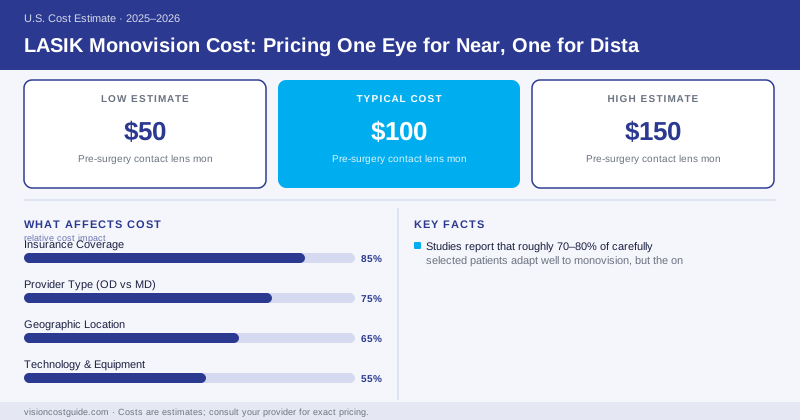
| Pre-surgery contact lens monovision trial | $50–$150 | — |
Monovision doesn’t add to the LASIK price — the laser does the same work either way. The only extra cost is the optional contact lens trial beforehand, which is money well spent.
Why Monovision Exists
After about age 40, presbyopia sets in — your eye’s lens stiffens and near focus fades. Standard distance LASIK fixes your faraway vision but leaves you reaching for readers. Monovision sidesteps that by leaving one eye (usually your non-dominant one) slightly nearsighted for reading while the dominant eye handles distance.
Your brain learns to use whichever eye it needs for the task. Look at a road sign, the distance eye takes over. Read a text, the near eye does. Most people stop consciously noticing the difference within a few weeks.
Test before you commit. The single best predictor of monovision success is a contact lens trial, where you wear lenses set up for monovision for one to two weeks of normal life — driving, computer, reading. Studies report that roughly 70–80% of carefully selected patients adapt well to monovision, but the ones who don’t are far better off learning that with removable contacts than with permanent surgery.
Who Adapts Well — and Who Doesn’t
Good candidates tend to be people who:
- Already tolerated monovision with contacts
- Want freedom from readers for everyday tasks
- Don’t depend on razor-sharp depth perception for work (pilots, some surgeons)
Harder cases include people with demanding night-driving needs or those who simply can’t tolerate the slight blur in one eye. The trade-off is real: monovision modestly reduces fine depth perception and night-driving sharpness.
Monovision is a compromise, not perfection. You may still want glasses for long night drives, fine detail work, or extended reading of tiny print. If you can’t tolerate the contact lens trial, do not proceed to surgery — forcing permanent monovision on a brain that rejects it leads to dissatisfaction and sometimes an enhancement procedure to reverse it.
Monovision LASIK vs. Other Presbyopia Options
Monovision isn’t the only path. Your alternatives include:
- PRK monovision — same concept, surface ablation instead of a flap, useful for thin corneas
- Refractive lens exchange with a multifocal IOL — replaces the lens entirely for all-distance vision, costs more but addresses the aging lens directly
- Reading glasses — free-ish, but the thing you’re trying to escape
For people whose lenses are also clouding, refractive lens exchange may be the smarter long-term move since it also prevents future cataracts.
Paying for It
Monovision LASIK is elective, so insurance won’t cover it. HSA and FSA funds apply, and most LASIK centers offer 12–24 month interest-free CareCredit plans. Many practices price both eyes as a package.
Bottom Line
Monovision LASIK costs the same as standard LASIK — $2,000–$3,500 per eye — and for the right person over 40, it buys genuine freedom from reading glasses. The deciding factor isn’t price, it’s whether your brain accepts the setup. Do the contact lens trial first. If you love it in contacts, you’ll likely love it after surgery.
Frequently Asked Questions
Monovision LASIK costs $2,000–$3,500 per eye, the same as standard LASIK, since it uses the identical laser procedure with different target prescriptions.
For many people over 40 it is. It reduces dependence on reading glasses, and studies show roughly 70–80% of well-selected patients adapt successfully to monovision.
Yes. Surgeons routinely simulate monovision with contact lenses for one to two weeks so you can confirm you tolerate it before permanent surgery.