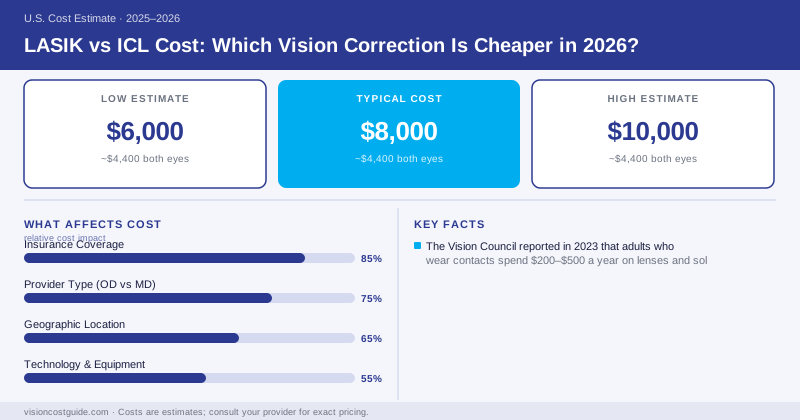
The price difference can be jarring: a LASIK quote might land around $4,400 for both eyes, then the same clinic mentions ICL at $8,000. Why the gap? You’re not just paying for a different laser. You’re paying for a tiny lens that gets implanted inside your eye.
Let’s break down what each procedure actually costs and who should pay the premium.
What You’re Paying For
LASIK reshapes your cornea with a laser. No hardware stays behind. The American Refractive Surgery Council pegs the national average near $2,200 per eye in 2024, so roughly $4,400 for both. That figure usually bundles the pre-op exam and a year of follow-ups.
ICL (Implantable Collamer Lens) is different. A surgeon places a soft, biocompatible lens behind your iris. Nothing gets removed. That lens is a manufactured medical device, and implanting it inside the eye is a more delicate operation than skimming the surface. That’s why ICL surgery runs $6,000–$10,000 for both eyes.
| LASIK | ICL |
|---|---|
| $2,000–$2,500 per eye | $3,000–$5,000 per eye |
| ~$4,400 both eyes | $6,000–$10,000 both eyes |
| Reshapes cornea (permanent) | Implants reversible lens |
| Best for low-to-moderate Rx | Best for high Rx or thin corneas |
Why ICL Costs More
The lens isn’t cheap, and neither is the precision. Three things push ICL above LASIK:
- The collamer lens is a custom-sized device ordered per patient
- The surgery enters the eye, so it carries a higher complication-management cost
- Surgeons certified to implant ICLs are fewer, which keeps prices firm
There’s also the candidacy angle. The U.S. FDA approved the EVO ICL in 2022 for a wider range of prescriptions, and that expanded who qualifies. People with prescriptions stronger than -8.00 diopters or corneas too thin for LASIK often have ICL as their only safe surgical route.
If you’re a straightforward LASIK candidate, LASIK saves you $2,000–$5,000. If your prescription is very high or your corneas are thin, ICL may be your only good option, and the higher price buys a reversible result that doesn’t thin the cornea.
The Long-Term Math
A common question: does ICL’s higher upfront cost pay off over time? Not really, because both are one-time procedures. Neither needs ongoing payments the way contact lenses do.
The real comparison is against years of glasses and contacts. The Vision Council reported in 2023 that adults who wear contacts spend $200–$500 a year on lenses and solution. Over 20 years that’s $4,000–$10,000, which means either surgery can break even versus a lifetime of contacts.
Who Should Choose Which
Pick LASIK if your prescription is mild to moderate, your corneas are healthy thickness, and you want the lower price. It’s the cheaper, faster, well-established route.
Pick ICL if you’ve been told you’re not a LASIK candidate, your prescription is very strong, or you like that the lens can be removed later. The American Academy of Ophthalmology notes that ICL preserves the cornea entirely, which appeals to patients worried about dry eye.
Beware “starting at” pricing. A $3,500 LASIK ad usually covers the simplest cases. Custom wavefront LASIK and ICL almost always cost more once your real prescription is measured. Get a written all-in quote before committing.
Financing Either One
Since neither is covered by insurance, most clinics offer financing through CareCredit or in-house plans. A $4,400 LASIK bill spread over 24 months at 0% is about $183 a month. An $8,000 ICL is roughly $333 a month over the same term. If you’re weighing whether surgery beats glasses long-term, our breakdown of whether LASIK is worth it walks through the payback period.
The bottom line: LASIK wins on price, ICL wins on candidacy flexibility. Your corneas, not your budget, usually make the call.
Frequently Asked Questions
Yes. ICL typically costs $6,000–$10,000 for both eyes, while LASIK averages around $4,400. The implantable lens itself and the more involved surgery drive the price up.
ICL is reversible and doesn't remove corneal tissue, so it's often the better pick for people with thin corneas or very high prescriptions who aren't good LASIK candidates.
Rarely. Both are elective, so you'll usually pay out of pocket. Many clinics offer 0% financing for 12–24 months.