LipiFlow isn’t a cleaning treatment. It’s a heat therapy that works from inside your eyelid. That distinction matters — and it explains both why it works when warm compresses don’t, and why it costs what it does.
At $1,200–$1,800 for both eyes, LipiFlow is the most studied thermal pulsation treatment for evaporative dry eye. Here’s what you get for the price — and who actually benefits from spending it.
What LipiFlow Does (and Why It’s Different From Warm Compresses)
The meibomian glands line your upper and lower eyelids — roughly 25–40 glands per lid. They produce the oil layer (meibum) that coats the surface of each tear and prevents evaporation. When those glands get clogged, atrophied, or start secreting poor-quality oil, your tear film breaks down in seconds instead of lasting 10+ seconds. That’s evaporative dry eye.
Warm compresses help by softening the waxy meibum so glands can express more freely. But applying a compress to your closed eyelid delivers heat to the outer lid surface — and by the time that heat travels through the eyelid tissue to reach the gland orifices on the inner surface, it’s lost a lot of its effectiveness.
LipiFlow’s activators — disposable cups that fit over each eye — apply controlled heat (107°F / 41.5°C) directly to the conjunctival surface of the inner eyelid, where the gland openings are. Simultaneously, the device applies gentle vectored pressure on the outer lid to help express loosened secretions. Twelve minutes per eye. The combination of precise heat and pulsatile pressure from the right side of the lid is what separates it from compresses.
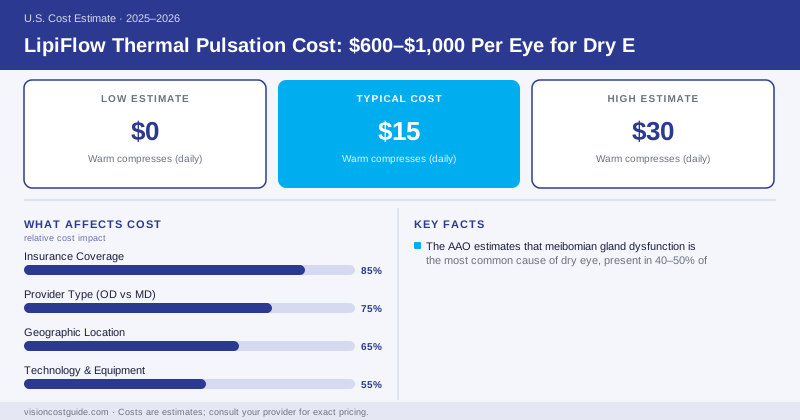
The AAO estimates that meibomian gland dysfunction is the most common cause of dry eye, present in 40–50% of contact lens wearers and up to 70% of dry eye patients overall.
2026 Cost Breakdown
| Treatment Option | Cost | Session Time | Evidence Level | Insurance |
|---|---|---|---|---|
| LipiFlow (bilateral) | $1,200–$1,800 | ~30 min total | Strong (FDA-cleared) | Rarely covered |
| LipiFlow (per eye) | $600–$1,000 | ~15 min | Strong | Rarely covered |
| IPL (Intense Pulsed Light) | $400–$800/session | 20–30 min | Strong | Rarely covered |
| iLux MGD Treatment | $800–$1,400 bilateral | ~8 min | Good | Rarely covered |
| TearCare (thermal therapy) | $700–$1,200 bilateral | ~15 min | Good | Rarely covered |
| Warm compresses (daily) | $0–$30/month | 10 min/day | Moderate | N/A |
All three are FDA-cleared thermal pulsation devices for MGD. LipiFlow (Johnson & Johnson Vision) has the most clinical data — FDA approval in 2011, with multiple published RCTs. iLux (Alcon) is handheld and allows the doctor to target individual glands. TearCare (Sight Sciences) uses smart lids you wear like contact lens inserts during manual gland expression. Outcomes are similar across all three; pricing and availability vary by practice. LipiFlow remains the most widely available.
Who Qualifies — and Who Doesn’t
LipiFlow is designed specifically for evaporative dry eye caused by meibomian gland dysfunction. Before the treatment makes sense, your eye doctor should perform:
Meibography — Infrared imaging of your meibomian glands to see how many are still functioning. If you have significant gland dropout (gland atrophy where tissue is permanently lost), LipiFlow can’t regrow the glands — it can only help the ones that remain. Knowing your gland score upfront prevents expensive disappointment.
TBUT (Tear Break-Up Time) — Normal tear film holds together for 10+ seconds. Evaporative dry eye typically shows TBUT under 5 seconds. This confirms the diagnosis.
Good candidates:
- Moderate-to-severe evaporative dry eye with confirmed MGD
- Failed months of warm compresses, omega-3 supplements, and lid hygiene
- Visible gland blockage (thickened, toothpaste-like secretions rather than clear oil)
Not likely to benefit:
- Aqueous-deficient dry eye (Sjögren’s syndrome, post-radiation, damaged lacrimal glands)
- Severe gland dropout where most meibomian tissue is gone
- Active eye infection or acute blepharitis
How to Find the Actual Price Near You
LipiFlow pricing isn’t standardized. Call 3–4 optometry or ophthalmology practices in your area and ask:
- “Does the price include the meibography evaluation, or is that separate?”
- “Do you treat both eyes in one session, and is that one price or per-eye pricing?”
- “What’s your re-treatment policy and cost?”
In major metro areas (NYC, LA, Chicago), $1,600–$1,800 for bilateral is common. In smaller cities and rural markets, you may find $1,200–$1,400. Academic eye centers sometimes price it lower because residents are involved in the procedure.
Some practices charge separately for meibography ($150–$300), the dry eye evaluation ($100–$200), and the LipiFlow treatment itself. Make sure you’re comparing total-session cost, not just the device fee. Ask for an itemized quote before booking.
Does Insurance Cover LipiFlow?
Rarely — but it’s worth checking.
Most insurance companies classify LipiFlow as an elective in-office procedure rather than a medical necessity, even though MGD is a diagnosed medical condition. You’re unlikely to get coverage from standard vision plans (VSP, EyeMed, Davis Vision).
Medical insurance (not vision) occasionally covers LipiFlow when:
- Diagnosis codes for MGD and chronic dry eye disease are submitted
- There’s documentation of failed conservative treatment (3–6 months of warm compresses, drops, prescription agents)
- The procedure is done under ophthalmology billing, not just optometry
FSA and HSA accounts can be used to pay for LipiFlow. If you have $1,500+ in your health savings account, this is one of the most evidence-backed ways to spend it for dry eye.
After LipiFlow: Maintenance Costs
LipiFlow isn’t a one-and-done fix. Think of it as a reset — it opens blocked glands and clears congested secretions, but the underlying tendency toward MGD doesn’t disappear.
Most patients continue:
- Daily warm compress therapy (10 min/day, $0–$30/month for a Bruder mask)
- Lid hygiene (hypochlorous acid spray or lid wipes, ~$20–$40/month)
- Omega-3 supplementation ($20–$60/month for pharmaceutical-grade fish oil)
Retreatment costs $1,200–$1,800 annually or as needed. Some practices offer package pricing for repeat sessions.
The Bottom Line
LipiFlow is the most studied thermal pulsation treatment for evaporative dry eye, with strong evidence that it outperforms warm compresses for clearing blocked meibomian glands. At $1,200–$1,800 bilaterally, it’s not cheap — and insurance almost never covers it. But if you have documented MGD, failed months of at-home treatment, and still have viable gland tissue on meibography, it’s a legitimate option worth the cost of a consultation.
For a full comparison of MGD treatment options at every price point, see the meibomian gland dysfunction treatment cost guide.
Frequently Asked Questions
LipiFlow typically costs $600–$1,000 per eye in the US, which means $1,200–$1,800 for bilateral treatment (both eyes, done in a single session). Some high-cost metro areas charge up to $2,000 for both eyes. Most practices treat both eyes at once since MGD is almost always bilateral. The price usually includes the one-time-use activator disposables and the treatment session itself.
Clinical studies show most patients maintain significant improvement for 12 months or more after a single treatment. A pivotal trial published in Cornea found that 79% of patients showed meaningful improvement in meibomian gland secretion at 9 months. Many patients repeat treatment annually to maintain results, especially if their underlying MGD is chronic. Some get by with one treatment every 18–24 months.
If your dry eye is caused primarily by meibomian gland dysfunction (evaporative dry eye), and you've failed months of warm compresses, lid massage, and prescription drops, LipiFlow has strong clinical evidence behind it. If your dry eye is aqueous-deficient — meaning your lacrimal glands don't produce enough tears — LipiFlow is unlikely to help because it targets the glands that produce the oil layer, not the water layer. Meibography imaging to assess your gland health is essential before committing to the cost.