Eleanor’s ophthalmologist told her she had macular degeneration and handed her a pamphlet on “low vision aids.” She left the office assuming that meant a single trip to the pharmacy for a magnifying glass. It took her another year to learn the actual range of what’s available — and how much it varies in both price and usefulness.
The National Eye Institute estimates that more than 4 million Americans age 40 and older currently live with some form of low vision or blindness, a number projected to nearly double by 2050 as the population ages. For most of these patients, the goal isn’t restoring normal vision — it’s maximizing functional use of remaining vision, and magnifiers are the most common tool for doing exactly that.
Low Vision Magnifier Cost by Type
| Magnifier Type | Price Range | Best For |
|---|---|---|
| Basic handheld magnifier | $10–$40 | Occasional use, reading labels or mail |
| Illuminated handheld magnifier | $25–$75 | Better contrast, low-light reading |
| Stand magnifier | $30–$100 | Steadier hands-free reading |
| Prescription magnifying reading glasses | $75–$300 | Custom-fit stronger correction |
| Portable electronic video magnifier | $300–$800 | Adjustable zoom, contrast/color modes |
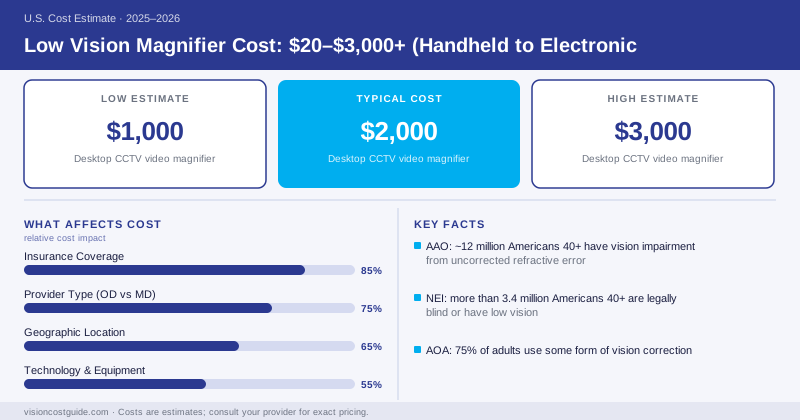
| Desktop CCTV video magnifier | $1,000–$3,000+ | Largest screen, best for extended reading |
The gap between a $20 handheld magnifier and a $3,000 desktop video magnifier isn’t just about screen size — it’s about how much functional vision each device can realistically restore for someone with significant central vision loss.
Why Basic Magnifiers Often Aren’t Enough
For mild vision loss, a simple handheld or illuminated magnifier may provide sufficient help for reading mail or medication labels. But for more significant central vision loss — common in advanced macular degeneration — basic optical magnifiers often can’t provide enough magnification power without distorting the image or requiring an uncomfortably close viewing distance. This is where electronic video magnifiers become genuinely more useful, not just more expensive: they combine high magnification with adjustable contrast and color modes that many low vision patients find make reading measurably easier than an optical lens alone.
Low vision magnifiers range from $20 for basic handheld models to $3,000+ for desktop electronic video magnifiers, with the right choice depending on the severity of vision loss, not just budget. A low vision specialist evaluation — distinct from a routine eye exam — helps match the right device to your specific remaining vision rather than guessing at a price point.
Get a Low Vision Evaluation First
Before spending money on any magnifier, a low vision evaluation — a specialized assessment separate from a routine eye exam, typically performed by an optometrist with low vision specialty training — measures exactly how much magnification and contrast enhancement will actually help your specific pattern of vision loss. This evaluation typically costs $150–$300 and often prevents the common and expensive mistake of buying an electronic magnifier that turns out to be more power (and cost) than actually needed, or conversely, a basic magnifier that doesn’t provide enough help to be worth using regularly.
Insurance and Assistance Programs
Medicare and most private insurance generally don’t cover low vision devices themselves, treating them as assistive technology rather than durable medical equipment, though the low vision evaluation visit is often covered as a medical service. Several nonprofit organizations and state vocational rehabilitation programs offer low vision device loan programs or financial assistance, particularly for patients who are legally blind or have lost driving-related independence — worth researching through your state’s vision rehabilitation services before assuming the full cost falls on you.
Beyond Magnifiers
For some patients, especially those with significant vision loss affecting daily independence, low vision rehabilitation services — training in adaptive techniques, home safety modifications, and orientation skills — provide broader functional benefit than a magnifier alone, and are often covered more readily by insurance as a rehabilitative medical service.
Don’t assume a single magnifier will handle every task. Most low vision patients end up using different tools for different situations — a small illuminated handheld for reading labels while shopping, a desktop video magnifier for extended reading at home. A proper low vision evaluation accounts for this rather than recommending one device to do everything.
Bottom Line
Low vision magnifiers range from $20 to $3,000+, and the right choice depends far more on the severity and pattern of your vision loss than on picking the most expensive option available. Start with a proper low vision evaluation before buying anything — it’s the step most patients skip, and the one most likely to save money in the long run.