In 2010 a kid with worsening nearsightedness got the same single-vision glasses their parent wore. Today, lenses like Hoya’s MiYOSMART are engineered to slow the eye’s growth, and they cost $200 to $450 a pair. That price jump comes with a payoff backed by real trial data.
MiYOSMART uses what Hoya calls D.I.M.S. technology, short for Defocus Incorporated Multiple Segments. Picture a clear center surrounded by a honeycomb of tiny treatment zones. The center corrects vision; the surrounding segments send a defocus signal that tells the eye to slow down.
The Science in Plain Terms
When light enters a normal lens, it focuses behind a myopic child’s retina, which seems to encourage the eye to keep elongating. The hundreds of micro-segments on a MiYOSMART lens redirect some of that light to focus in front of the retina, creating a “stop growing” cue.
The proof came from a landmark study published in the British Journal of Ophthalmology. Over two years, kids wearing MiYOSMART saw their myopia progress 59% slower than kids in single-vision glasses, and axial elongation slowed about 60%. Roughly 1 in 5 children showed no progression at all during the study.
Cost Breakdown
| Item | Cost Range |
|---|---|
| MiYOSMART lenses (pair) | $200–$450 |
| Frames | $50–$200 |
| Anti-reflective or UV coating | $30–$80 |
| Myopia follow-up visit | $80–$150 each |
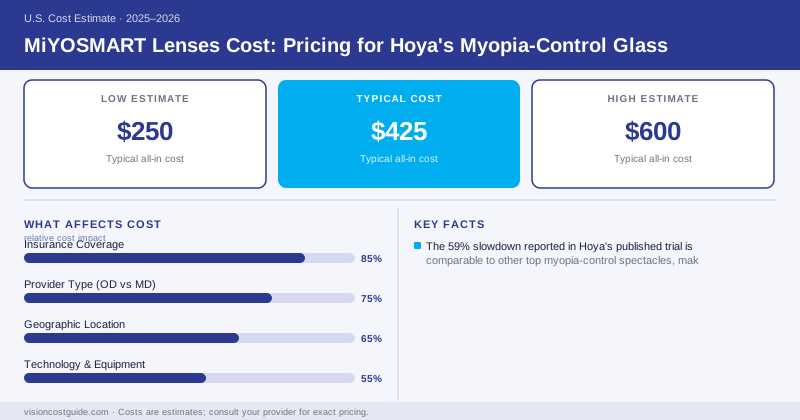
| Typical all-in cost | $250–$600 |
That’s three to five times the cost of standard glasses for kids, and the difference is the lens technology, not the frame. You can trim total cost with a budget frame, but the lens itself is the non-negotiable expense.
MiYOSMART lenses cost $200–$450 per pair, or $250–$600 with frames. The 59% slowdown reported in Hoya’s published trial is comparable to other top myopia-control spectacles, making MiYOSMART a strong glasses-based choice.
MiYOSMART vs. Stellest vs. Drops
These two lens brands are the heavyweights in myopia-control glasses, and their trial numbers are close: roughly 59% slowing for MiYOSMART and around 67% for Stellest. Both require consistent full-time wear to work.
- MiYOSMART: D.I.M.S. tech, often slightly cheaper, widely studied
- Stellest: H.A.L.T. tech, strong trial data, patchier U.S. supply
- Atropine drops: cheapest, no glasses dependency, easy to combine
If your child won’t wear glasses reliably, neither lens helps. In that case a soft myopia-control contact lens or low-dose atropine may fit better. The full menu is in our myopia control cost guide.
Availability and Insurance
MiYOSMART rolled out across Canada, Europe, and Asia ahead of the United States, so U.S. supply remains limited to myopia-focused practices as of 2026. If your optometrist carries it, expect to pay out of pocket. Vision insurance covers a basic single-vision lens but classifies the myopia-control upgrade as elective.
FSA and HSA accounts are your friend here. The lenses qualify as a medical expense, so keep the itemized receipt.
Wear time is everything. Hoya’s data assumes kids wear the glasses essentially all waking hours. A child who only wears them at school loses much of the benefit. Track compliance honestly before paying the premium, because part-time wear turns an expensive lens into an ordinary one.
Should You Buy Them?
If your child already lives in glasses and tolerates them well, MiYOSMART is one of the lowest-effort ways to slow myopia: nothing to insert, nothing to remember at bedtime. The premium buys a documented 59% slowdown and lower long-term risk of the eye disease tied to high myopia.
Start with a pediatric eye exam so the optometrist can confirm candidacy and take precise measurements. Then ask whether MiYOSMART, a competitor, or a combination approach makes the most sense for your child’s prescription trajectory and daily routine. The right answer usually comes down to which method your kid will actually use every single day.
Frequently Asked Questions
MiYOSMART lenses run about $200 to $450 per pair, reaching $250 to $600 with frames. Cost depends on your region, coatings, and whether the practice includes follow-up monitoring.
Hoya's two-year clinical study, published in the British Journal of Ophthalmology, reported MiYOSMART slowed myopia progression by an average of 59% versus single-vision lenses.
As of 2026, MiYOSMART has limited U.S. availability and is more common in Canada, Europe, and Asia. They're typically paid out of pocket since insurance treats myopia-control lenses as an upgrade.