Can a contact lens you throw away each night actually slow your child’s nearsightedness? Yes, and it’ll run you $700 to $1,200 a year. Daily-disposable myopia-control soft lenses have become one of the most popular tools optometrists reach for, because they pair clear vision with a documented slowing effect.
The lenses look ordinary, but they’re built with concentric treatment rings. The center corrects vision while the outer zones create a defocus signal that discourages the eye from elongating. Same goal as myopia-control glasses, different delivery.
Why Optometrists Like Them for Kids
Daily disposables sidestep the biggest contact-lens headaches. There’s no overnight storage, no cleaning solution, no reusing lenses past their welcome. Your child opens a fresh sterile pair each morning and tosses them at night, which slashes infection risk, the top worry parents raise.
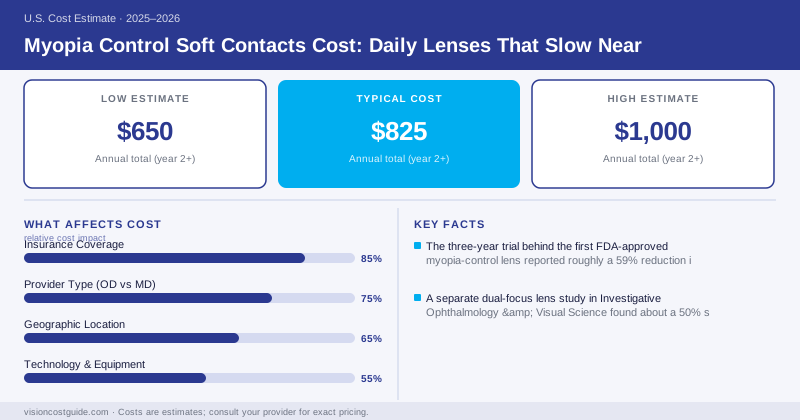
The slowing data holds up too. The three-year trial behind the first FDA-approved myopia-control lens reported roughly a 59% reduction in progression versus standard single-vision lenses. A separate dual-focus lens study in Investigative Ophthalmology & Visual Science found about a 50% slowdown in axial elongation. Those numbers rival orthokeratology and myopia-control spectacles.
Full-Year Cost
| Item | Cost |
|---|---|
| Fitting and lens evaluation (year 1) | $100–$300 |
| Daily-disposable myopia lenses (annual supply) | $600–$900 |
| Follow-up monitoring visits | $80–$150 each |
| Annual total (year 1) | $700–$1,200 |
| Annual total (year 2+) | $650–$1,000 |
The fitting fee is the one-time hit. After that, your recurring cost is mostly the lens supply, which is pricier than adult contacts because the myopia-control design is specialized and sold as a full-year box.
Myopia-control soft contacts cost $700–$1,200 the first year, dropping slightly after. They deliver a 50%–59% slowdown in published trials while being the easiest contact option for kids, no overnight wear, no cleaning.
How They Compare
Soft myopia contacts sit in a sweet spot: easier than ortho-K, more glasses-free freedom than spectacle lenses, and a similar slowing effect to both.
- vs. ortho-K: no overnight wear, lower infection risk, but no glasses-free mornings without inserting them
- vs. myopia-control glasses: clearer peripheral vision and better for sports, but more hands-on care
- vs. atropine drops: stronger glasses-free benefit, but higher cost and more effort
Many families combine soft lenses with low-dose atropine for an additive effect. Our myopia control cost guide breaks down every pairing.
Insurance and Savings
Vision plans rarely cover the myopia-control premium, treating these lenses as elective rather than standard correction. Some plans apply a contact-lens allowance, typically $100 to $200, which you can put toward the supply. Always check your benefit before assuming you’ll pay full price.
FSA and HSA dollars cover the rest, since myopia management qualifies as a medical expense. Buy a full year’s supply at once when possible, because manufacturer rebates often knock $50 to $200 off an annual box.
Daily disposables are safest only when used as directed: one fresh pair per day, never reused, never slept in. Reusing daily lenses to save money raises infection risk sharply. If budget is tight, talk to your optometrist about atropine drops rather than stretching disposables past their single-day design.
Is This the Right Pick?
Soft myopia-control contacts shine for active kids who play sports, dislike glasses, or want clearer peripheral vision than spectacles offer. The daily-disposable format keeps care simple and infection risk low, which is why many optometrists make it their first contact-lens recommendation for myopia management.
The main downside is recurring cost. At $650 to $1,200 a year, it’s pricier than atropine drops over time. But for the right kid, the combination of clear vision, sports-friendly freedom, and a 50%-plus slowdown justifies the spend.
Start with a pediatric eye exam and a contact-lens fitting to confirm your child can handle insertion and removal. Once they’ve got the routine down, these lenses are about as low-drama as myopia control gets, just remember to reorder before the supply runs out.
Frequently Asked Questions
Expect $700 to $1,200 a year for daily-disposable myopia-control lenses, plus a $100 to $300 fitting fee the first year. That covers a full year's supply and follow-up visits.
FDA-approved dual-focus soft lenses slowed myopia progression by roughly 50% to 59% over three years in published trials, comparable to ortho-K and myopia-control glasses.
Most optometrists fit children around age 8 to 12, once they can insert and remove lenses with supervision. Daily disposables are preferred for kids because there's no overnight storage or cleaning.