Myopia prevalence among U.S. adults has roughly doubled since the early 1970s, now affecting an estimated 40% of the population, according to figures drawn from National Health and Nutrition Examination Survey data cited by the National Eye Institute. Whatever’s driving that increase — genetics, more near-work and screen time, less outdoor light exposure during childhood — it means nearsightedness correction is one of the most common expenses in eye care, and the price range across options is enormous.
Correction Options and Their Real Costs
| Option | Typical Cost | Ongoing Cost |
|---|---|---|
| Single-vision glasses | $150-$400 per pair | Replace every 1-3 years |
| Soft contact lenses (daily disposable) | $500-$800/year | Ongoing indefinitely |
| Soft contact lenses (monthly) | $300-$500/year | Ongoing indefinitely |
| Rigid gas-permeable lenses | $300-$600 (last longer) | Replace every 1-2 years |
| Orthokeratology (Ortho-K, overnight lenses) | $1,000-$2,000 first year, $400-$800 renewal | Ongoing, nightly wear |
| LASIK | $4,000-$6,000 (both eyes) | $0 (occasional enhancement) |
| PRK | $3,600-$5,500 (both eyes) | $0 (occasional enhancement) |
| SMILE | $4,000-$6,500 (both eyes) | $0 |
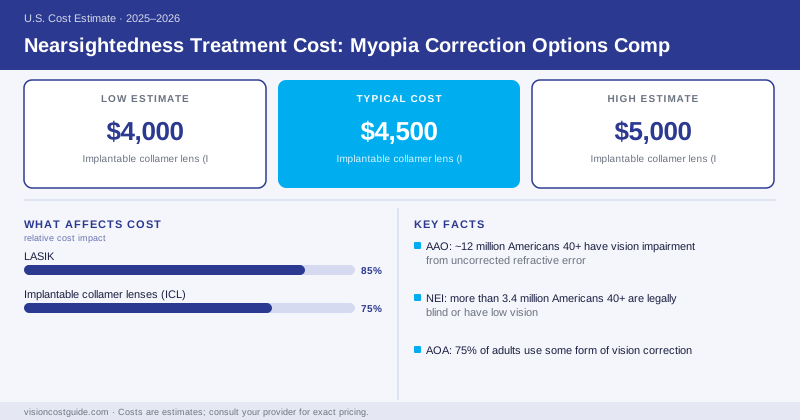
| Implantable collamer lens (ICL) | $4,000-$5,000 per eye | $0, for high myopia beyond LASIK range |
Glasses: The Baseline Everyone Starts With
Single-vision glasses remain the cheapest, most accessible correction for nearsightedness, at $150-$400 for a complete pair including exam-based prescription lenses and basic frames. For mild-moderate myopia, this is often perfectly adequate for a lifetime of correction, replaced every 1-3 years as prescriptions shift or frames wear out. Higher myopia prescriptions require thinner, more expensive high-index lenses to avoid the “coke bottle” thickness effect, adding $50-$150 to the lens cost.
Contact Lenses: The Ongoing Cost Trade-Off
Contacts trade a lower upfront cost for a meaningfully higher ongoing annual expense compared to glasses. Daily disposables, the most convenient and hygienic option, run $500-$800/year; monthly replacement lenses cost less, $300-$500/year, but require more diligent cleaning and carry somewhat higher infection risk with poor compliance. Over a 10-year period, contact lens wearers typically spend $3,000-$8,000, compared to $500-$2,000 for glasses replaced periodically over the same period — a gap worth considering for anyone deciding between the two long-term.
Orthokeratology (Ortho-K) uses specially designed rigid lenses worn overnight to temporarily reshape the cornea, providing clear daytime vision without glasses or contacts. It costs more upfront than standard contacts — typically $1,000-$2,000 for the first year including fitting and lenses, then $400-$800 annually for lens renewal — but has gained significant traction for children with progressive myopia, since research suggests it may help slow myopia progression in addition to correcting vision, unlike standard glasses or soft contacts. It’s a legitimate option worth discussing with a pediatric optometrist for a nearsighted child whose prescription is worsening year over year.
Surgery: When the Math Starts Favoring a One-Time Cost
For most adults with stable myopia (prescription unchanged for at least a year, ideally two), the long-run economics increasingly favor surgery the younger and the more nearsighted a person is. Someone spending $600/year on contacts for 20 years spends $12,000 — well above a one-time $4,000-$6,000 LASIK cost, even before factoring in the convenience of not needing correction at all for daily activities like swimming or waking up with clear vision.
LASIK treats the widest range of myopia of the laser options, generally up to about -8 to -10 diopters depending on corneal thickness.
PRK offers similar outcomes for patients with thinner corneas or higher-risk occupations/hobbies (contact sports, military service) where flap-related risk is a bigger concern.
Implantable collamer lenses (ICL) — a lens surgically placed in front of the eye’s natural lens, without removing any corneal tissue — extend correction to very high myopia (beyond what LASIK can safely treat) and are increasingly chosen even by LASIK-eligible patients who prefer a reversible procedure, at a higher cost of $4,000-$5,000 per eye.
Insurance Coverage
Glasses and contacts for myopia are covered under standard vision insurance, typically with an annual frame/lens allowance or contact lens allowance. LASIK, PRK, SMILE, and ICL are elective procedures, not covered by vision or medical insurance, though FSA/HSA funds apply to all of them, and many surgery centers offer 0% interest financing plans.
If your myopia prescription has increased significantly within the past year, hold off on surgery consultations until your prescription has been stable for at least 12 months — operating on a still-changing prescription risks undercorrection and the need for a costly enhancement procedure later.
Bottom Line
Glasses remain the cheapest starting point for nearly everyone. The contacts-versus-surgery decision is really a long-term math problem: run your own numbers based on how many years you expect to need correction, and the case for surgery often gets stronger than people initially assume.