A $2,000 glaucoma diagnosis conversation often starts with a $50 test. Optic nerve imaging is the quiet, unglamorous workhorse behind most glaucoma monitoring and diagnosis — and understanding what each individual test costs helps make sense of why a routine glaucoma check-up bill looks the way it does.
The American Academy of Ophthalmology estimates that glaucoma affects roughly 3 million Americans, and notably, only about half of those with the disease know they have it — largely because early glaucoma has no symptoms and can only be detected through specific optic nerve testing, not by how your vision feels.
Cost by Test Type
| Test | What It Measures | Uninsured Cost | With Insurance |
|---|---|---|---|
| Fundus photography | Optic nerve appearance, baseline documentation | $40-$100 | Often bundled with exam |
| OCT of the optic nerve | Nerve fiber layer thickness, structural changes | $100-$250 | $20-$80 copay |
| Visual field test (perimetry) | Functional vision loss pattern | $75-$200 | $20-$75 copay |
| Gonioscopy | Drainage angle assessment | $30-$75 (often included in exam) | Included with exam typically |
| Pachymetry (corneal thickness) | Risk stratification for glaucoma | $30-$75 | Often included |
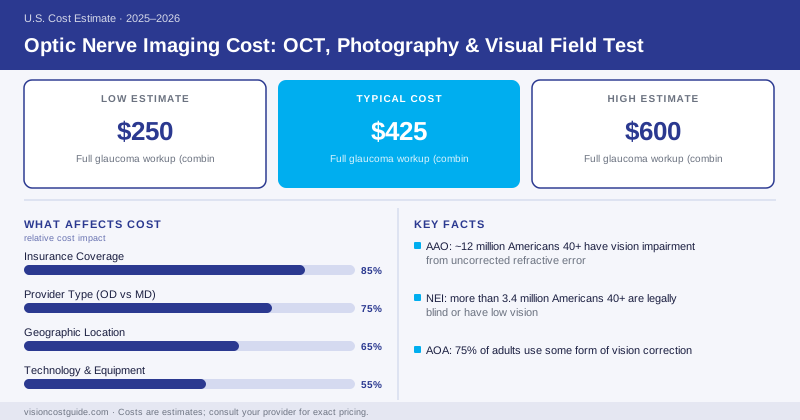
| Full glaucoma workup (combined) | Comprehensive baseline assessment | $250-$600 | $50-$200 out of pocket |
Why OCT Is the Single Most Important (and Repeated) Test
Optical coherence tomography of the optic nerve measures the thickness of the retinal nerve fiber layer — the layer of cells that carries visual signals from the eye to the brain, and the layer that thins progressively as glaucoma damages the nerve. Unlike a single snapshot, OCT’s real value comes from tracking change over time: repeated scans, typically every 6-12 months for patients being monitored for glaucoma or glaucoma suspicion, reveal whether nerve fiber thinning is progressing, stable, or has stopped in response to treatment.
This is why glaucoma patients don’t get one optic nerve scan and move on — the test is repeated regularly for years, sometimes decades, making the cumulative cost meaningfully higher than the per-test price suggests. Over 10 years of annual OCT monitoring, even at a modest $50 copay per visit, that’s $500 in imaging alone.
Visual Field Testing: The Functional Complement to OCT
While OCT shows structural nerve damage, visual field testing (perimetry) measures functional vision loss — literally mapping out blind spots and areas of reduced sensitivity across your field of view. Glaucoma specialists typically use both tests together because structural changes on OCT sometimes precede detectable functional loss on visual field testing, and vice versa in some cases — neither test alone tells the complete story.
If you’re diagnosed as a “glaucoma suspect” (meaning some risk factors or borderline findings, but not a definitive diagnosis), your doctor will likely establish baseline OCT and visual field measurements even before starting any treatment. This baseline is what all future scans get compared against to detect progression. Skipping or delaying baseline testing to save money on an early visit can make it genuinely harder and slower to determine later whether glaucoma is progressing, since there’s no clear starting point for comparison.
Why Costs Vary Between Practices
Optic nerve imaging equipment (OCT machines specifically) represents a substantial capital investment for a practice, often $50,000-$100,000+ per machine, and per-test pricing partly reflects amortizing that cost. Academic medical centers, hospital-affiliated practices, and independent optometry or ophthalmology offices all price these tests somewhat differently, and self-pay/cash rates for imaging can sometimes be negotiated directly with a practice’s billing office, particularly for patients without insurance.
Insurance and Medicare Coverage
Optic nerve imaging for glaucoma diagnosis or monitoring is covered under medical insurance and Medicare (HCPCS code 92133 for OCT of the optic nerve) when there’s documented medical necessity — meaning a diagnosis or strong suspicion of glaucoma, not routine screening without risk factors. Medicare typically covers this testing at defined intervals (not more than once per year in many cases without additional justification), so ask your doctor’s billing staff about frequency limits if you’re being monitored closely.
If you’re over 40, have a family history of glaucoma, or are of African, Hispanic, or Asian descent (all groups with elevated glaucoma risk per AAO data), don’t skip your dilated eye exam and baseline optic nerve assessment just because your vision “feels fine.” Glaucoma’s hallmark is that it typically causes no symptoms until significant, irreversible nerve damage has already occurred.
Bottom Line
Individual optic nerve imaging tests are inexpensive on their own, but they’re designed to be repeated regularly for years as part of glaucoma monitoring — budget for the recurring nature of this testing, not just a single visit.