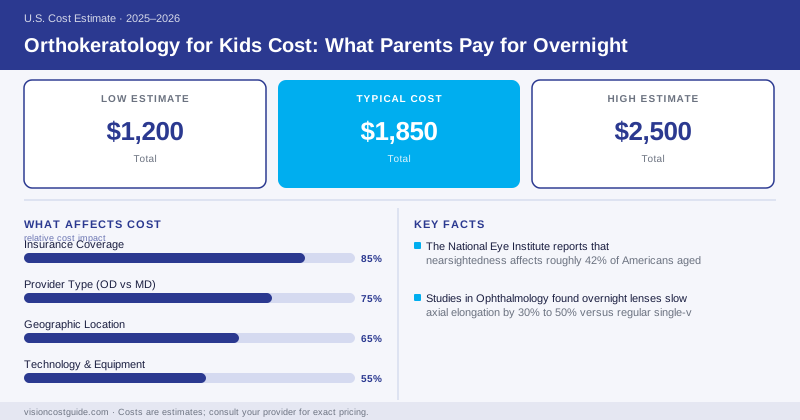
Your kid’s prescription jumped half a diopter again this year, and the optometrist just mentioned “ortho-K.” The price tag, $1,200 to $2,500 for the first year, probably made you blink. So let’s break down exactly where that money goes and whether it’s worth it.
Orthokeratology, or ortho-K, uses rigid lenses worn overnight to gently reshape the cornea. Your child sleeps in them, takes them out at breakfast, and sees clearly all day with no glasses. The bonus that has parents paying attention: peer-reviewed trials show it slows nearsightedness from getting worse.
Why Parents Choose It
Myopia in U.S. kids isn’t slowing down. The National Eye Institute reports that nearsightedness affects roughly 42% of Americans aged 12 to 54, up sharply from past decades. Once a child’s eye starts elongating, every diopter of progression raises the lifetime risk of retinal detachment and glaucoma.
Ortho-K addresses both problems at once. Studies in Ophthalmology found overnight lenses slow axial elongation by 30% to 50% versus regular single-vision glasses. For a kid whose prescription climbs -0.75D a year, that’s a real difference by adulthood. If you’re weighing options, our myopia control cost guide compares the alternatives side by side.
What You’ll Actually Pay
| Cost Item | Year 1 | Year 2+ |
|---|---|---|
| Corneal topography mapping | $100–$250 | Included in check-up |
| Custom lens pair | $400–$900 | $250–$500 (replacement) |
| Fitting and follow-up visits | $400–$800 | $150–$300 |
| Lens care solutions (annual) | $150–$250 | $150–$250 |
| Total | $1,200–$2,500 | $300–$700 |
That first-year number stings because it front-loads everything: the mapping, the custom-designed lenses, and four to six fitting appointments to dial in the fit. Year two and beyond cost a fraction of that.
Budget $1,200–$2,500 for year one of ortho-K, then expect $300–$700 a year after. The myopia-slowing benefit (30%–50% in published trials) is what separates it from a standard pair of kids’ glasses.
The Hidden Costs Nobody Mentions
Lens replacement is the big one. Kids lose lenses, scratch them, or outgrow the fit as their cornea changes. Plan on replacing at least one lens a year at $150 to $300 each. Some practices bundle a warranty into the first-year fee, so ask before you sign.
Solutions add up too. Hydrogen peroxide cleaning systems and saline run about $15 to $25 a month, or $180 to $300 annually. It’s small per bottle but real over time.
How It Compares to Other Myopia Tools
Ortho-K isn’t your only path. Soft myopia-control contacts and low-dose atropine drops both work, and so do specialty spectacle lenses. The right pick depends on your child’s age, prescription, and willingness to handle lenses.
- Ortho-K: best for kids who want glasses-free days and can manage overnight lenses
- Soft daily myopia lenses: easier handling, similar slowing effect
- Atropine drops: lowest hands-on effort, often the cheapest
A full pediatric eye exam is the starting point for any of these. Your optometrist measures corneal shape and prescription to decide which approach fits.
Ortho-K carries a small but real risk of corneal infection from overnight wear. The published rate is roughly 1 in 1,000 to 1 in 6,000 wearer-years. Strict hygiene and regular check-ups keep that risk low, but skipping cleaning steps is the number-one cause of problems in kids.
Is It Worth the Money?
If your child’s myopia is progressing fast and they’re old enough to handle lenses, ortho-K offers two payoffs for one price: clear daytime vision and slower progression. Over a childhood, slowing the eye’s growth may save thousands in future high-prescription lenses and lower the odds of serious eye disease later.
For families on a tighter budget, atropine drops cost less upfront. But many parents find the freedom from daytime glasses worth the premium, especially for active kids in sports. Compare the full menu in our myopia control cost breakdown before deciding.
One more thing: ortho-K is fully reversible. Stop wearing the lenses, and the cornea returns to its natural shape within a few days. That reversibility makes it a low-commitment way to try myopia management while your child’s prescription is still moving.
Talk to a myopia-management optometrist, get an itemized quote, and ask specifically what’s bundled into year one versus billed separately. The difference between a $1,200 and a $2,500 quote is usually just how the practice packages follow-up visits and replacement lenses.
Frequently Asked Questions
The first year runs $1,200–$2,500, which covers corneal mapping, custom lenses, and several fitting visits. After that, annual costs drop to roughly $300–$700 for replacement lenses and check-ups.
Most optometrists start kids around age 7 to 9, once they can handle lens insertion with help. The myopia-slowing benefit matters most during the years of fastest progression, typically ages 8 to 15.
Standard vision plans rarely cover it, but FSA and HSA dollars almost always qualify since it's a medical correction. A few pediatric plans offer partial reimbursement, so ask for the contact-lens benefit language in writing.