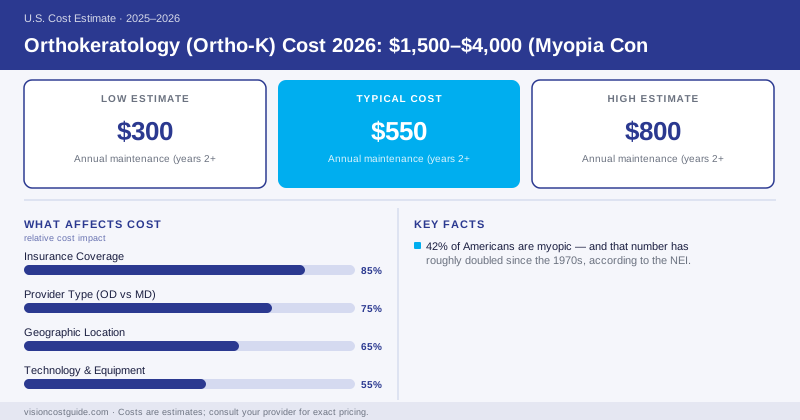
42% of Americans are myopic — and that number has roughly doubled since the 1970s, according to the NEI. If your child is one of them, you’ve probably heard about Ortho-K as a way to slow down that progression. But at $1,500–$4,000 for the first year, it’s a real investment. Here’s exactly where that money goes and whether it makes sense for your situation.
What Ortho-K Actually Does
Ortho-K (orthokeratology) uses rigid gas-permeable contact lenses worn overnight. While you sleep, the lenses gently reshape the front surface of the cornea. By morning, you remove them — and you can see clearly all day without glasses or daytime contacts. The effect is temporary; it reverses if you stop wearing the lenses.
For children with myopia, there’s a clinical benefit beyond convenience: wearing Ortho-K lenses slows the progression of nearsightedness. The American Academy of Ophthalmology (AAO) recognizes myopia control as an evidence-based treatment goal, and studies show Ortho-K reduces axial elongation of the eye by approximately 50% compared to single-vision correction. That matters because high myopia (above -6.00 diopters) dramatically increases lifetime risk of retinal detachment, glaucoma, and early macular degeneration.
Cost Breakdown
| Component | Typical Cost | Notes |
|---|---|---|
| Initial consultation + corneal topography | $150–$350 | Maps the exact shape of the cornea |
| Lens fitting fee (professional services) | $500–$1,200 | Includes trial lens assessment and adjustments |
| First pair of Ortho-K lenses | $600–$1,500 | Per eye; rigid GP lenses custom-fabricated |
| Follow-up visits (first 3 months) | $200–$500 | Usually 3–5 visits to dial in the fit |
| Lens care solutions (annual) | $100–$200 | Specialized GP lens cleaning products |
| First-year total (one eye) | $1,500–$3,750 | — |
| First-year total (both eyes) | $2,000–$4,000 | Most patients fit both eyes |
| Annual maintenance (years 2+) | $300–$800 | Replacement lenses + 2 follow-up visits |
Prices vary by geography — fitting fees at academic medical centers in major cities tend to run higher than at private optometry practices in smaller markets. Some practices bundle everything into a flat first-year package fee; others bill component by component.
Ortho-K vs. LASIK: A Direct Comparison
| Factor | Ortho-K | LASIK |
|---|---|---|
| Upfront cost | $2,000–$4,000 | $4,000–$6,000 (both eyes) |
| Age requirement | Any age (8+) | Must be 18–21+, stable Rx |
| Reversible? | Yes — stop wearing, cornea reverts | No — permanent |
| Myopia control for kids | Yes — clinically proven | Not applicable to children |
| Daytime glasses-free? | Yes | Yes |
| Ongoing cost | $300–$800/year | Near zero after surgery |
| 10-year total cost | ~$5,000–$11,000 | ~$4,000–$6,000 |
For adults with stable myopia who want a one-time solution, LASIK is often cheaper long-term. For children whose prescriptions are still changing, Ortho-K is the only option that also slows progression — LASIK can’t be performed on eyes that aren’t done growing.
The NEI reports that people with myopia above -5.00 diopters face a 7–10x higher lifetime risk of retinal detachment compared to people with normal vision. Ortho-K’s documented ability to slow axial elongation means slowing progression toward those high-risk levels — not just avoiding glasses. That clinical benefit is part of why many pediatric ophthalmologists now actively recommend it for children with fast-progressing myopia.
Who’s a Good Candidate
You’re likely a good Ortho-K candidate if:
- Your child has myopia between -0.75 and -6.00 diopters that’s been progressing year over year
- You or your child want daytime glasses-free vision without surgery
- You’re willing to commit to nightly lens wear — skipping nights means reduced daytime clarity
- You don’t have significant corneal astigmatism above about 1.75 diopters (higher astigmatism reduces how well the reshaping works)
Adults use Ortho-K for the glasses-free benefit too — it’s popular with athletes and people who find daytime contacts uncomfortable. But the myopia control indication is really where the clinical evidence is strongest.
Finding an Ortho-K Provider
Not every optometrist fits Ortho-K. Look for practitioners who advertise myopia management or orthokeratology specifically, or search the AAO’s provider finder filtered for cornea and contact lens specialists. Corneal topographers and specific GP lens design software are required — practices without them can’t fit these lenses properly.
Expect to pay more at providers who specialize heavily in pediatric myopia control. The fitting complexity and follow-up intensity justify a premium over a general optometry practice.
Avoid any provider who promises Ortho-K results without corneal topography mapping. This technology is non-negotiable for safe lens fitting — it determines exactly what custom curves the lenses need to reshape your specific cornea. Fitting without topography is a shortcut that risks corneal damage, poor vision results, and infection risk from an ill-fitting lens.
The Bottom Line
Ortho-K costs $2,000–$4,000 in year one, dropping to $300–$800 annually after that. For children with progressing myopia, it’s one of the few interventions with solid clinical evidence for actually slowing the disease — not just correcting it. For adults, it’s a reversible alternative to LASIK with similar daytime vision results at lower upfront cost, though higher long-term cost.
The NEI’s data on myopia’s rising prevalence — now affecting 1 in 3 Americans and growing — makes the myopia control question increasingly urgent for parents of nearsighted children. If your child’s prescription worsens every year, a conversation with a myopia management specialist is worth the visit cost alone.
Cost estimates based on AAO clinical guidance on myopia management and orthokeratology, NEI epidemiological data on myopia prevalence, and survey data from U.S. optometry practices. Individual pricing varies by region, provider, and prescription complexity.
Frequently Asked Questions
Ongoing costs after the first year typically run $300–$800 annually. That covers replacement lenses (usually one to two pairs per year), solution, and follow-up visits every six months. The first year is the most expensive because of the fitting workup, corneal topography mapping, and the initial lens fabrication. Years two and beyond are significantly cheaper — closer to the cost of annual contact lens wear.
Standard vision plans (VSP, EyeMed, Davis Vision) generally don't cover Ortho-K because it's considered elective. However, some plans offer partial credit toward contact lens fitting fees. Health FSA and HSA accounts can be used for Ortho-K costs since it corrects a diagnosed refractive condition. If your child's myopia is progressing rapidly, some medical insurers may consider partial coverage — it's worth asking your provider to submit with a myopia control diagnosis code.
Most eye doctors recommend Ortho-K for children and teenagers ages 8–18 whose myopia is actively progressing. The AAO recognizes myopia control as a valid clinical goal, and multiple peer-reviewed studies show Ortho-K slows axial eye elongation — the mechanism driving worsening nearsightedness — by roughly 50% compared to standard single-vision lenses. Adults with stable myopia up to about -6.00 diopters are also candidates, primarily for the daytime glasses-free benefit.