In your 20s and 30s, LASIK had one job: give you clear distance vision at a single focal point, full stop. Today, once presbyopia enters the picture — the age-related stiffening of the eye’s natural lens that eventually affects nearly everyone by their mid-to-late 40s — laser correction has evolved to address near vision too, at a meaningfully higher price point than standard single-vision LASIK.
The National Eye Institute estimates that presbyopia affects the large majority of Americans by age 45-50, essentially a universal age-related change rather than a disease — but the surgical approaches to managing it alongside distance vision correction vary widely in technique, predictability, and cost.
Presbyopia-Focused LASIK Approaches and Costs
| Approach | How It Works | Typical Cost (Both Eyes) |
|---|---|---|
| Standard monovision LASIK | One eye corrected for distance, one for near | $4,000-$6,000 |
| Blended/modified monovision | Smaller intentional difference between eyes | $4,200-$6,200 |
| PresbyLASIK (multifocal corneal ablation) | Creates multiple focal zones on the cornea itself | $5,000-$7,000 |
| KAMRA corneal inlay | Small ring implanted in one eye to extend depth of focus | $4,500-$6,500 (inlay eye) + distance correction other eye |
| Refractive lens exchange with multifocal IOL | Replaces natural lens with multifocal implant | $9,000-$12,000 (both eyes) |
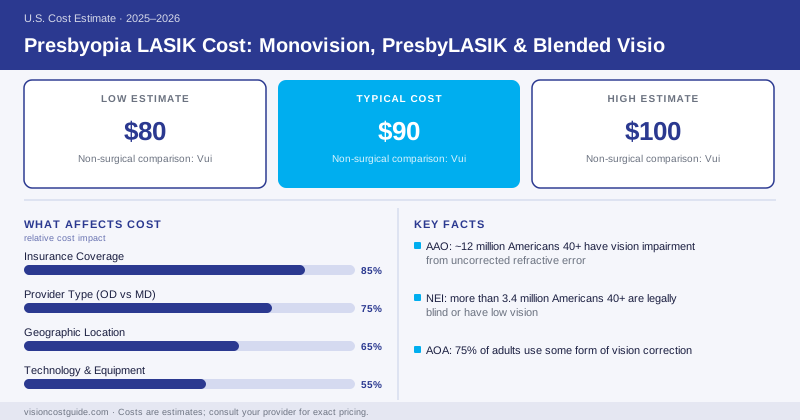
| Non-surgical comparison: Vuity eye drops | Pharmacologic pupil-constricting drop, temporary effect | $80-$100/month |
Monovision: The Established, Lower-Cost Standard
Monovision LASIK — correcting one eye fully for distance and deliberately leaving the other eye slightly nearsighted for close-up tasks — has been used for decades and remains the most common, most predictable, and least expensive presbyopia-focused laser approach, priced similarly to standard LASIK at $4,000-$6,000. The brain adapts to using each eye for its respective task, though not everyone tolerates the resulting difference in clarity between eyes well, which is why a contact lens monovision trial is standard practice before committing to permanent surgical monovision.
PresbyLASIK: A Different Optical Strategy
Rather than making each eye do one job, PresbyLASIK reshapes the cornea to create multiple focal zones within the same eye, similar in concept to how a multifocal contact lens or progressive glasses lens works, but built into the cornea’s surface itself. This is a more complex ablation pattern than either standard LASIK or monovision, and costs somewhat more — $5,000-$7,000 for both eyes — reflecting both the technique’s complexity and its comparatively newer adoption among refractive surgeons.
Before committing to monovision, blended vision, or PresbyLASIK, most reputable surgeons will have you trial the visual effect with contact lenses first — often for several weeks — since not everyone adapts comfortably to having each eye see differently, or to a somewhat reduced quality of distance vision in exchange for less glasses dependence. This trial period costs little beyond the contact lenses themselves but is one of the most important cost-saving steps in this entire category: it prevents an expensive surgical outcome that the patient ultimately can’t tolerate and would need to reverse or compensate for with glasses anyway.
KAMRA Inlay: A Different Mechanism Entirely
The KAMRA corneal inlay, FDA-approved in 2015, is a tiny, opaque ring with a pinhole aperture surgically placed within the cornea of the non-dominant eye, extending depth of focus similar to how a pinhole camera works — allowing near and intermediate vision without significantly compromising distance vision in that eye. It’s typically combined with standard distance correction (LASIK or PRK) in the other eye. Cost runs $4,500-$6,500 for the inlay eye, plus standard laser correction pricing for the other eye if needed.
When Lens-Based Surgery Makes More Sense Than Any LASIK Approach
For patients whose presbyopia is compounded by early cataracts, or who have higher refractive errors outside comfortable LASIK treatment range, refractive lens exchange with a multifocal or extended-depth-of-focus intraocular lens addresses distance, intermediate, and near vision simultaneously by replacing the aging natural lens entirely — at a considerably higher cost of $9,000-$12,000 for both eyes, but without the need for future cataract surgery, since the natural lens (which would eventually need cataract removal anyway) has already been replaced.
Insurance Coverage
All presbyopia-focused laser vision correction procedures are elective and not covered by vision or medical insurance. Refractive lens exchange is similarly elective when performed before cataracts develop; once cataracts are diagnosed, the base lens replacement surgery becomes medically necessary and insurance-covered, with only the multifocal lens upgrade remaining an out-of-pocket cost.
Don’t skip the pre-surgical contact lens trial for monovision or blended vision approaches to save time. Surgical monovision is difficult to fully reverse, and a meaningful percentage of patients who skip the trial and proceed directly to surgery end up dissatisfied with the vision quality trade-off they didn’t anticipate.
Bottom Line
Presbyopia-specific LASIK techniques cost more than standard single-vision LASIK, and for good reason — they’re solving a fundamentally harder optical problem. Insist on a contact lens trial before surgery regardless of which approach you’re considering; it’s the cheapest insurance against an expensive regret.