You grab a $15 pair of readers off the pharmacy rack and they work fine, mostly. Then one day the print still blurs unless you tilt your head just right, and you’ve got a headache by chapter three. That’s the moment people start wondering if the $300 prescription pair is worth it. Sometimes it is. Often the drugstore pair is genuinely all you need.
Here’s how to know which side you’re on.
The Price Gap
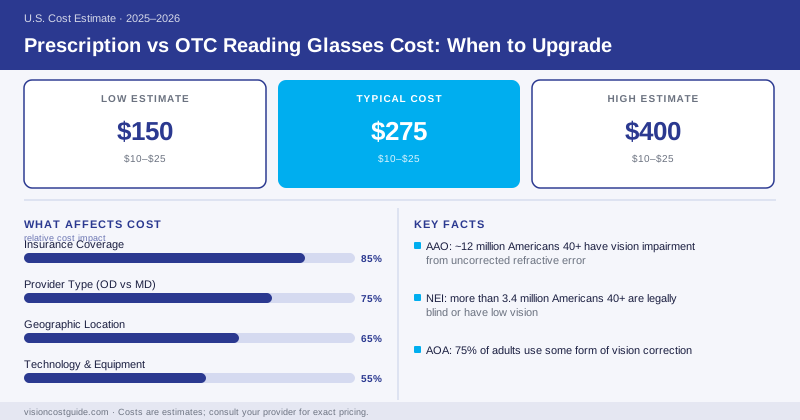
Over-the-counter readers are mass-produced and sold everywhere from gas stations to pharmacies. They cost $10–$25 and come in standard powers from +1.00 to +3.50.
Prescription reading glasses are custom-ground for your exact eyes, can correct astigmatism, and account for differences between your left and right eye. That precision costs $150–$400.
| OTC Readers | Prescription Readers |
|---|---|
| $10–$25 | $150–$400 |
| Same power both lenses | Custom power per eye |
| No astigmatism correction | Corrects astigmatism |
| Fixed PD | Measured to your PD |
Why OTC Readers Work for Many People
If both your eyes need roughly the same boost and you don’t have astigmatism, a drugstore pair is honestly fine. The American Academy of Ophthalmology has stated that OTC reading glasses are perfectly safe for people whose eyes are otherwise healthy and similar.
Presbyopia, the age-related loss of near focus, hits almost everyone by their mid-40s. The AAO notes it affects an estimated 128 million Americans. For a huge share of them, a $15 pair from the rack does the job.
If both eyes need the same power and you have no astigmatism, $15 drugstore readers are all you need, and buying a few pairs to stash around the house costs less than one prescription pair. Upgrade to prescription readers ($150–$400) only when your eyes differ, you have astigmatism, or cheap readers leave you straining.
When the Upgrade Is Worth It
The drugstore rack falls short when your eyes aren’t a matched pair. Here’s when to spend on prescription readers:
- Your two eyes need different powers. OTC readers force the same lens on both, which strains the weaker match.
- You have astigmatism. Off-the-rack readers can’t correct it, leaving print fuzzy.
- You wear them all day. Optical-quality lenses and accurate PD reduce fatigue during long sessions.
- You want them in your existing frames or as part of progressive glasses.
A proper eye exam tells you which camp you’re in. The American Optometric Association recommends one every one to two years for adults over 40, partly to catch these mismatches.
Don’t ignore persistent headaches or eyestrain from drugstore readers. They’re often a sign your eyes need different powers or astigmatism correction that OTC pairs can’t provide. Pushing through the strain to save money can make near work miserable.
The Smart Hybrid Approach
Many people do both. Buy one good prescription pair for daily heavy reading or computer work, then stash $15 OTC readers in the car, kitchen, and bedside drawer so you’re never hunting for them. The cheap backups make losing a pair painless.
If you also need distance correction, a single pair of progressive eyeglasses can replace separate distance and reading glasses, though they cost more upfront. And if your distance vision is otherwise sharp, you may eventually weigh contact lenses with a reading add or monovision instead.
The bottom line: OTC readers are a steal for matched, healthy eyes. Prescription readers earn their price when your eyes need individual attention. Get one exam to know which you are, then spend accordingly.
Frequently Asked Questions
Over-the-counter readers cost $10–$25. Prescription reading glasses run $150–$400 because they're custom-made for each eye and can correct astigmatism.
No, they won't damage your eyes, but they use the same power in both lenses. If your eyes differ or you have astigmatism, they can cause strain and headaches.
Switch when your two eyes need different powers, you have astigmatism, or drugstore readers leave you with eyestrain and headaches after reading.