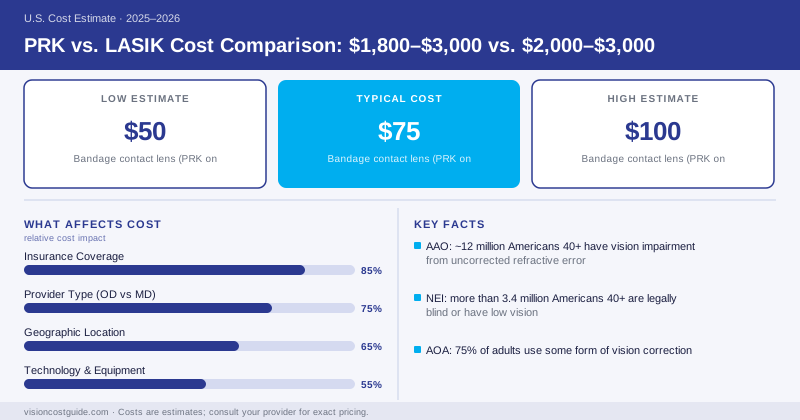
PRK runs $1,800–$3,000 per eye. LASIK runs $2,000–$3,000 per eye. That’s a gap of maybe a few hundred dollars — not the dramatic discount most patients expect from the “older” laser vision correction procedure.
The FDA approved PRK (photorefractive keratectomy) in 1995, several years before LASIK gained approval in 1999. Despite PRK coming first, it never became meaningfully cheaper, because both procedures use nearly identical excimer laser equipment and require the same screening, surgeon expertise, and follow-up care. The real difference between them isn’t price — it’s how the surface of your eye is prepared before the laser reshapes it.
Side-by-Side Cost Breakdown
| Cost Component | PRK | LASIK |
|---|---|---|
| Procedure (per eye) | $1,800–$3,000 | $2,000–$3,000 |
| Pre-op screening/candidacy exam | $150–$300 | $150–$300 |
| Post-op medications | $100–$300 | $50–$150 |
| Enhancement (if needed later) | $300–$800 | $300–$800 |
| Recovery time off work | 4–7 days (unpaid, if applicable) | 1–2 days |
| Bandage contact lens (PRK only) | $50–$100 | Not applicable |
LASIK’s slightly higher price reflects the femtosecond laser used to create the corneal flap — additional equipment that PRK doesn’t require, since PRK removes the surface epithelial layer entirely rather than creating a flap underneath it.
The Real Difference Isn’t Price — It’s Recovery
LASIK creates a thin corneal flap that’s lifted, reshaped underneath with the laser, then replaced — healing is fast because the flap acts like a natural bandage, with clear vision often achieved within a day. PRK removes the surface epithelium entirely rather than cutting a flap, so the eye must regrow that surface layer over 4–7 days, during which vision is blurry and light sensitivity is common. Many PRK patients need a week or more away from screen-heavy work before vision stabilizes enough to return comfortably.
PRK costs $1,800–$3,000 and LASIK costs $2,000–$3,000 per eye — a much smaller price gap than most patients assume. The bigger factor in choosing between them is corneal thickness and lifestyle: PRK is often the better (sometimes only) option for thinner corneas or higher-risk occupations, despite its longer recovery.
Why Some Patients Have No Choice
Not every patient qualifies for LASIK. Thinner corneas, larger pupils, or higher-risk professions (contact sports, military service) often steer surgeons toward PRK instead, since there’s no flap to dislodge or complicate later trauma. If your candidacy exam shows borderline corneal thickness, your surgeon may recommend PRK regardless of your recovery-time preference — safety, not cost, drives that call.
Long-Term Cost Is Nearly Identical
Both procedures carry similar long-term outcomes in terms of visual acuity achieved, similar rates of needing an enhancement years later, and similar risk of regression. Neither is meaningfully “cheaper” once you account for equivalent screening, equivalent enhancement rates, and comparably long-lasting results. The real financial variable most patients overlook is lost income during PRK’s longer recovery window — worth factoring in if you’re paid hourly or can’t work remotely during the healing period.
Insurance and Financing
Neither procedure is covered by standard health insurance, since both are classified as elective refractive surgery. Most practices offer financing plans, and some employers offer FSA/HSA-eligible reimbursement since both procedures qualify as a qualified medical expense under IRS rules.
Never choose PRK over LASIK — or vice versa — based on price alone. Corneal thickness, pupil size, and prescription stability are the factors that actually determine candidacy and safety. A surgeon recommending PRK for a thin cornea is making a safety call, not an upsell.
Bottom Line
The price difference between PRK and LASIK is smaller than most people expect — a few hundred dollars per eye, not a discount category. Let your candidacy exam, not the sticker price, determine which one is actually right for your eyes.