Why do progressive lenses cost triple what single-vision lenses do? The honest answer isn’t marketing — it’s manufacturing complexity, and it’s worth understanding before you get quoted a number that feels arbitrary.
Presbyopia — the age-related loss of near-focusing ability — affects nearly all adults by their mid-40s to 50s, according to the American Optometric Association, making progressive lenses one of the most commonly prescribed lens categories in the country. Unlike bifocals, which have a single visible line dividing distance and near vision, progressives blend distance, intermediate, and near correction into one seamless lens surface with no visible line at all.
Progressive Lens Cost by Tier
| Lens Tier | Price Range | Notes |
|---|---|---|
| Entry-level/standard progressive | $200–$350 | Narrower usable zones; adjustment period longer |
| Mid-range/premium progressive | $350–$550 | Wider viewing zones, faster adjustment |
| Premium digital/free-form progressive | $500–$800 | Custom-calculated to your exact prescription and frame |
| Add-on: anti-reflective coating | +$50–$150 | Recommended for progressives; reduces visual “swim” |
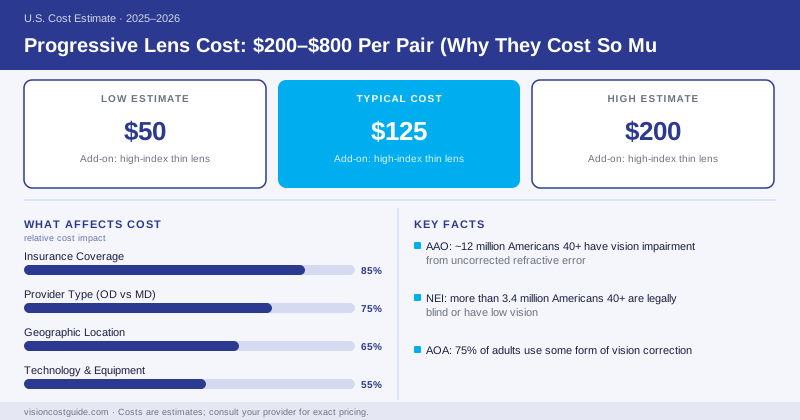
| Add-on: high-index thin lens material | +$50–$200 | Common for stronger prescriptions |
The jump from entry-level to premium isn’t just marketing tiering — it reflects genuinely different manufacturing precision. Premium digital progressives use free-form surfacing technology that calculates the lens curvature specifically for your prescription, frame shape, and even how the lens sits relative to your eyes, rather than grinding from a generic mold.
Why Progressives Cost So Much More Than Bifocals or Single-Vision
A single-vision lens has one continuous, uniform curvature across the entire surface — relatively simple to manufacture. A progressive lens has to smoothly and continuously vary its focusing power across the surface, from distance correction at the top to near correction at the bottom, with an intermediate zone blended in between, all while minimizing the peripheral distortion that causes the “swimming” sensation new wearers sometimes notice. That complexity requires more sophisticated lens design software, tighter manufacturing tolerances, and often a longer production time.
Progressive lenses cost $200–$800 per pair depending on tier, roughly two to four times the cost of single-vision lenses, because of the manufacturing precision required to blend multiple focusing powers into one seamless surface. Premium digital progressives cost more but typically mean a faster, easier adjustment period with fewer peripheral distortion complaints.
The Adjustment Period Nobody Mentions Upfront
Nearly every new progressive wearer experiences some adjustment period — typically 3–14 days — getting used to positioning their head and eyes correctly to find the right viewing zone for distance, computer work, and reading. Premium tiers with wider usable zones tend to shorten this adjustment considerably, which is a meaningful part of what you’re paying extra for, not just a marketing distinction.
Insurance Coverage
Most vision insurance plans provide a set allowance toward lenses (often $100–$200) regardless of lens type, meaning progressive lenses typically leave you with a larger out-of-pocket balance than single-vision lenses would under the same plan. Some employer vision plans offer an upgraded progressive-specific allowance — worth checking your specific benefits summary rather than assuming standard coverage applies evenly.
Where to Save Without Sacrificing Quality
Online retailers like Zenni or Warby Parker offer progressive lenses at a meaningful discount compared to traditional optical retailers, sometimes $150–$300 for a complete pair including frame. The tradeoff is no in-person adjustment or fitting verification, which matters more for progressives than for single-vision lenses given how sensitive proper alignment is to how well the lens performs.
Progressive lens fit is unusually sensitive to accurate measurements — particularly pupillary distance and the vertical height where your eye sits relative to the frame. An improperly fitted progressive lens can cause headaches, dizziness, or the sensation that “nothing focuses right,” even with a technically correct prescription. Always get progressives fitted and adjusted in person if possible.
Bottom Line
At $200–$800 per pair, progressive lenses cost significantly more than single-vision lenses, but the price reflects real manufacturing complexity in blending multiple focusing powers seamlessly. If budget is tight, an entry-level progressive with anti-reflective coating covers the basics — premium tiers are worth the extra cost mainly if you want a shorter adjustment period or wider usable zones.