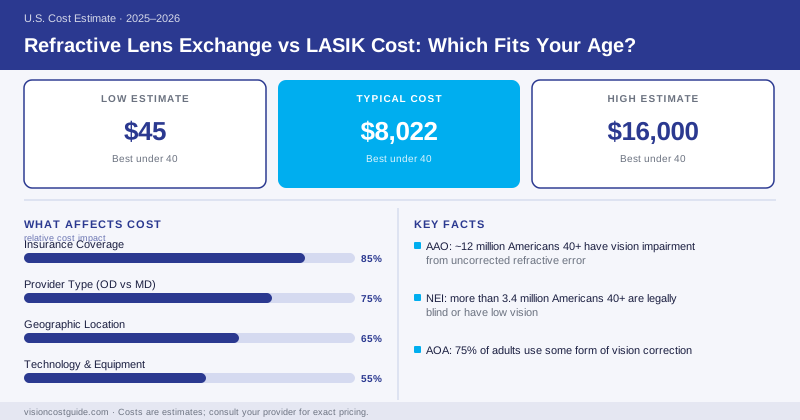
A 50-year-old and a 28-year-old walk into the same surgical center wanting to ditch their glasses. They’ll likely leave with very different recommendations and very different bills. The younger one is a LASIK candidate at around $4,400. The older one may be steered toward refractive lens exchange at three times the price. Age, not budget, usually drives this decision.
Here’s why the older patient pays more, and when it’s worth it.
Two Very Different Procedures
LASIK reshapes the cornea with a laser. Your natural lens stays put. The American Refractive Surgery Council reports the national average near $2,200 per eye in 2024, so roughly $4,400 for both.
RLE (Refractive Lens Exchange) is essentially cataract surgery before you have a cataract. The surgeon removes your natural lens and replaces it with an artificial intraocular lens. That’s a far bigger procedure, which is why it runs $4,000–$8,000 per eye.
| LASIK | Refractive Lens Exchange |
|---|---|
| ~$2,200 per eye | $4,000–$8,000 per eye |
| ~$4,400 both eyes | $8,000–$16,000 both eyes |
| Reshapes cornea | Replaces natural lens |
| Best under 40 | Best over 45 |
Why RLE Costs So Much More
RLE is intraocular surgery, the same operation as cataract removal. You’re paying for a premium artificial lens (often a multifocal one), an operating-room procedure, and a surgeon’s expertise inside the eye. Compared to LASIK, the complexity and the lens device push the price two to three times higher.
The premium lenses themselves drive a chunk of the cost. A standard multifocal IOL upgrade alone can add thousands per eye, similar to what cataract patients pay for premium lenses.
LASIK costs far less ($4,400 vs $8,000–$16,000) and is the right pick for most people under 40. RLE earns its higher price for those over 45, because it corrects vision, fixes presbyopia, and prevents future cataracts in one procedure. The decision hinges on your age and lens condition, not just the price tag.
The Age Factor
Here’s the key insight: LASIK doesn’t fix presbyopia, the age-related loss of near focus that the American Academy of Ophthalmology says affects an estimated 128 million Americans. So a 55-year-old who gets LASIK still needs reading glasses afterward.
RLE replaces the aging lens entirely, often with a multifocal IOL that handles both distance and near. For an older patient, that one-procedure fix can be worth the premium. It also means you’ll never develop a cataract, which would otherwise require surgery down the road anyway.
When LASIK Is the Clear Winner
If you’re under 40 with a stable prescription and healthy corneas, LASIK is the obvious value. There’s no reason to remove a perfectly good natural lens. The American Refractive Surgery Council notes that LASIK has decades of safety data behind it.
RLE carries the same surgical risks as cataract surgery, including a small risk of retinal detachment, especially in very nearsighted patients. Don’t choose RLE purely to avoid future cataract surgery without discussing those risks with your surgeon. For younger candidates, LASIK is both cheaper and lower-risk.
Making the Decision
- Under 40, good candidate? LASIK wins on price and risk.
- Over 45 and presbyopic? RLE corrects near and far in one shot.
- Already developing early cataracts? RLE doubles as cataract prevention.
- Very thin corneas (not a LASIK candidate)? RLE or ICL may be your route.
Neither is typically covered by insurance unless RLE is performed once a true cataract exists, at which point it becomes cataract surgery and may be covered. If you’re weighing the laser route on cost alone, our is LASIK worth it guide runs the payback math.
The bottom line: LASIK for younger eyes, RLE for aging ones. Your age and lens health make the call long before your budget does.
Frequently Asked Questions
Much more. RLE costs $4,000–$8,000 per eye versus about $2,200 for LASIK, so RLE for both eyes can run $8,000–$16,000.
RLE replaces the eye's natural lens, correcting vision and preventing future cataracts. It suits people over 45 who are presbyopic or not good LASIK candidates.
Yes. Because the natural lens is removed and replaced with an artificial one, you can never develop a cataract in that eye later.