A parent flips through phone photos and notices one of their toddler’s eyes glows white in the flash instead of red. That single observation has saved thousands of children’s lives. That white glow, called leukocoria, is the most common first sign of retinoblastoma — the most common eye cancer in children, per the NEI, usually found before age 5.
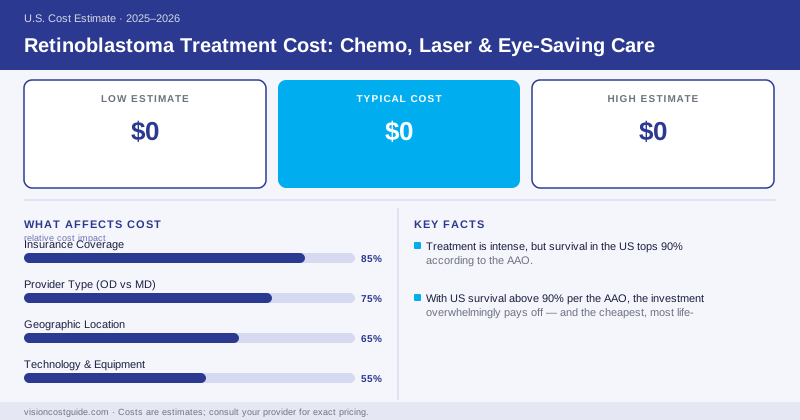
Treatment is intense, but survival in the US tops 90% according to the AAO. Here’s what that care costs.
Why This Is a Cancer, Not Just an Eye Problem
Retinoblastoma is a malignant tumor of the retina. Left untreated, it can spread along the optic nerve to the brain or metastasize. That’s why treatment is run by pediatric ocular oncologists at specialized centers, and why the costs look more like cancer care than eye care.
| Stage | Typical Approach | Goal |
|---|---|---|
| Early/small tumor | Laser, cryotherapy | Save eye and vision |
| Intermediate | Intra-arterial or systemic chemo | Shrink tumor, save eye |
| Advanced (fills eye) | Enucleation + prosthetic | Save the child’s life |
| Bilateral/hereditary | Combination, both eyes | Maximize survival and vision |
Diagnostic Workup Costs
Diagnosis requires an exam under anesthesia (EUA) because young children can’t hold still for a dilated retinal exam.
| Diagnostic Step | Cost Without Insurance |
|---|---|
| Exam under anesthesia (EUA) | $3,000–$8,000 |
| MRI of orbits and brain | $2,000–$5,000 |
| Genetic testing (RB1 gene) | $1,000–$3,000 |
| Pediatric oncology consult | $400–$800 |
Genetic testing matters because the hereditary form affects both eyes and carries a risk for other cancers, which changes the whole treatment plan.
What Eye-Saving Treatment Costs
When the tumor is caught early, the focus is saving both the eye and vision.
Retinoblastoma cost tracks almost perfectly with how early it’s found. A small tumor caught from a white-pupil photo might be handled with laser and cryotherapy over a few sessions for $20,000–$50,000. The same cancer, found a year later filling the eye, can mean systemic chemo, surgery to remove the eye, a prosthetic, and years of follow-up — easily $150,000–$250,000. The leukocoria a parent notices in a flash photo is, financially and medically, the most valuable finding in the entire process.
- Laser photocoagulation / cryotherapy: $2,000–$5,000 per session, often several sessions
- Intra-arterial chemotherapy (IAC): $15,000–$30,000 per treatment cycle, delivered directly to the eye’s blood supply
- Intravitreal chemotherapy: $3,000–$8,000 per injection for tumor seeds in the vitreous
- Systemic chemotherapy (chemoreduction): $30,000–$100,000+ across the full course
Early laser-and-cryo cases can total $20,000–$50,000, while chemo-based eye-saving regimens commonly reach $60,000–$150,000.
When the Eye Must Be Removed
For advanced tumors filling the eye, enucleation is the safest path to protect the child’s life.
| Item | Cost |
|---|---|
| Enucleation surgery | $8,000–$20,000 |
| Orbital implant | $3,000–$6,000 |
| Custom ocular prosthetic | $3,000–$8,000 |
| Prosthetic refits (as child grows) | $1,500–$4,000 each |
A modern prosthetic eye looks remarkably natural and moves with the other eye. As the child grows, the prosthetic needs periodic refitting, adding ongoing cost over the years.
Any white pupil reflex, new eye crossing, or unexplained eye redness or swelling in a young child needs an urgent dilated exam — not a wait-and-see. Retinoblastoma is curable when caught early and life-threatening when it isn’t. If a pediatrician brushes off a white-pupil photo, push for a referral to a pediatric ophthalmologist. This is one finding where being the pushy parent saves a life.
The Follow-Up Costs People Forget
Survivors need exams under anesthesia every few months for years to catch any recurrence, plus lifelong monitoring for hereditary cases. Children treated for retinoblastoma also need regular care for the healthy eye, sometimes including a separate retinal detachment surgery or other complications. Routine vision monitoring continues with periodic eye exam visits well into adulthood.
Bottom Line
Early, eye-saving retinoblastoma treatment runs $20,000–$50,000, chemo-based regimens climb to $60,000–$150,000, and advanced cases needing surgery and a prosthetic can exceed $200,000 across the full course. Insurance and Medicaid cover the bulk, but families still face $5,000–$25,000 out of pocket plus travel. With US survival above 90% per the AAO, the investment overwhelmingly pays off — and the cheapest, most life-saving step is simply checking a white-pupil photo early.
Frequently Asked Questions
Yes. Retinoblastoma is a life-threatening childhood cancer, so treatment is covered under medical insurance, and most children also qualify for Medicaid or state CHIP programs that cover catastrophic pediatric cancer care. Families still face deductibles, out-of-network specialist costs, and travel expenses, since care is concentrated at a handful of ocular-oncology centers. Out-of-pocket totals commonly run $5,000–$25,000 even with good coverage.
Often, yes — if it's caught early. Eye-saving treatments include intra-arterial chemotherapy, intravitreal chemo, laser, and cryotherapy. The AAO notes that more than 90% of US children with retinoblastoma survive, and many keep the affected eye when the tumor is found early. Advanced tumors filling the eye still usually require enucleation (removal) to prevent the cancer from spreading.
Leukocoria — a white reflection in the pupil, often spotted in flash photos instead of the normal red-eye. The other common sign is a new eye misalignment (strabismus). The NEI reports retinoblastoma is the most common eye cancer in children, typically diagnosed before age 5. Any white pupil reflex in a child warrants an urgent dilated eye exam.