More Americans have irregular corneas than the old textbook numbers suggested. Keratoconus, the most common cause of corneal irregularity requiring specialty lenses, was long cited as affecting roughly 1 in 2,000 people — but more recent population-based studies using modern corneal imaging have put the real prevalence considerably higher, closer to 1 in a few hundred. That gap matters, because a lot of people walking around with “can’t get contacts to fit right” have never been told why.
Scleral lenses are large-diameter rigid gas-permeable lenses that vault entirely over the cornea, resting instead on the white part of the eye (the sclera). For eyes with keratoconus, post-surgical irregularity, or severe dry eye, they create a smooth optical surface and a fluid reservoir that standard soft or even standard rigid lenses simply can’t replicate.
Scleral Lens Cost Breakdown
| Cost Component | Price Range | Notes |
|---|---|---|
| Lens pair (both eyes) | $600–$2,000 | Materials and lab fabrication |
| Specialty fitting fee | $300–$1,500 | Multiple fitting visits, often not fully covered by insurance |
| Diagnostic/topography testing | $150–$400 | Corneal mapping required before fitting |
| Replacement lens (single eye, if lost/damaged) | $300–$1,000 | Custom-made per eye |
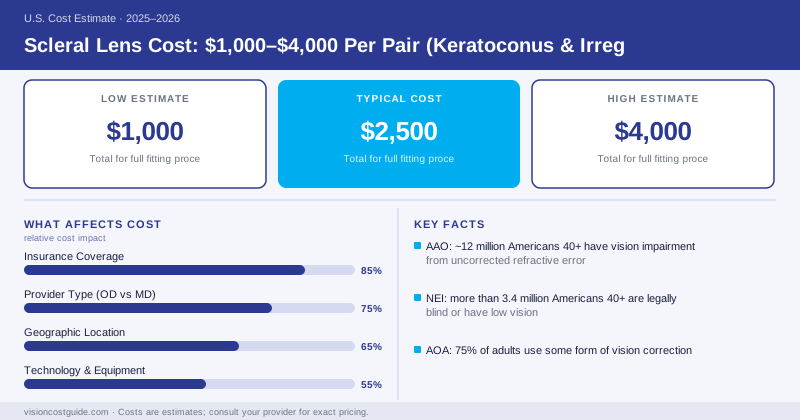
| Total for full fitting process | $1,000–$4,000 | Combines lenses + fitting + diagnostics |
The fitting process itself is where a lot of the cost lives — unlike standard soft contacts, scleral lenses are custom-designed for each individual eye’s unique shape, often requiring 2–5 fitting visits with trial lenses before the final prescription is finalized.
Why Scleral Lenses Cost So Much More Than Regular Contacts
A box of standard soft contacts runs $30–$60 a month. Scleral lenses cost 10-20 times more per lens because each pair is custom-manufactured based on detailed corneal topography measurements unique to your eyes, rather than mass-produced to a handful of standard curvatures. The fitting process also demands significantly more chair time from your eye doctor — getting the vault height and edge alignment right often takes multiple visits and adjustments, which is reflected in the professional fee.
Scleral lenses cost $1,000–$4,000 for the full fitting process including lenses, and they’re typically the best option — sometimes the only workable option short of surgery — for eyes with keratoconus or significant corneal irregularity. Insurance coverage for the medical portion (diagnosis, fitting related to keratoconus) is common, though the lens materials themselves are often only partially covered.
Insurance Coverage Reality
This is where scleral lenses differ meaningfully from routine contact lens fittings. Because keratoconus and other corneal irregularities are medical diagnoses, not simple refractive errors, many medical insurance plans (not just vision plans) cover a portion of the diagnostic workup and fitting fee under medical necessity codes. However, most plans still cap or exclude the actual lens materials cost, leaving patients responsible for $600–$2,000 out of pocket for the lenses themselves even with good medical coverage.
How Long They Last
A well-cared-for pair of scleral lenses typically lasts 1–3 years before needing replacement, longer than standard soft contacts but requiring more careful daily handling — they must be filled with sterile saline before each insertion and cleaned with lens-specific solutions that run $20–$40 a month in ongoing supply costs.
Alternatives Worth Knowing
For milder corneal irregularity, standard rigid gas-permeable lenses or hybrid lenses (rigid center, soft skirt) cost considerably less — typically $200–$600 per pair — and may be sufficient before scleral lenses become necessary. For progressive keratoconus, corneal cross-linking can halt disease progression and is often done before or alongside scleral lens fitting to prevent the cornea from continuing to steepen.
Never attempt to fit or order scleral lenses without a proper in-person fitting by a specialty contact lens practitioner. Poor vault height or edge alignment can cause corneal hypoxia, abrasion, or infection — risks that are significantly higher with scleral lenses than with standard soft contacts due to the fluid reservoir sitting against the eye for extended periods.
Bottom Line
At $1,000–$4,000 for the complete fitting process, scleral lenses are a meaningful investment, but for eyes with keratoconus or irregular corneas, they’re often the difference between blurry, uncomfortable vision and genuinely clear sight. Ask your eye doctor whether medical insurance can offset the diagnostic and fitting portion before assuming the full cost is out of pocket.