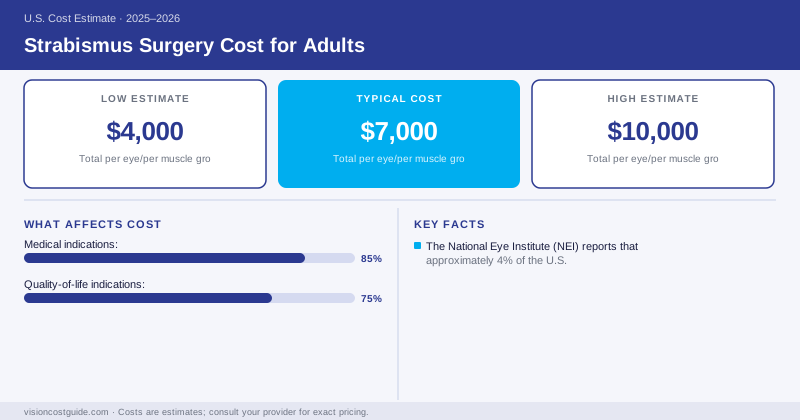
In 2010 this type of surgery was almost exclusively done on children. Today adults are actively seeking correction — and increasingly getting it. The National Eye Institute (NEI) reports that approximately 4% of the U.S. population has strabismus, a misalignment of the eyes where one or both eyes turn inward, outward, upward, or downward. Adults live with it for decades, assuming it’s too late or too expensive to fix. Neither assumption is accurate.
Here’s what strabismus surgery actually costs for adults, what insurance pays — and what to consider before booking a consultation.
Why Adults Seek Strabismus Surgery
Adults pursue strabismus correction for two distinct reasons, and the reason matters for insurance coverage:
Medical indications: Double vision (diplopia) from acquired strabismus — strabismus that developed after childhood due to stroke, thyroid eye disease, nerve palsy, or trauma — is a functional disability. So is strabismus that develops from decompensation of a childhood-onset misalignment. Insurance almost always covers surgery for these cases.
Quality-of-life indications: Adults who’ve had childhood strabismus that was never corrected, or was undercorrected, often seek surgery primarily for appearance and social confidence — avoiding the social consequences of visible eye misalignment. Insurance coverage for this group is less predictable; the medical necessity documentation needs to focus on any functional element (diplopia, depth perception, binocular vision impairment) rather than cosmetics.
Cost Breakdown
| Component | Typical Cost |
|---|---|
| Surgeon’s professional fee | $2,500–$5,000 |
| Ambulatory surgery center (ASC) facility fee | $800–$2,000 |
| Anesthesia (general or IV sedation) | $500–$1,200 |
| Pre-operative testing and evaluation | $200–$500 |
| Post-operative follow-up (3–6 visits) | $75–$200 each |
| Total per eye/per muscle group | $4,000–$10,000 |
When surgery addresses bilateral strabismus (both eyes) in the same session, the facility and anesthesia costs are shared, making the per-eye cost lower than if each eye were operated separately. Many surgeons correct multiple muscles in one session — 1 to 3 muscles is typical, depending on the type and magnitude of misalignment.
What the Surgery Actually Involves
Adult strabismus surgery adjusts the extraocular muscles — the six muscles that control each eye’s movement. The surgeon loosens, strengthens, or repositions muscles to bring the eyes into better alignment. It’s typically done in an ambulatory surgery center under general or IV sedation anesthesia. Most cases take 30–90 minutes depending on how many muscles are addressed.
Adults sometimes receive an adjustable suture technique — a method where the sutures are left temporarily adjustable during the first 24 hours after surgery. While the patient is awake and alert, the surgeon fine-tunes the alignment by loosening or tightening the suture knot before it’s permanently secured. This technique isn’t available with children (they can’t cooperate for the adjustment), and it meaningfully improves precision in adults.
Published success rates for adult strabismus surgery vary significantly based on how “success” is defined. In clinical literature, success typically means achieving alignment within 8–10 prism diopters of orthotropia (straight ahead). More stringent definitions — within 2–4 prism diopters, sufficient for binocular fusion — show success rates of 60–80% after a single procedure.
Approximately 30% of adults need re-operation to fine-tune alignment. This isn’t a failure — it’s expected in a portion of cases given how adult extraocular muscles respond. The cost of re-operation is similar to the initial surgery. When planning, ask your surgeon their personal reoperation rate and what criteria would trigger a second procedure.
Insurance Coverage: The Medical Necessity Argument
Medical insurance — not vision insurance — covers strabismus surgery. The key is establishing medical necessity in the insurer’s terms:
Stronger coverage cases:
- Acquired diplopia (double vision) documented by prism testing
- Strabismus secondary to stroke, thyroid eye disease, or nerve palsy
- Amblyopia risk in an adult with recent-onset strabismus
- Documented binocular vision impairment affecting daily function (driving, reading, workplace performance)
Weaker coverage cases:
- Long-standing childhood strabismus with no diplopia and minimal functional complaint
- Request framed primarily around appearance
Prior authorization is required in virtually all cases. Your surgeon’s office typically handles the PA submission, but it helps to understand what they’re documenting: diagnosis codes, prism measurements, symptom history, prior conservative treatment (prism glasses), and functional impact statements. If an initial denial comes back, appeal with your surgeon’s clinical documentation.
The Prism Glasses Alternative
Not everyone with adult strabismus needs surgery. Prism glasses — lenses with built-in prism that optically shifts image position to compensate for eye misalignment — can manage diplopia without any procedure. Cost: $150–$400 per pair depending on prescription complexity.
Prism glasses are an effective management tool for diplopia, but they don’t correct the underlying misalignment — they compensate for it optically. For small deviations (under 15–20 prism diopters) with stable alignment, prisms are a reasonable long-term option. For larger deviations, variable or intermittent misalignment, or cases where the prism amount keeps increasing, surgery is the more definitive path. Most strabismus specialists recommend a trial period with prism glasses before surgery for acquired strabismus — both because alignment sometimes stabilizes spontaneously and because the PA process for surgery often requires documentation of failed conservative treatment.
Finding the Right Surgeon
Adult strabismus surgery is a subspecialty, not a general ophthalmology procedure. Look for a pediatric ophthalmologist or a strabismologist who explicitly lists adult strabismus as a significant part of their practice. The American Association for Pediatric Ophthalmology and Strabismus (AAPOS) directory is a useful starting point.
Ask specifically:
- How many adult strabismus cases do you perform per year?
- Do you use adjustable sutures? For my specific type of strabismus, would you recommend them?
- What is your reoperation rate for adults with my diagnosis?
- Has your institution or practice published outcomes data you can share?
A surgeon doing hundreds of pediatric cases per year with a handful of adult cases annually isn’t the same as one who has built a dedicated adult strabismus practice. The technical skill and surgical planning for adults differ from pediatric strabismus in ways that experience resolves.
Bottom Line
Adult strabismus surgery costs $4,000–$10,000 total out-of-pocket before insurance. With commercial insurance or Medicare Part B covering medically necessary cases at 80%, the patient’s share drops significantly — typically $800–$2,000 depending on deductibles and coverage. Prism glasses at $150–$400/pair are the first-line alternative for smaller deviations and are required documentation before surgery in most prior authorization pathways. If diplopia or functional impairment is well-documented, insurance coverage is obtainable — but it requires a surgeon’s office that knows how to document medical necessity, not just write a referral.
Frequently Asked Questions
Total cost typically runs $4,000–$10,000 per eye (or per muscle corrected). This includes a surgeon fee of $2,500–$5,000, facility/ASC fee of $800–$2,000, and anesthesia of $500–$1,200. When both eyes are treated in the same session — common for bilateral strabismus — some costs are shared, reducing the per-eye figure.
Yes, when medically necessary. Insurance covers adult strabismus surgery when there's documented diplopia (double vision), amblyopia risk, or functional impairment that meets medical necessity criteria. Cosmetic correction alone — misalignment that doesn't cause diplopia or functional deficit — is more frequently denied. Prior authorization is required; your surgeon's office submits documentation of the medical necessity basis.
Possibly. Success rates (within 2–4 prism diopters of target alignment) are 60–80% after a single adult strabismus procedure. Approximately 30% of adults need a second surgery to fine-tune alignment. The need for re-operation is higher in adults than in children — adult extraocular muscles don't adapt as predictably. Discussing your surgeon's personal reoperation rate is worth doing before the first procedure.