Quick question: when’s the last time you actually read your vision plan’s name before opening the wallet at the optical counter? If your benefits card says Superior Vision, you’ve got coverage from one of the larger networks in the country — even if the brand isn’t a household name. Here’s what that plan really delivers.
What Superior Vision Costs
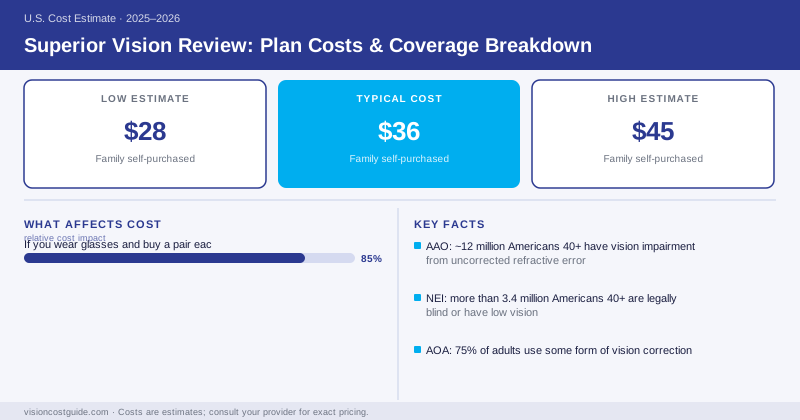
Like most vision insurance, the price swings a lot depending on whether you get it through work or buy it solo. Employer plans land around $6–$12/month for an individual after the subsidy. On the individual market, expect $13–$28/month, with family coverage at $28–$45/month.
| Plan Type | Monthly Cost | Annual Cost |
|---|---|---|
| Employer individual | $6–$12 | $72–$144 |
| Employer family | $16–$30 | $192–$360 |
| Individual self-purchased | $13–$28 | $156–$336 |
| Family self-purchased | $28–$45 | $336–$540 |
Those numbers track with national spending. The Vision Council’s 2024 data shows roughly three in four U.S. adults use some form of vision correction, and managed vision plans typically charge $10–$30/month — Superior sits right in the middle of that range.
What’s Covered
Superior Vision’s benefits follow the familiar template that defines how nearly every plan works:
- Comprehensive eye exam: 100% covered or a $10–$15 copay in-network, once every 12 months
- Frame allowance: $120–$200 depending on the plan tier
- Lens benefit: Single vision, bifocal, and progressive lenses with copays
- Contact lens allowance: $120–$150 in place of glasses
Superior Vision’s biggest selling point is network size — over 116,000 provider access points, including independent optometrists, Walmart Vision Centers, Sam’s Club, and many regional chains. That Walmart and Sam’s Club access matters: it means your covered exam and allowance work at some of the lowest-cost optical retailers in the country, stretching your benefit further.
How It Compares
Against VSP and EyeMed, Superior is competitive but not dominant. Its network is large and includes value retailers most plans skip, which is a real plus for budget shoppers. The frame allowance tops out at a respectable $200 on premium tiers — better than Davis Vision’s typical $130–$175.
The catch is consistency. Superior Vision is now part of Versant Health (alongside Davis Vision), and benefit details vary widely between the dozens of employer group plans it administers. Two people with “Superior Vision” can have very different copays and allowances. Always read your specific Summary of Benefits rather than assuming a standard package.
It’s worth understanding the lens copay structure too, because that’s where surprise costs hide. The base frame allowance and exam coverage look generous, but premium lens options — progressives, high-index thinning, anti-reflective and blue-light coatings, photochromic tints — typically carry separate copays that stack on top. A pair that started as “covered” can climb $100–$200 once you add the upgrades many people actually want. Ask for an itemized quote before you commit so you know exactly which add-ons cost extra and which are baked in. That single question saves Superior members real money at the optical counter.
The Break-Even Math
Run the numbers on an individual plan at $20/month ($240/year):
If you wear glasses and buy a pair each year:
- Plan cost: $240
- Exam copay: $10
- Frames after $150 allowance: ~$60
- Lens copay: $25
- Total out-of-pocket: $335
- Without insurance: ~$130 exam + ~$280 glasses = $410
- Net savings: roughly $75/year
The math gets better at value retailers. Use your benefit at Walmart Vision Center, where frames and lenses often run under $150 total, and your allowance can cover nearly the whole purchase.
Superior Vision does not meaningfully cover LASIK or medical eye treatment — it offers discounts (typically 10–20% off) at partner surgery centers, not real coverage. For elective surgery, you’ll need to budget separately or finance through a program like CareCredit. Medical eye conditions like glaucoma or cataracts go through your regular health insurance, not your vision plan.
Is Superior Vision Worth It?
Through an employer at $6–$12/month, Superior is an easy yes — the covered exam alone nearly justifies the premium, and the Walmart/Sam’s Club access keeps your out-of-pocket low. On the individual market, weigh it against your actual usage; our guide on whether vision insurance is worth it walks through the break-even logic.
If you wear contacts exclusively or only need an exam every couple of years, the savings shrink fast. But for an annual glasses wearer who’ll shop at value retailers, Superior Vision is a genuinely sensible pick.
Frequently Asked Questions
Individual Superior Vision plans run $13–$28/month. Employer-sponsored versions often drop to $6–$12/month after the company contribution.
Superior Vision offers a large network of over 116,000 provider access points and competitive allowances. It's a solid mid-tier plan, especially through an employer.
Yes, most Superior Vision plans include a $120–$150 contact lens allowance, used in place of the frame and lens benefit rather than in addition to it.