Picture a 1,500-meter pool set where you can’t read the pace clock or spot the wall coming. For anyone who needs vision correction, swimming blind is more than annoying — it’s a safety issue. Prescription swim goggles fix it for $25 to $200, and the gap between cheap and custom comes down to one thing: how exactly they match your eyes.
Off-the-shelf vs. custom
Most swimmers do fine with off-the-shelf prescription goggles, which come in fixed powers. You pick the power closest to your prescription, and you’re done.
| Type | Cost | Best For |
|---|---|---|
| Off-the-shelf single power | $25–$60 | Standard near/farsightedness |
| Mixed-power (different per eye) | $40–$80 | Mismatched eyes |
| Custom-ground to exact Rx | $120–$200 | Astigmatism, strong/unusual Rx |
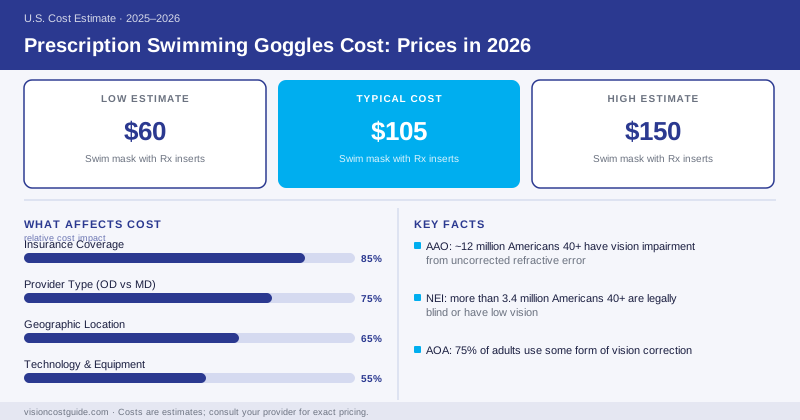
| Swim mask with Rx inserts | $60–$150 | Snorkeling, open water |
The catch with off-the-shelf: they come in steps, often 0.5 diopter jumps, and most don’t correct astigmatism. The American Optometric Association notes that a large share of adults have some astigmatism, so plenty of swimmers end up needing the custom route for crisp vision.
If your prescription is straightforward, off-the-shelf prescription swim goggles at $25 to $60 are a steal. If you have astigmatism or a strong/unusual prescription, spend $120 to $200 on custom-ground lenses — anything less leaves you squinting underwater.
Never swim in contacts
This is the rule swimmers break constantly. The Centers for Disease Control and Prevention specifically warns against wearing contact lenses in any water — pools, hot tubs, lakes, or the ocean — because water traps microbes against the lens. Acanthamoeba keratitis, a rare but devastating infection, is strongly linked to water exposure in contact wearers.
Do not wear contact lenses while swimming. The CDC links pool and open-water exposure to serious, sometimes vision-threatening eye infections in contact wearers. If you need correction in the water, prescription goggles are the only safe choice. If a lens does get wet, discard it.
So forget the idea of wearing your regular contact lenses under clear goggles. Get prescription goggles instead — they’re cheaper than one infection treatment, and infinitely safer.
How to read the power you need
Your swim-goggle power isn’t always identical to your glasses prescription. Goggles typically use the “sphere” value (the main near/farsighted number) and often round to the nearest available step. If you’re not sure, your optometrist can translate your numbers during a routine eye exam, which runs $50 to $200.
For reference, your everyday eyeglasses prescription is the starting point — bring it to whoever sells you the goggles.
Open water and triathlon
Open-water swimmers and triathletes often prefer a prescription swim mask or goggles with a tinted, UV-blocking lens to cut sun glare off the surface. That overlaps with what you’d want from prescription sunglasses on land — protect against UV, kill the glare. Expect $60 to $150 for a quality open-water option.
How to save
- Try off-the-shelf first. If your Rx is simple, you’ll save $100-plus over custom.
- Buy mixed-power pairs if your eyes differ rather than paying for full custom.
- Use FSA/HSA — prescription swim goggles qualify as a medical vision expense.
- Replace the strap, not the goggle, when it wears out to extend the life.
Bottom line
For most swimmers, off-the-shelf prescription goggles at $25 to $60 nail it. Step up to custom-ground at $120 to $200 only if you have astigmatism or a strong prescription. And whatever you do, keep your contacts out of the water — that’s the one rule with no exceptions.
Frequently Asked Questions
Off-the-shelf prescription swim goggles in standard powers cost $25 to $60. Fully custom lenses ground to your exact prescription run $120 to $200.
Yes. Off-the-shelf goggles come in fixed powers (usually in 0.5 or 1.0 steps), which work if your prescription matches. For astigmatism or unusual powers, custom-ground goggles match your exact Rx for $120 to $200.
You shouldn't. The CDC warns that wearing contacts in pools, lakes, or oceans raises the risk of serious eye infections like acanthamoeba keratitis. Prescription goggles are the safe alternative.