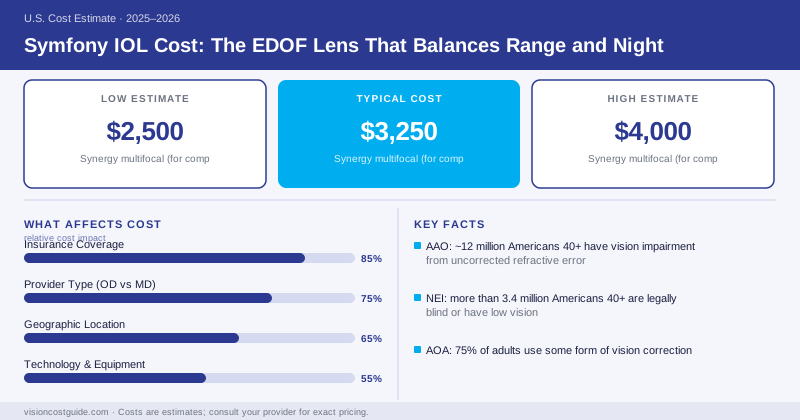
What does the Symfony lens actually cost, and what do you get for it? Roughly $1,800–$3,200 per eye out of pocket — and what you get is range. The FDA approved the Johnson & Johnson Tecnis Symfony in 2016 as the first extended depth of focus IOL in the U.S., and it carved out a middle lane between basic monofocals and the all-distance trifocals.
If you want more than a single focal point but you’re nervous about night-vision side effects, Symfony was built for you.
Symfony IOL Cost Breakdown
| Lens | Out-of-Pocket Per Eye | Both Eyes |
|---|---|---|
| Standard monofocal (Medicare baseline) | $0 | $0 |
| Tecnis Symfony EDOF | $1,800–$3,200 | $3,600–$6,400 |
| Symfony Toric (astigmatism correction) | $2,500–$3,800 | $5,000–$7,600 |
| Synergy multifocal (for comparison) | $2,500–$4,000 | $5,000–$8,000 |
That’s the premium above what Medicare pays for the base cataract surgery. The surgery itself is covered; the lens upgrade is your responsibility.
How Symfony Works
Symfony uses a diffractive echelette design that elongates the focus, creating one continuous stretch of clear vision from distance through intermediate. Instead of splitting light into separate near, middle, and far points like a trifocal, it spreads focus along a range.
The practical upside is sharper distance and intermediate vision with less of the contrast loss multifocals cause. The practical downside is that true near vision — phone-at-arm’s-length and closer — isn’t as crisp. Many Symfony patients use low-power readers for small print.
Symfony’s whole identity is balance. Published studies and J&J’s clinical data show Symfony patients report fewer and milder halos than diffractive trifocal patients, while still gaining functional intermediate vision that monofocals don’t provide. It’s the lens for someone who works on a computer, drives at night, and is willing to keep readers around for the occasional menu or label.
Symfony vs. Vivity vs. Trifocals
These three premium categories blur together at the counter, so here’s the plain-language split:
- Symfony — extended range with strong intermediate vision, mild halos; readers for fine print
- Vivity — non-diffractive EDOF with the fewest halos; slightly less near range than Symfony
- Multifocal/trifocal — best all-distance glasses freedom, but more halos and contrast trade-off
The ASCRS recommends matching lens design to a patient’s dominant visual tasks rather than to price alone. Symfony tends to win for the computer-heavy professional who also values clean night driving.
Good Candidates and the “Mini-Monovision” Trick
Surgeons often pair Symfony lenses in a “blended” or mini-monovision setup — setting one eye slightly for near — to squeeze out better reading vision without sacrificing the lens’s clean optics. This is a popular strategy that can substantially reduce reading-glasses use.
Symfony’s diffractive design can still produce a “spider web” or concentric-ring halo around bright lights at night, even if it’s milder than a trifocal’s. Patients with significant night-driving demands or prior corneal surgery should weigh Vivity instead. Always ask your surgeon how many of each lens they implant and what their patients report about night vision.
How People Pay
Medicare and commercial plans cover the operation but not the premium lens. HSA and FSA accounts can fund the full out-of-pocket amount pre-tax, and CareCredit financing is widely offered. If you’re comparing your lens options to corneal laser correction, see how LASIK pricing stacks up for non-cataract candidates.
Is Symfony Worth It?
For the right patient, yes. If you spend hours at a screen, drive at night, and can accept readers for small print, Symfony delivers a clean, balanced visual range at a mid-tier price. If your top priority is reading without any glasses at all, a trifocal will serve you better. And if night-vision purity is everything, an EDOF like Vivity edges it out. Match the lens to how you actually use your eyes.
Frequently Asked Questions
The Tecnis Symfony lens runs $1,800–$3,200 per eye out of pocket above standard cataract coverage, or about $3,600–$6,400 for both eyes.
Symfony is an extended depth of focus (EDOF) lens. It creates a continuous range of vision rather than the distinct focal points of a multifocal, which reduces halos.
Often for fine print, yes. Symfony delivers strong distance and intermediate vision; many patients keep low-power readers for small text in dim light.