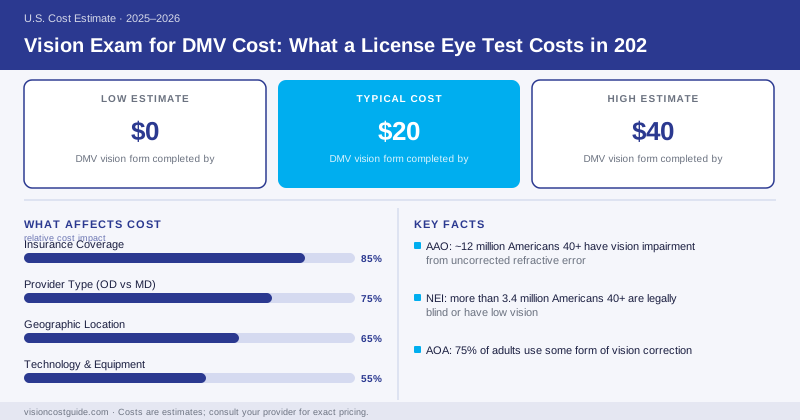
Here’s a number that surprises people: in most states, the eye test at the DMV counter costs you nothing. It’s baked into your license fee. The cost only shows up when you fail — then you’re looking at $50 to $200 for a comprehensive exam and a doctor’s form to clear you. For most drivers, the real total is somewhere between $0 and $200.
Let’s break down when you pay and when you don’t.
The free part: the counter screening
When you renew or apply, a clerk points you at a vision tester and asks you to read a line. That’s the screening, and it’s free with your license transaction. Most states want 20/40 in at least one eye — the same threshold the federal government uses for commercial drivers, which keeps the rules consistent.
| Scenario | Typical Cost |
|---|---|
| DMV counter vision screening | $0 (in license fee) |
| You pass — done | $0 |
| You fail — comprehensive eye exam needed | $50–$200 |
| New glasses to pass | $150–$300 |
| DMV vision form completed by doctor | $0–$40 |
The DMV vision screening itself is free in nearly every state — it’s part of your license fee. You only spend money if you fail and need an eye doctor to examine you and sign a vision form, which runs $50 to $200. Wearing glasses to pass is completely allowed.
When the DMV sends you to a doctor
Fail the counter test and the DMV hands you a vision report form to take to an optometrist or ophthalmologist. The doctor performs a comprehensive eye exam, records your corrected acuity, and signs off. That exam is the main cost — $50 to $200 depending on your area and whether you have insurance.
The American Optometric Association reports that millions of Americans are driving with uncorrected or undercorrected vision, and a failed DMV screen is often the first time someone learns their prescription has slipped.
Glasses to clear the standard
If the exam shows you need correction, a basic pair of single-vision eyeglasses at $150 to $300 will get you to 20/40 and beyond. Once you’re corrected, your license carries a restriction code — usually “must wear corrective lenses.” It’s routine; tens of millions of licensed drivers have it.
For drivers over 45 juggling road signs and the dashboard, progressive lenses handle both distances, though they cost more.
Don’t try to memorize the eye chart or “fake” your way past a failed screening. If your vision genuinely doesn’t meet the standard, driving uncorrected is dangerous and, if it leads to a crash, a serious liability. Get the exam, get the glasses, and drive safely.
Senior drivers and renewal rules
Many states tighten vision-renewal rules with age. The National Eye Institute notes that conditions like cataracts and glaucoma become far more common after 60, and several states require in-person vision screening (no mail-in renewal) for older drivers. If you’re renewing later in life, expect the counter test rather than an automatic mail renewal.
How to keep it cheap
- Pass the free screening by keeping your prescription current — that’s the whole game.
- Use vision insurance if you need the exam; many plans cover one yearly visit fully.
- Tap FSA/HSA for the exam and any glasses.
- Ask the office to complete the DMV form during your visit — most do it free or for a small fee.
- Address worsening night glare early — our eye strain treatment guide covers when it’s a sign of something more.
Bottom line
For most drivers, the DMV vision test is free and you walk out with your license. The cost only appears if you fail — then budget $50 to $200 for an exam and a signed form, plus glasses if you need them. Keep your prescription updated and the renewal stays a no-charge formality.
Frequently Asked Questions
The screening at the DMV counter is usually free and included in your license fee. If you fail and need a doctor's vision form, a comprehensive eye exam costs $50 to $200.
Most U.S. states require 20/40 vision in at least one eye, with or without glasses, to drive without restriction. Below that, you may get a 'corrective lenses required' note or daylight-only restriction.
Yes. You can wear glasses or contacts to pass. If you do, your license will carry a restriction code meaning you must wear them whenever you drive.