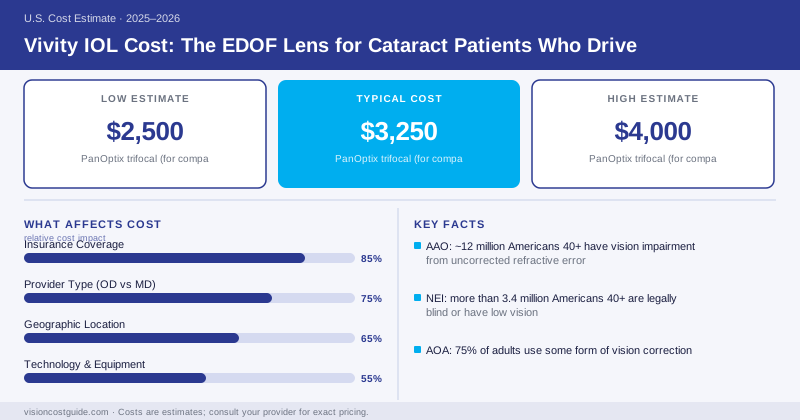
Most patients assume the premium lens with the fewest night-driving problems must be the priciest. Wrong. The Alcon Vivity, an extended depth of focus (EDOF) lens the FDA approved in 2020, actually sits at the lower end of the premium tier — $1,500–$3,000 per eye out of pocket — while delivering the night vision that worried trifocal patients want.
That combination of moderate price and clean night vision is why Vivity has become a go-to recommendation for cataract patients who drive after dark.
Vivity IOL Cost Breakdown
| Lens Type | Out-of-Pocket Per Eye | Both Eyes |
|---|---|---|
| Standard monofocal (Medicare baseline) | $0 | $0 |
| Vivity EDOF | $1,500–$3,000 | $3,000–$6,000 |
| Vivity Toric (adds astigmatism correction) | $2,500–$4,000 | $5,000–$8,000 |
| PanOptix trifocal (for comparison) | $2,500–$4,000 | $5,000–$8,000 |
These figures are the upgrade cost above Medicare’s standard cataract surgery coverage. The base operation is covered; the premium lens is the part you fund yourself.
What “EDOF” Means for Your Wallet and Your Eyes
Vivity isn’t a multifocal lens. Trifocals like PanOptix split light into three distinct focal points, which is great for crisp reading but produces those ring-shaped halos around headlights. Vivity uses a non-diffractive design that stretches a single elongated focal range. The result: continuous distance-to-intermediate vision with dramatically fewer visual side effects.
The trade-off is near vision. You’ll see your dashboard, your computer, and across the room beautifully. For small print — pill bottles, restaurant menus in dim light — you’ll likely still grab readers.
Vivity is the lens for people who prioritize quality of vision over total glasses freedom. Alcon’s clinical trials reported that the vast majority of Vivity patients experienced no bothersome halos, glare, or starbursts — a profile much closer to a standard monofocal than to a trifocal. If night driving is a big part of your life, that matters more than shaving a line off the reading chart.
Vivity vs. Trifocal vs. Multifocal
The decision usually comes down to how much you read versus how much you drive at night:
- Choose Vivity if night driving, contrast, and visual quality top your list, and you accept using readers for fine print
- Choose a multifocal IOL or trifocal if you want maximum spectacle independence at all distances and can tolerate halos during the adaptation period
- Choose a premium toric option if you also have significant astigmatism to correct
The AAO and ASCRS both stress matching the lens to lifestyle rather than chasing the most expensive option. Vivity often wins precisely because it sidesteps the complaint that drives premium-lens regret: glare and halos.
Who’s a Good Candidate
Vivity tolerates imperfect eyes better than trifocals do. Patients with mild macular changes, early glaucoma, or prior corneal surgery — who’d be poor candidates for a diffractive multifocal — can often still do well with Vivity because it doesn’t sacrifice as much contrast sensitivity.
Don’t expect Vivity to read fine print without help. Marketing language about “continuous vision” can oversell near performance. If a salesperson promises you’ll never need readers again with Vivity alone, be skeptical — that’s a trifocal claim, not a Vivity one. Get clear, realistic expectations in writing before paying the upgrade fee.
Paying for Vivity
Medicare and commercial insurance cover the surgery, not the lens upgrade. Most patients use HSA or FSA funds, which apply pre-tax dollars to the full out-of-pocket cost. CareCredit and in-house payment plans are common too. If you’re comparing lens-based correction to corneal procedures, our look at refractive lens exchange covers the same lens technology for non-cataract patients.
Bottom Line
At $1,500–$3,000 per eye, Vivity is one of the better values in premium IOLs — especially if clean night vision matters more to you than ditching readers entirely. It corrects astigmatism in its toric version, plays nicely with less-than-perfect eyes, and produces fewer regrets than diffractive lenses. For night drivers, it’s frequently the smartest premium choice on the menu.
Frequently Asked Questions
Vivity runs $1,500–$3,000 per eye out of pocket above Medicare's standard cataract coverage, or roughly $3,000–$6,000 for both eyes.
Usually yes. Vivity is an EDOF lens that typically costs $500–$1,500 less per eye than a PanOptix trifocal, which runs $2,500–$4,000 per eye.
Far fewer than trifocal lenses. Vivity's non-diffractive optics are designed to limit halos and glare, which is why night drivers often prefer it.