A laser pulse that reshapes your cornea takes about 20 to 50 seconds per eye. So why does that quick zap cost $2,000 to $3,000 per eye? The honest answer: you’re not paying for the seconds of laser time. You’re paying for a half-million-dollar machine, a thorough screening process, a highly trained surgeon, and the royalty the laser maker collects every single time the device fires.
Let’s break down where the money actually goes.
Where Your LASIK Dollars Go
The all-in price for bilateral LASIK at a quality clinic in 2025 lands around $4,000 to $5,000. Here’s a rough breakdown of how a single-eye fee gets divided.
| Cost Component | Share of Per-Eye Price |
|---|---|
| Laser equipment + per-use royalty fee | $400–$700 |
| Surgeon’s professional fee | $500–$900 |
| Pre-op screening + candidacy exam | $200–$400 |
| Facility, surgical suite, staff | $300–$500 |
| Post-op visits (1 year) | $150–$300 |
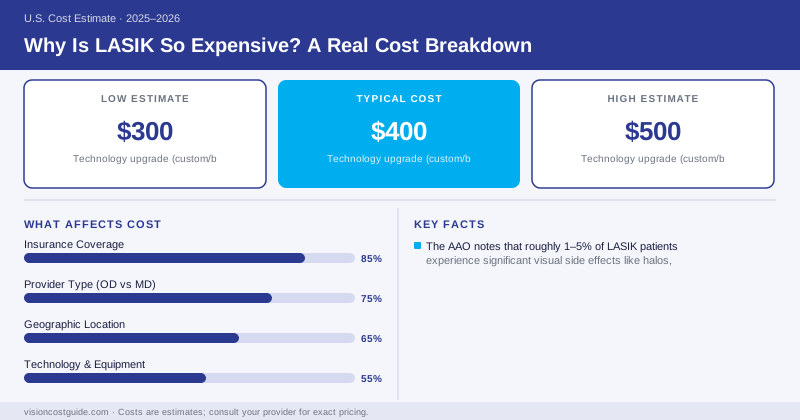
| Technology upgrade (custom/bladeless) | $300–$500 |
Notice what’s missing from the top of that list: the actual reshaping of your cornea. The procedure itself is fast. Almost everything you pay for happens before and after the laser fires.
The Equipment Tax Nobody Talks About
Here’s the part that surprises people. Excimer and femtosecond laser platforms cost upward of $500,000 to buy. But the bigger ongoing expense is the per-procedure royalty — laser manufacturers charge the clinic a fee, often $100 to $250, every time the machine treats an eye. That cost gets baked straight into your bill and it doesn’t shrink no matter how busy the clinic is.
This is also why LASIK hasn’t gotten dramatically cheaper. Consumer tech drops in price as production scales up, but a royalty-per-use model doesn’t work that way.
A patient with a tiny -1.00 prescription and one with a heavy -7.00 use the same laser, the same screening, and roughly the same chair time. Since the cost is overhead-driven, not tissue-driven, clinics charge a flat per-eye rate. The only real upcharge is for custom wavefront treatment, which higher and more irregular prescriptions are more likely to need — typically $300 to $500 extra per eye.
The Screening You’re Paying For (and Should Want)
Before anyone touches your eyes, a quality clinic runs corneal mapping, thickness measurement, pupil sizing, and a dry-eye assessment. That LASIK candidacy workup takes real equipment and a trained tech, and it’s where roughly 15% to 25% of interested patients get told they’re not good candidates.
That screening is a feature, not padding. The American Academy of Ophthalmology reports that careful candidate selection is one of the biggest factors in LASIK’s high satisfaction rate. Cut-rate operations that rush screening are exactly where you don’t want to save money.
A rock-bottom price often signals corners cut on the things that protect you — screening depth, surgeon experience, or older bladed technology. The AAO notes that roughly 1–5% of LASIK patients experience significant visual side effects like halos, glare, or persistent dry eye. Choosing a surgeon by price alone raises your odds of landing in that group. Compare total all-in quotes and technology, not headline per-eye numbers.
The Surgeon’s Fee Is Doing Real Work
A board-certified refractive surgeon performing thousands of procedures commands a meaningful professional fee. Experience genuinely correlates with better outcomes here. When a clinic advertises $999 per eye, that number frequently reflects a less experienced surgeon, a simple low prescription, or older microkeratome technology — not the bladeless, wavefront-guided approach most patients actually want.
If you’re comparing LASIK against alternatives, it’s worth reading the LASIK vs. PRK cost breakdown, since PRK skips the corneal flap and can run a few hundred dollars less per eye.
How to Lower the Real Price
You can’t make the laser royalty disappear, but you can shrink your out-of-pocket cost. LASIK is an IRS-qualified medical expense, so paying with FSA or HSA dollars cuts the effective price 20% to 37% depending on your tax bracket. Stack that with an employer or VSP discount program (15% to 25% off) and a $4,000 procedure becomes an effective $2,000 to $2,500.
For the full picture on coverage and financing options, see is LASIK worth it for the 10-year cost math against glasses and contacts.
Frequently Asked Questions
So is LASIK overpriced, or just expensive for good reasons? Mostly the latter. The price reflects a fixed stack of costs — equipment, royalties, screening, and surgeon expertise — that don’t scale down with how quick the actual procedure is. A $999-per-eye ad usually describes a simpler, lower-tech version of what most patients end up needing once astigmatism and custom mapping enter the picture.
The smartest way to handle the cost isn’t hunting for the cheapest laser in town. It’s using pre-tax FSA or HSA money and an employer discount to lower what you actually pay, while keeping the screening rigor and surgeon experience that make the procedure safe. Pay full attention to the all-in quote, ask exactly what’s bundled, and confirm whether enhancements are covered before you sign anything.
Frequently Asked Questions
Because the bulk of the price is fixed overhead — the laser system, the screening workup, and the surgeon's time — not the amount of tissue removed. A -1.00 myope and a -7.00 myope use nearly identical chair time and the same equipment, so clinics charge a flat per-eye rate of roughly $2,000–$3,000. Custom wavefront treatments for higher or irregular prescriptions can add $300–$500 per eye.
Sometimes, but read the fine print. Bargain ads often quote the lowest possible price for a simple, low prescription using older microkeratome (bladed) technology. Astigmatism, custom wavefront mapping, and the all-laser bladeless method usually push the real quote to $2,000+ per eye. The AAO advises comparing the total all-in price, including pre-op exams and one year of follow-up, not the headline number.
At reputable clinics, the quoted price usually bundles the candidacy exam, the procedure, and roughly a year of post-op visits. Lifetime enhancement (touch-up) programs are sometimes included and sometimes an add-on of $300–$800. Always ask what happens if regression occurs after year one — enhancements affect about 5–10% of patients over a decade.
Femtosecond and excimer laser platforms cost $500,000 or more to purchase, plus per-procedure royalty fees the manufacturer charges each time the laser fires (often $100–$250 per eye). Add a service contract, calibration, and a climate-controlled surgical suite, and the equipment alone accounts for a large slice of your bill.
Yes. FSA and HSA dollars cut the effective price 20–37% because LASIK is an IRS-qualified medical expense. Employer and VSP discount programs knock off another 15–25%. Stacking pre-tax funds with a discount can turn a $4,000 procedure into an effective $2,000–$2,500 — without choosing a cheaper, lower-quality provider.
Prices have stayed remarkably flat for over a decade. The Vision Council and industry data show average per-eye costs have barely moved since the early 2010s, mostly because the per-procedure royalty fees and surgeon expertise don't scale down like consumer electronics. If anything, newer custom and bladeless methods have nudged the average up.