The optician quotes you $480 for lenses. You paid $180 last time. The difference? Your prescription changed — it crossed into high-index territory. If you’ve got a prescription beyond −4.00 or +3.00, the lens material and design choices multiply fast. Here’s how to make sense of the pricing and avoid paying more than you need to.
What Makes a Prescription “High”?
Standard plastic (CR-39) lenses work fine for most mild-to-moderate prescriptions. But as the prescription strength increases, standard-index lenses become thick, heavy, and cosmetically unacceptable — especially at the lens edges for myopes and lens centers for hyperopes.
The solution is high-index glass — materials with a higher refractive index that bend light more efficiently, allowing the lens to be physically thinner.
General prescription ranges by lens category:
- Standard (1.50 index): −3.00 to +2.50 range, light prescription
- Mid-index (1.56–1.60): −4.00 to +3.50, moderate
- High-index 1.67: −6.00 to +5.00, high prescription
- High-index 1.74: −8.00 and beyond, or high + cylinder, the thinnest available
Cylinder power (astigmatism) adds to thickness too — a prescription of −3.00 −2.50 cyl is optically equivalent to a roughly −4.25 sphere for thickness purposes.
High Prescription Lens Cost by Index
| Lens Type | Index | Typical Retail Cost (Single Vision, Per Pair) |
|---|---|---|
| Standard plastic | 1.50 | $50–$100 |
| Mid-index polycarbonate | 1.59 | $80–$150 |
| High-index | 1.67 | $150–$300 |
| Ultra-high-index | 1.74 | $250–$500 |
| High-index progressives (1.67) | 1.67 | $300–$600 |
| Ultra-high-index progressives (1.74) | 1.74 | $450–$800 |
| Aspheric design upgrade | any | +$50–$150 |
| Anti-reflective coating | any | +$50–$150 |
Why These Prices Vary So Much
Retail markup is the dominant driver. Eyeglass chain stores and independent opticians mark up lens wholesale costs by 200–400%. The actual wholesale cost of a high-index 1.67 lens blank is $15–$40. You pay $200 retail. That’s not fraud — it covers fabrication, edging, staff, and overhead — but it means there’s room to shop.
Online retailers like Zenni, Warby Parker, Clearly, and EyeBuyDirect charge dramatically less. Zenni’s 1.74 high-index lenses start around $35–$65 for single vision. Clearly typically runs $60–$120. The optical quality is comparable to retail at the same index level; the difference is service, fitting assistance, and return policy.
Frame compatibility affects cost too. Some ultra-thin high-index lenses can’t be edge-cut for very small or rimless frames. Your optician will steer you toward compatible options, which may push you toward a pricier frame to accommodate your lens.
Prescription complexity adds cost. If your prescription includes significant prism, a high add power for bifocals, or atypical vertex distances, standard stock lens blanks may not work — custom-order lenses from the lab cost more and take longer.
Add-Ons Worth Considering for High Prescriptions
Anti-reflective (AR) coating is non-optional at high index. High-index glass is more reflective than standard plastic due to its higher refractive index — without AR coating you get distracting reflections and ghost images. Every high-index lens should have AR. Budget $50–$150 extra; it’s worth it.
Aspheric design reduces the “magnified eye” or “bug-eye” appearance that comes with high plus prescriptions, and reduces peripheral distortion in high minus lenses. Aspheric costs $50–$150 extra retail but is increasingly included as standard with higher-index materials.
Blue light filtering adds $30–$80 at most retail locations. Evidence for its efficacy is limited — the American Academy of Ophthalmology doesn’t recommend it for everyone — but if you’re spending significant screen time it’s a minor addition to a large purchase.
Scratch-resistant coating is usually included with high-index lenses. Confirm before you pay for it as a separate add-on.
- Get your prescription in writing — you’re legally entitled to it after your exam
- Compare at least one online retailer (Zenni, Clearly, or EyeBuyDirect) vs. your optician’s quote for the same index and coatings
- Ask your optician to price the lenses in your own existing frame — saving $100–$250 on frames can offset the lens cost
- Check if your vision insurance covers “premium lens materials” — many VSP plans pay an extra $50–$75 toward high-index upgrades
- For prescriptions above −8.00, ask specifically about the 1.74 index even if your optician quotes 1.67 — at extreme prescriptions, the thickness difference is visible
Online vs. In-Store for High Prescriptions
This is where the conventional wisdom most needs updating. For simple single-vision high-prescription lenses in a full-rim frame — online is an excellent option. Zenni’s 1.67 lenses start around $25–$40; Clearly’s run $50–$100. The optical quality is lab-certified and fully equivalent.
Where in-store has an edge:
- Progressive high-index lenses: Fitting requires precise pupillary distance, monocular PD, and fitting height measurements. An OD or optician with physical tools does this more accurately than a self-measured PD app. A poorly fitted progressive at any index is uncomfortable and unwearable — and that’s a bigger risk with a $300–$600 pair.
- Very high prescriptions (beyond −8.00 or beyond +6.00): Centration and back-vertex distance matter enormously. In-person fitting is worth the premium.
- First-time progressives: If you’ve never worn progressive lenses, having a knowledgeable optician guide you matters.
The NEI and High Myopia
The National Eye Institute notes that high myopia (−6.00 and beyond) is more than a glasses prescription issue — it’s a risk factor for retinal detachment, glaucoma, and macular degeneration. If you’re in the high-prescription range, the lens choice is only one cost. You also need annual dilated exams (not just a prescription check), and potentially fundus photography and OCT to monitor retinal health. The lens cost is real; the eye health monitoring cost is even more important.
Bottom Line
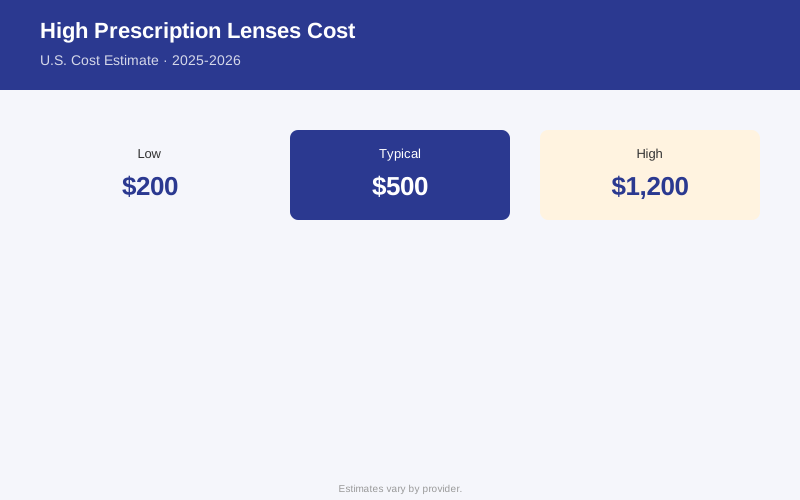
High-prescription lenses in a 1.67 or 1.74 high-index material cost $150–$500 at retail optical, or $35–$150 online for single vision. Add AR coating — it’s essential. Shop online for simple single-vision needs; use an optician for progressives or very strong prescriptions. Your vision insurance may cover part of the high-index upgrade — check before you assume you’re paying out of pocket.