Most LASIK patients want one answer: is this a one-time thing, or will I end up needing glasses again in ten years? The honest answer: the corneal correction is permanent. Your prescription’s stability over time is not. Those are two different things — and mixing them up leads to a lot of confusion about what LASIK actually delivers long-term.
LASIK Is Permanent — But Your Eyes Aren’t Static
LASIK uses an excimer laser to reshape your cornea. That reshaping is permanent in the same way a haircut is a physical change — your hair doesn’t “un-cut” itself, but it does keep growing. The cornea doesn’t regenerate laser-removed tissue. The correction made at surgery holds.
What can change:
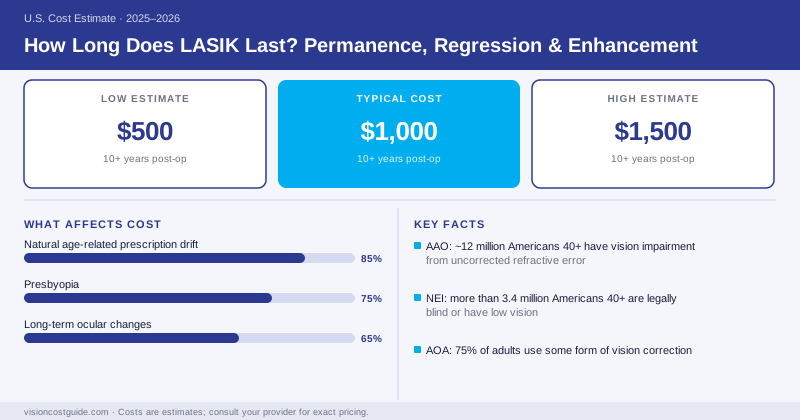
Natural age-related prescription drift. For most people, myopia (nearsightedness) stabilizes in the mid-to-late 20s. If your prescription was stable for two years before LASIK, significant regression is uncommon. But some patients — particularly high myopes with prescriptions over -6.00 — experience mild prescription drift over years.
Presbyopia. Around age 40–45, virtually everyone loses near-vision flexibility due to lens hardening inside the eye. LASIK does nothing about presbyopia. If you had LASIK at 28, you’ll still need reading glasses in your 40s — exactly the same as if you hadn’t had LASIK.
Long-term ocular changes. Cataract development, retinal changes, and other age-related conditions affect visual quality over decades, independently of your LASIK correction.
Enhancement Rates: What the Data Shows
| Timeframe | Enhancement Rate | Enhancement Cost |
|---|---|---|
| Within 1 year | 1–2% | Often included in original fee |
| 1–5 years post-op | 2–5% cumulative | $0–$1,500 (depends on guarantee) |
| 5–10 years post-op | 5–10% cumulative | $500–$1,500 per eye |
| 10+ years post-op | Up to 15% (high myopes) | $500–$1,500 per eye |
The ASCRS reports that approximately 5–10% of LASIK patients undergo enhancement surgery within 10 years. Enhancement rates are higher for patients with higher original prescriptions (above -6.00 sphere), higher cylinder corrections, and patients who were at the edge of candidacy for corneal thickness. The AAO notes that most regressions are mild — patients don’t return to their full original prescription, just drift 0.50–1.00 diopters toward it.
An enhancement (also called a retreatment or touch-up) re-lifts the original LASIK flap and applies additional laser correction to address the residual prescription. It’s a faster procedure than the original and typically involves a shorter recovery period. Not everyone’s cornea has sufficient remaining tissue for an enhancement — another reason why choosing a conservative surgeon who selects patients carefully matters for long-term options.
Lifetime Enhancement Programs: Read the Fine Print
Most major chain LASIK centers (LasikPlus, TLC Laser Eye Centers, many private practices) offer lifetime enhancement programs. These are genuinely valuable for the 5–10% who need retreatment. But “lifetime” comes with conditions:
- Annual follow-up visits at the same clinic are typically required to keep the guarantee active
- Enhancements are excluded if dry eye, corneal thinning, or other contraindications develop
- Some programs expire if you move away and can’t make annual appointments
- The definition of “needing” an enhancement may be narrower than you’d expect (some programs require 20/40 or worse uncorrected vision to qualify)
If you’re choosing between a slightly higher-cost clinic with a solid written guarantee versus a lower-cost option without one, factor in the $500–$1,500 enhancement cost when doing the comparison.
What About Reading Glasses After LASIK?
This is the most common source of disappointment for patients in their 40s. They had LASIK at 32, enjoyed 10+ years of glasses-free life, then found themselves reaching for reading glasses at 43.
That’s presbyopia — not LASIK failure. Every person who lives long enough develops presbyopia regardless of their correction history. Monovision LASIK (correcting one eye for distance, leaving the other slightly nearsighted for reading) can delay reading glass dependence — but it involves tradeoffs in depth perception and binocular acuity that not everyone tolerates.
LASIK for patients over 40 carries the presbyopia caveat: you’ll likely still need reading glasses within a few years, even with excellent distance correction. Surgeons should be having this conversation explicitly at the pre-op consultation. If yours didn’t, ask directly — it’s important for your long-term expectations.
Bottom Line on LASIK Longevity
LASIK corrections are permanent. Most patients who are good candidates enjoy 20+ years of clear distance vision without glasses or contacts. The 5–10% who need an enhancement typically get one that restores their vision back to target. The issues that bring patients back to glasses in middle age — presbyopia, cataract, other age-related changes — would have happened with or without LASIK.
See also: LASIK Eye Surgery Cost for procedure pricing, LASIK Enhancement Cost for touch-up pricing details, and LASIK vs. PRK Cost for alternatives.