Warby Parker changed the math when it launched at $95 a pair in 2010. Then Zenni undercut that with $6.95. EyeBuyDirect runs “buy one get one” promotions that bring complete pairs under $20. The American Academy of Ophthalmology notes that about 11 million Americans lack needed vision correction — cost is consistently the top reason cited. Online glasses are one real answer to that problem. Here’s how to use them without compromising your vision.
Online Glasses Retailers: Price Comparison
| Retailer | Starting Price | With AR Coating | Best For |
|---|---|---|---|
| Zenni Optical | $6.95 | $14–$50 | Budget backup pairs, simple prescriptions |
| EyeBuyDirect | $6 | $20–$60 | Budget picks, BOGO promotions |
| Warby Parker | $95 | Included | Mid-range with in-person try-on (some markets) |
| Clearly (Coastal) | $29 | $50–$80 | Canadian brand, wide selection |
| GlassesUSA | $39 | $55–$120 | Often runs 50% off promotions |
| Firmoo | $19 | $30–$60 | Budget international option |
| Full-service optical | $200–$600 | Extra $40–$80 | Complex prescriptions, progressive lenses |
When Cheap Online Glasses Work Fine
Simple prescriptions — single-vision, sphere power under ±4.00, minimal or no astigmatism — are very well served by budget online glasses. The optics of a standard CR-39 plastic lens are essentially identical whether it’s cut by Zenni’s automated lab or your local optician’s outsourced lab (which is often the same wholesale operation, just with more markup).
Specific use cases where budget online glasses make the most sense:
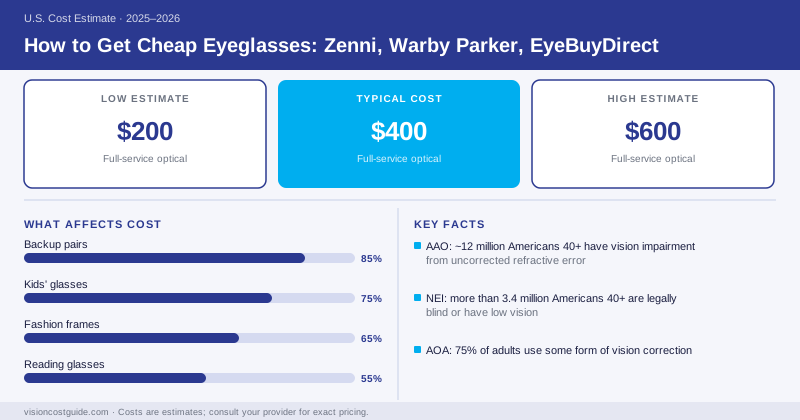
Backup pairs. You need a pair in case your primary glasses break. A $20 Zenni pair with your current prescription handles that perfectly. There’s no reason to spend $400 on a backup pair.
Kids’ glasses. Children destroy frames. A $15–$30 pair that gets replaced every year is a smarter investment than a $200 pair that’ll get sat on within 6 months.
Fashion frames. If you want colored frames, unique shapes, or seasonal variety, buying 3 pairs from Zenni for the cost of one pair in-store makes sense — especially for mild prescriptions where optical precision is less critical.
Reading glasses. For mild presbyopia readers without other prescription needs, the optical precision standards are lenient. A $12 pair that sits on your nightstand is fine.
When to Spend More
Progressive (no-line bifocal) lenses require a set of precise measurements that online retailers can’t take — the distance from your eyes to the lens optical centers must be measured in the specific frames you’ll wear. Getting progressives online with self-measured PD is risky. First-time progressive wearers especially benefit from in-person fitting and adjustment. If your progressives give you headaches or make straight lines appear to swim, a fitting issue is often the cause.
Complex prescriptions benefit from professional fitting:
- High sphere power (above ±5.00): optical center placement becomes more critical
- High cylinder (astigmatism over 2.00): axis orientation matters
- Prism correction: must be precisely centered
- Progressive or bifocal lenses: measurement-intensive
The PD Measurement: The Critical Variable
Pupillary distance (PD) is the measurement from pupil to pupil. All online retailers require it. Here’s how to get it accurately:
Ask your eye doctor. It’s sometimes on your prescription, sometimes not. You’re legally entitled to your prescription — the PD isn’t always included, but you can ask the doctor or optician to measure it at your appointment. Some offices charge a small fee ($5–$15) for PD measurement without purchase.
Measure it yourself. Ruler method: stand 8 inches from a mirror, hold a millimeter ruler at your brow, close your right eye, align the ruler zero with your left pupil center, then open your right eye and note the reading under your right pupil. Average adults measure 60–68mm. You want accuracy within 1mm.
Use an app. Warby Parker’s PD measure app and GlassesUSA’s app both use the phone’s front camera. They’re reasonably accurate for simple single-vision lenses.
A PD error of 2mm or more creates a measurable prismatic effect — double vision, eye strain, headaches. This matters far less for low-prescription distance glasses than for reading glasses or progressives. If new online glasses give you any of these symptoms, PD error is the first thing to check. Most retailers will remake for free if the PD they used was wrong.
Stacking Discounts on Online Glasses
Most online retailers run promotions continuously:
- Zenni: Frequent 15–30% off codes; BOGO promotions; clearance section under $10
- EyeBuyDirect: BOGO deals on select frames; first-time buyer codes for 25–50% off
- GlassesUSA: Often 50% off first pair; seasonal sales bringing $39 frames to $20
- Warby Parker: No major discounts — $95 complete includes AR coating and holds price
Insurance note: most VSP and EyeMed plans now include an out-of-network glasses reimbursement of $50–$100. You can buy from Zenni and submit for partial reimbursement — check your plan’s out-of-network optical benefit before ordering.
The Bottom Line on Cheap Glasses
For simple single-vision prescriptions, you genuinely don’t need to spend more than $20–$50 on functional glasses. The optics are adequate. The frames are cosmetically fine. The only real risk is getting the PD wrong — measure carefully, or have it measured professionally.
For progressives, prism, or high prescriptions — spend the money on professional fitting. The cost difference is real, but so is the risk of a pair that makes you feel worse than no glasses at all.
See also: Zenni Glasses Cost, Warby Parker Glasses Cost, and Online Glasses vs. In-Store Cost for full comparisons.