What if you could get the crisp vision of a rigid gas-permeable lens with the comfort of a soft contact? That’s exactly what hybrid lenses attempt — and for patients who’ve failed both standard soft lenses and rigid lenses, they’re often the answer nobody mentioned.
Hybrid contact lenses have a rigid gas-permeable (RGP) center bonded to a soft peripheral skirt. The RGP center vaults over irregular corneas and corrects high astigmatism with precision; the soft skirt centers the lens and creates the cushioned feel of a soft contact. The tradeoff is cost and fitting complexity — both considerably higher than standard soft lenses.
Who Actually Needs Hybrid Lenses
Not everyone does. Hybrid lenses occupy a specific niche:
- Keratoconus patients who can’t tolerate the edge sensation of scleral or RGP lenses but need better optics than soft lenses provide
- High regular astigmatism (>3D) not adequately corrected with toric soft lenses
- Post-surgical corneas — post-LASIK, post-RK, or post-corneal transplant patients with irregular corneal surfaces
- Presbyopic patients with irregular corneas who need a multifocal correction
The American Academy of Optometry notes that specialty contact lens fitting for irregular corneas is one of the fastest-growing areas of optometric practice — and hybrid lenses account for a meaningful portion of that growth.
Cost Breakdown
| Cost Component | Low | Typical | High |
|---|---|---|---|
| Specialty fitting exam (per eye) | $150 | $300 | $500 |
| Fitting/diagnostic lens fee | $100 | $200 | $400 |
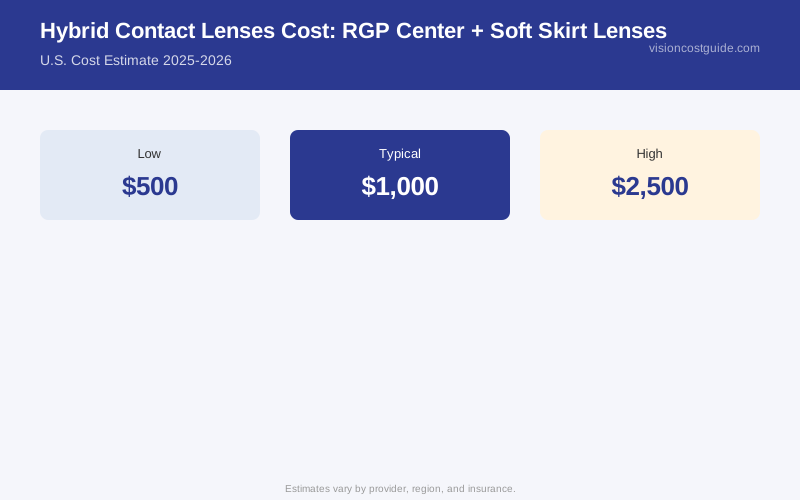
| Hybrid lenses (pair, 1-yr supply) | $350 | $600 | $1,000 |
| Follow-up visits (3–5 visits, year 1) | $200 | $400 | $800 |
| Total year 1 cost | $800 | $1,500 | $2,700 |
| Annual replacement cost (years 2+) | $400 | $700 | $1,200 |
The Main Hybrid Lens Brands
SynergEyes is the dominant US hybrid lens platform, offering several product lines:
- SynergEyes A: Standard design for moderate irregularity; starting around $150–$200 per lens
- SynergEyes KC: Specifically designed for keratoconus with steeper base curves and larger diameter
- Duette/Duette Multifocal: Thinner, more breathable; the multifocal version adds presbyopia correction
- UltraHealth: The flagship design for moderate-to-severe keratoconus; most customizable but also most expensive ($200–$350 per lens)
Art Optical and smaller specialty labs also produce hybrid-style lenses for practices that custom-order fits.
A “pair” of hybrid lenses costs $300–$700 depending on the brand and customization level. They don’t come in boxes of 30 — each lens is custom-fitted and replaced every 6–12 months rather than daily or monthly.
Standard vision plans (VSP, EyeMed, Spectera) generally don’t cover specialty contact lenses like hybrids at the same level as conventional soft lenses. Some plans have a “medically necessary contact lens” benefit that applies when irregular corneal astigmatism can’t be corrected to 20/40 or better with standard lenses — typically requiring a letter of medical necessity and supporting refraction data. UnitedHealthcare and Cigna have specific medical-necessity criteria for keratoconus contact lenses. Check your plan’s COB (certificate of benefits) specifically for the medically necessary contacts clause — this can provide $300–$500 in coverage that many patients leave on the table.
Hybrid vs. RGP vs. Scleral: The Right Tool for the Right Cornea
Here’s the honest comparison for irregular cornea patients:
RGP lenses: Cheapest option ($150–$400/year), best oxygen permeability, but the lens edge rests on the cornea — uncomfortable for many patients, and it can dislodge during sports or lid rubbing. Works well for mild-to-moderate keratoconus with good centration.
Hybrid lenses: Middle ground on cost ($500–$1,000/year), more comfortable than RGP, less comfortable than scleral. Can’t vault as high as a scleral, so they may not work for advanced keratoconus with extreme steepening. Excellent for moderate irregularity.
Scleral lenses: Most expensive ($1,500–$4,000/year all-in) but most comfortable and can accommodate the most severe irregularity. The lens vaults completely over the cornea on a liquid reservoir. For advanced keratoconus, sclerals are often the only option that works.
Many patients with progressing keratoconus start with hybrids in their 20s and transition to sclerals as the disease advances. It’s a reasonable progression path.
Finding a Hybrid Lens Fitter
Not every optometrist fits hybrid lenses. Look for:
- NCLE (National Contact Lens Examiners) certification with specialty lens experience
- Fellows of the American Academy of Optometry (FAAO) with specialty contact lens focus
- Practices that list keratoconus, irregular cornea, or specialty lens services on their website
The fitting process for hybrid lenses is iterative — expect 3–5 office visits during the initial fitting period as the base curve, diameter, and skirt parameters are dialed in. Don’t count on walking out with your final lenses after the first appointment.
Hybrid lenses have a design limitation: the junction between the RGP center and the soft skirt can be a point of stress on the corneal limbus in some patients. Patients with very steep corneas (Kmax > 60D) may experience corneal bearing at the transition zone, which can cause discomfort or superficial staining. For severe keratoconus, a scleral lens is usually the safer, better-fitting option — don’t let anyone talk you into a hybrid lens just because it’s cheaper if your topography suggests you need a scleral.
Annual Replacement and Ongoing Costs
Unlike monthly soft lenses, hybrid lenses aren’t replaced on a calendar schedule — they’re replaced when the lens wears out, typically every 6–12 months. Signs it’s time to replace: reduced vision clarity, increased halos, lens discoloration, or physical damage to the skirt. Budget $350–$700 per replacement pair (both lenses), plus 1–2 annual follow-up visits at $150–$250 each.
The Contact Lens Society of America estimates that patients with specialty lenses spend 3–5x more annually on contact lens care than standard soft lens wearers — a real cost consideration for patients managing on a budget.