42% of people with angle-closure glaucoma — the acute, painful kind that can cause permanent vision loss in hours — had no warning symptoms before their first attack. That statistic from the American Academy of Ophthalmology explains why ophthalmologists recommend laser peripheral iridotomy (LPI) prophylactically for patients with narrow angles, even if they’ve never had an acute episode. If your eye doctor is recommending this procedure, it’s not precautionary overkill. It’s a 20-minute laser treatment that can prevent a genuine ocular emergency.
What the Procedure Does
A YAG laser creates a tiny opening (about 0.2mm) in the peripheral iris — the colored part of your eye. This hole creates an alternate drainage pathway for aqueous fluid, equalizing pressure between the posterior and anterior chambers of the eye. When the angle closes acutely, pressure spikes to 40–70 mmHg (normal is 10–21 mmHg), causing severe pain, nausea, blurred vision, and irreversible nerve damage within hours. The laser hole prevents that crisis from occurring.
The procedure takes about 20 minutes per eye, is done in-office with numbing drops, and requires no incision. Recovery is minimal — some light sensitivity for a few days, and eye drops for a week.
Cost Breakdown
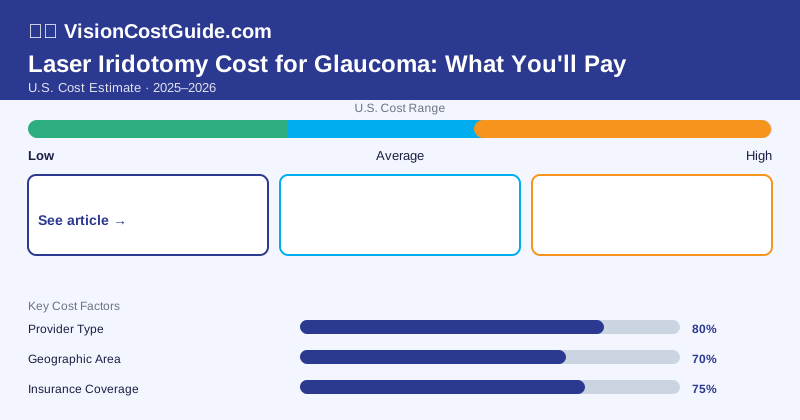
| Cost Scenario | Price Range | Notes |
|---|---|---|
| With commercial insurance (in-network) | $50–$300 per eye | After deductible and co-pay |
| With Medicare Part B | $150–$500 per eye | 20% co-insurance after deductible |
| Without insurance (self-pay) | $500–$2,500 per eye | Academic centers vs. private practice |
| Pre-procedure glaucoma evaluation | $150–$400 | Includes gonioscopy, pachymetry |
| Post-procedure visit | $50–$150 | Usually covered as follow-up |
The facility fee is the biggest cost variable. An in-office YAG laser at a private ophthalmology practice has a much lower facility charge than the same procedure billed through a hospital outpatient department. If you’re self-paying, ask whether the procedure can be performed in the office rather than scheduling it at a hospital facility — the difference can be $500–$1,000.
Insurance Coverage
Laser iridotomy is coded as a therapeutic procedure for narrow-angle glaucoma or acute angle-closure risk (CPT 66761). It qualifies as medically necessary under virtually all commercial insurance plans and Medicare. Coverage process is straightforward — your ophthalmologist documents the narrow angle findings on gonioscopy, and prior authorization is typically either automatic or very quick.
Medicare Part B covers the procedure at 80% after the annual Part B deductible ($257 in 2025). Your 20% co-insurance for a $600–$800 total charge works out to $120–$160 per eye — very manageable. With a Medigap supplement, that co-insurance is generally covered entirely.
Narrow angles are almost always bilateral — meaning both eyes are affected. Your ophthalmologist will typically recommend laser iridotomy in both eyes, sometimes done the same day, sometimes a week apart. Budget accordingly: the self-pay cost doubles, but your insurance out-of-pocket may or may not double depending on whether you’ve already met your annual deductible. Treating the second eye after meeting your deductible for the year is sometimes nearly free under commercial insurance.
When It’s Done Urgently vs. Prophylactically
Acute angle-closure attack (emergency): If you present to the ER or urgent eye care with an acute attack, laser iridotomy is performed emergently to break the attack. In this scenario, the procedure is billed through the ER or emergency ophthalmology setting, which typically costs more ($1,500–$3,000 per eye without insurance). Medical insurance — including emergency benefits — covers it.
Prophylactic/preventive for narrow angles: This is the more common scenario today. You’ve been told during a routine exam that your angles are narrow (detected during slit-lamp examination and confirmed with gonioscopy). You haven’t had an attack. Your ophthalmologist recommends LPI before one occurs. This is still covered by medical insurance as a medically necessary preventive intervention for documented narrow angles — not as cosmetic or elective.
The Glaucoma Research Foundation notes that primary angle-closure glaucoma accounts for about 50% of glaucoma-related blindness worldwide, despite representing roughly 20% of all glaucoma cases. The high visual morbidity-to-prevalence ratio makes prophylactic treatment a well-supported strategy.
What If You Don’t Have Insurance?
Self-pay options for laser iridotomy are reasonable if you shop correctly:
- University ophthalmology departments often have lower self-pay rates: $400–$800/eye all-in
- Some ophthalmology practices offer package pricing for both eyes
- CareCredit and other medical financing can spread the cost over 6–12 months interest-free
- HSA or FSA funds cover the full procedure cost
If you’ve been told you have narrow angles and your ophthalmologist has recommended laser iridotomy, don’t delay because of cost concerns. An acute angle-closure glaucoma attack causes vision loss that cannot be reversed — the optic nerve damage is permanent. The cost of the preventive laser is always less than the long-term cost of managing vision loss from an attack you could have prevented. Request the procedure soon and work out financing if needed.
Bottom Line
Laser iridotomy runs $500–$2,500 per eye out-of-pocket without insurance, and usually $50–$500 per eye with insurance coverage. It’s one of the most cost-effective procedures in all of ophthalmology given what it prevents. If narrow angles have been documented in your chart, this is the right call — both medically and financially.