The $5,000 you’ll spend on a Light Adjustable Lens buys something no other IOL offers: a do-over. After your eye heals, your surgeon uses UV light to reshape the lens already inside your eye, dialing your vision in until it’s right. The FDA approved the RxSight LAL in late 2017, and it’s the only adjustable intraocular lens on the U.S. market.
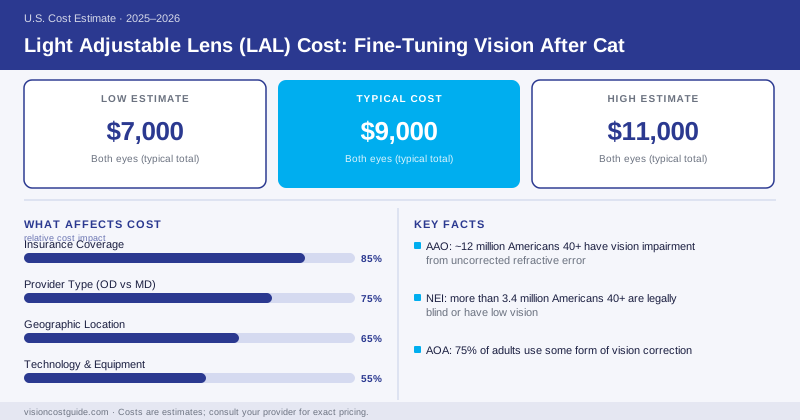
That flexibility costs money. Budget $3,500–$5,500 per eye out of pocket, on top of what Medicare or your insurer pays for the base cataract surgery.
What the Light Adjustable Lens Costs
| Item | Out-of-Pocket Cost Per Eye |
|---|---|
| Standard monofocal IOL (Medicare baseline) | $0 |
| Light Adjustable Lens upgrade | $3,500–$5,500 |
| Included UV light adjustment sessions | Bundled |
| Both eyes (typical total) | $7,000–$11,000 |
The price bundles the lens, the implantation, and the series of post-op light treatments. That’s the part that surprises people — you’re not just paying for a lens, you’re paying for a process that plays out over weeks after surgery.
How the Adjustment Actually Works
Here’s what makes the LAL different. The lens is made of a photosensitive silicone. After your eye heals for two to three weeks, you come back wearing special UV-blocking glasses (you wear these constantly until the process is done). Your surgeon shines a precise UV light pattern onto the lens, which shifts the molecules and changes the prescription.
You test-drive the result, decide if you want more near vision or sharper distance, and come back for another tweak. Once you love it, a final “lock-in” treatment makes the change permanent. Most people need three to four adjustments plus two lock-in sessions.
The LAL’s selling point is precision. RxSight’s data and published studies show LAL patients are roughly twice as likely to hit 20/20 uncorrected distance vision compared to standard monofocal IOLs. If you’ve had previous refractive surgery like LASIK — which makes IOL power calculations notoriously tricky — the adjustability can be a real advantage.
Who Benefits Most
The LAL shines for patients where getting the power exactly right is hard or where the stakes feel high:
- Prior LASIK or PRK patients — corneal reshaping throws off standard IOL calculations, and the LAL lets you correct after the fact
- Perfectionists — if “close enough” won’t satisfy you, the ability to test and adjust is worth the premium
- Patients wanting custom monovision — you can fine-tune one eye for near and one for distance, then try it before committing
It’s less compelling if you just want a basic, reliable distance lens — a standard monofocal does that for free under Medicare.
The Catch: Commitment and the Glasses
The trade-off isn’t medical risk so much as hassle. You have to wear the UV-protective glasses essentially all your waking hours until lock-in — often six to eight weeks. Skip them, even briefly in bright sun, and stray UV light can alter the lens unpredictably.
The LAL is not a multifocal lens. It corrects to a single focal point (or a monovision setup) extremely precisely, but it doesn’t deliver the all-distance vision of a premium multifocal IOL or multifocal lens. If your goal is reading, computer, and distance vision all without glasses, the LAL alone may not get you there. Discuss your actual visual goals with your surgeon first.
Paying for It
Since Medicare won’t touch the upgrade, most patients lean on HSA or FSA dollars, which can cover the full out-of-pocket amount with pre-tax money. Many practices also offer financing through CareCredit with 12 to 24 month interest-free plans, which spreads the upgrade across a year or two of manageable payments.
Is the LAL Worth $5,000 an Eye?
If precision matters to you, or if your eyes are hard to calculate for, the answer leans yes. The AAO notes that refractive accuracy is the single biggest driver of patient satisfaction after cataract surgery — and adjustability directly targets that. For a straightforward eye where a free monofocal would land you at 20/25, the premium is harder to justify. Talk to a surgeon who implants the LAL regularly; volume correlates with better outcomes on this particular lens.
Frequently Asked Questions
Expect $3,500–$5,500 per eye out of pocket above Medicare's standard coverage, which includes the lens plus the UV light adjustment sessions.
Medicare and most insurers cover the base cataract surgery but not the premium-lens upgrade. You pay the LAL difference yourself, usually $3,500–$5,500 per eye.
Most patients need three to four UV light treatments over several weeks, followed by two lock-in sessions. These are bundled into the per-eye price.