What if slowing your child’s nearsightedness cost about the same as a streaming bundle? Low-dose atropine drops run $30 to $80 a month, making them the most affordable myopia-control option on the table. One drop in each eye at bedtime, and that’s the whole routine.
It sounds almost too simple. But the research behind it is substantial, and the price gap between this and overnight lenses is large enough that every parent considering myopia management should understand it.
What These Drops Actually Do
Atropine relaxes the eye’s focusing muscle and appears to slow the elongation that drives myopia. At full strength it’s been used for a century to dilate pupils. The breakthrough was discovering that tiny concentrations, 0.01% to 0.05%, slow nearsightedness with far fewer side effects.
The landmark ATOM2 and LAMP trials, published in Ophthalmology, found 0.05% atropine cut myopia progression by roughly 50% to 67% over two years. The lower 0.01% dose slowed progression by about 30% to 50% with almost no light sensitivity or blur. That’s a meaningful slowdown for a kid whose prescription is climbing every year.
The Real Monthly Cost
| Item | Cost | Frequency |
|---|---|---|
| Compounded atropine (0.01%) | $30–$50 | Per month |
| Compounded atropine (0.05%) | $50–$80 | Per month |
| Baseline myopia exam | $80–$200 | Once at start |
| Follow-up monitoring visits | $80–$150 | Every 4–6 months |
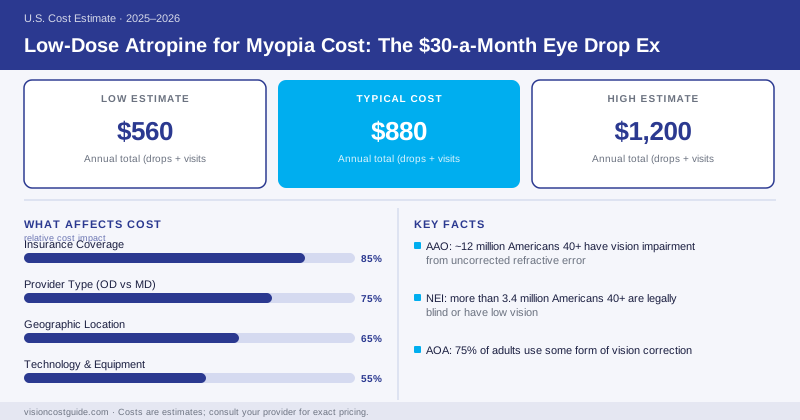
| Annual total (drops + visits) | $560–$1,200 | Per year |
Because the FDA hasn’t approved atropine specifically for myopia, it’s compounded by specialty pharmacies and prescribed off-label. That’s why insurance rarely touches it. The upside: even paying full freight, it’s cheaper than orthokeratology or soft myopia-control contacts in most years.
At $30–$80 a month, low-dose atropine is the budget-friendly entry point to myopia control. Annual cost lands around $560–$1,200 with monitoring. Compare that to $1,200–$2,500 for first-year ortho-K and the savings are obvious.
Why Insurance Won’t Pay (Yet)
Here’s the frustrating part. Atropine works, the data is solid, but no manufacturer has secured FDA approval for the myopia indication in the U.S. as of 2026. Without that approval, vision and medical plans classify it as experimental or off-label and decline coverage.
The workaround most families use is paying with an FSA or HSA, since the prescription qualifies as a medical expense. Save your pharmacy receipts and the prescription documentation for reimbursement.
Side Effects to Watch
The whole point of the low dose is minimizing side effects, and it mostly works.
- 0.01%: rare light sensitivity, minimal near-vision blur, well tolerated
- 0.05%: slightly more light sensitivity, occasional need for a sun hat or photochromic lenses
- Higher concentrations: noticeable blur and glare, which is why low doses won the day
Atropine slows progression but doesn’t correct existing nearsightedness. Your child still needs glasses or contacts to see clearly. And if you stop the drops, some children experience a rebound where progression speeds back up, so plan for a gradual taper with your optometrist rather than quitting cold.
How It Stacks Up
The honest comparison: atropine is the easiest and cheapest option, but it doesn’t give glasses-free vision the way ortho-K does. Many optometrists now combine atropine with myopia-control glasses or contacts for an additive effect.
- Lowest cost and effort: atropine drops alone
- Glasses-free days plus control: ortho-K, at roughly double the cost
- Easy handling plus control: soft daily myopia contacts
A thorough pediatric eye exam sets the baseline and tracks whether the drops are working. Your doctor measures axial length and refraction every few months to confirm the slowing effect.
Bottom Line for Parents
If cost is your main worry and your child already wears glasses comfortably, low-dose atropine is the logical first move. You’re looking at roughly $40 a month for drops plus a few monitoring visits a year, far less than the alternatives.
Ask your optometrist which concentration fits your child’s progression rate. Faster progressors often start at 0.05%; milder cases do well on 0.01%. Either way, you’re buying a 30% to 67% slowdown for a fraction of what other myopia control methods cost.
Frequently Asked Questions
Compounded 0.01% to 0.05% atropine runs $30 to $80 a month, depending on concentration and pharmacy. That works out to roughly $360 to $960 a year, plus the cost of follow-up exams.
Most plans don't, because the FDA hasn't approved atropine specifically for myopia control yet. It's prescribed off-label, so you'll usually pay out of pocket, though FSA and HSA funds qualify.
Major trials show 0.05% atropine slows myopia progression by about 50% to 67% over two years. The 0.01% strength is gentler but slightly less effective, slowing progression by roughly 30% to 50%.