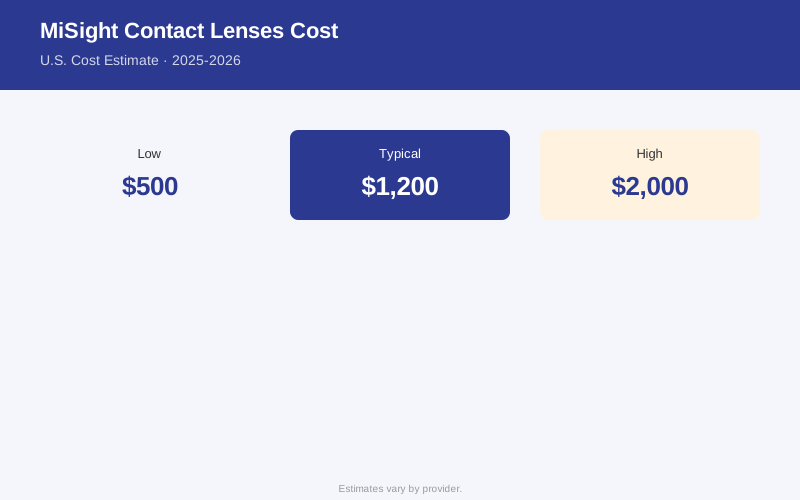
In 2019, the FDA approved the first contact lens specifically indicated to slow myopia progression in children: CooperVision’s MiSight 1 day. That approval was a turning point. Before it, parents were told myopia just gets worse — there was nothing to do but update the glasses prescription annually. Now there’s a proven intervention, and parents are asking: what does it actually cost?
What Are MiSight Lenses?
MiSight 1 day are daily disposable soft contact lenses designed for children ages 8–12 at the time of fitting (though used by older myopes too). They use a patented ActivControl technology with alternating correction and treatment zones. The correction zones sharply focus central vision. The treatment zones create simultaneous myopic defocus in the peripheral retina — a signal that’s believed to slow axial elongation of the eye (the mechanism behind myopia progression).
In CooperVision’s pivotal 3-year clinical trial, MiSight slowed myopia progression by an average of 59% compared to standard single-vision contact lenses, and reduced axial elongation by 52%. That’s the strongest FDA-cleared evidence in the soft contact lens category for myopia control.
The National Eye Institute projects that by 2050, myopia could affect 50% of the global population. In children, aggressive progression during school years drives risk of high myopia, which significantly elevates lifetime risk of retinal detachment, glaucoma, and myopic macular degeneration.
MiSight Cost Breakdown
| Cost Component | Typical Annual Cost |
|---|---|
| MiSight lens supply (90-count boxes × 4 per year) | $500–$800 |
| Initial myopia control consultation / specialty fitting | $150–$300 (one-time) |
| Annual myopia control follow-up exams (2–3 per year) | $200–$450 |
| Total Year 1 (with initial fitting) | $850–$1,550 |
| Total Year 2+ (ongoing) | $700–$1,250 |
Why MiSight Costs More Than Regular Contacts
Standard daily disposable lenses in a comparable power run $200–$400 per year in the same lens count. MiSight’s premium reflects:
- Specialty lens design: The alternating zone technology is proprietary and costs more to manufacture
- CooperVision’s market position: As the only FDA-cleared option in its category, MiSight commands a premium
- Specialty fitting: Myopia control fitting involves axial length measurement (typically requiring an IOLMaster or similar biometer), a detailed consultation with a myopia management protocol, and more frequent follow-up visits than standard contact fittings
Some practices bundle the lenses, fitting, and follow-up visits into a single annual or monthly fee. “Myopia management programs” run $100–$175/month at practices that offer bundled pricing. That often includes unlimited follow-up visits, corneal topography, and axial length tracking — which is good value if your child needs more monitoring.
Comparing MiSight to Other Myopia Control Options
MiSight 1 day contacts: $700–$1,250/year. Daily disposables, FDA-cleared, worn 10–14 hours/day. Best evidence in soft lens category.
Orthokeratology (ortho-k): $1,200–$2,200 first year (lenses + fitting + exams). Worn overnight, removed during day. Eliminates need for daytime correction. Good myopia control evidence.
Low-dose atropine drops (0.01–0.05%): $120–$600/year. Nightly eye drops. Compounded at specialty pharmacies; not FDA-approved for myopia but widely used off-label. Evidence is strong but concentration-dependent.
DIMS spectacle lenses (e.g., Stellest, MyoCare): $400–$900/year. Glasses-based solution — easiest compliance for young children. Available in the U.S. as of 2023–2024.
Standard single-vision glasses or contacts: $200–$400/year, but offer no myopia control benefit.
The right choice depends on the child’s age, current prescription progression rate, ability to handle contacts, and family preference. MiSight is often the first contact lens option tried for kids who are motivated to wear lenses and don’t want glasses.
Insurance Coverage for MiSight
This is where families get frustrated. Vision insurance plans — VSP, EyeMed, Spectera, Davis Vision — typically do NOT cover myopia control contact lenses as a medical treatment. They cover a standard contact lens supply and fitting, but won’t pay the premium for myopia control lenses specifically.
Medical insurance covers myopia control even less commonly. Myopia management is increasingly recognized as a pediatric health issue, but coding and coverage for it remain inconsistent.
What insurance typically covers:
- The annual comprehensive eye exam (vision benefit)
- A standard contact lens fitting allowance ($0–$150 depending on plan)
- A lens supply allowance ($130–$200 per year at most VSP plans)
What you’ll pay out of pocket:
- The difference between your lens allowance and MiSight’s cost — often $300–$600/year
- The specialty myopia consultation fee
- Axial length measurement costs (usually $50–$150 per visit)
HSA and FSA: MiSight lens costs qualify as an FSA/HSA medical expense. Use your FSA/HSA to pay for lenses and eye exams — it saves you the taxes (20–30% effective savings if you’re in a middle income bracket).
Finding Lower-Cost MiSight Options
Shop lens suppliers online. MiSight lenses are prescription contact lenses, so you need a valid prescription from your OD. But you can fill that prescription at 1-800 Contacts, ContactsDirect, or Lens.com rather than buying from your OD’s office. Typical savings: $50–$150/year.
Ask about CooperVision rebates. CooperVision runs annual rebate programs — often $50–$100 back per 8-box purchase. Ask your OD or check CooperVision’s website.
Combine with atropine. Some myopia specialists use low-dose atropine (compounded 0.01–0.025%) alongside MiSight in children with aggressive progression. Atropine is inexpensive ($120–$250/year) and adds an extra layer of control. That combination may slow the rate of prescription change enough to reduce how often new lenses are needed.
Compare program pricing. Practices that offer bundled myopia management programs sometimes cost less than paying for each component separately — especially if your child needs frequent follow-ups.
Is MiSight Worth the Cost?
That depends on your child’s situation. For a 9-year-old at −1.50 who’s progressing at −0.75 per year — yes, strongly. Each diopter of reduction in final myopia meaningfully reduces lifetime risk of retinal complications. The cost over 5 years of treatment ($3,500–$6,000 total) may prevent treatments costing tens of thousands later, and more importantly, may preserve retinal health.
For a 14-year-old at −2.00 whose progression has slowed to −0.25 per year — the benefit is real but smaller. At that point, the conversation is about weighing incremental benefit against cost.
Your OD should show you axial length data, not just prescription change, to track whether myopia control is working. If progression continues despite treatment, changing to a more aggressive option (like ortho-k or combined therapy) is appropriate.
Bottom Line
MiSight 1 day contact lenses cost $700–$1,250 per year ongoing, plus a one-time specialty fitting fee of $150–$300. Vision insurance partially offsets costs through standard lens allowances but rarely covers the full premium. Use FSA/HSA funds to get the tax advantage. For children with moderate-to-high myopia progression rates, MiSight represents the best-evidenced daily soft lens option currently FDA-approved in the U.S. — the cost is real, but so is the long-term benefit to your child’s vision.