What does it cost to ditch your reading glasses? That’s essentially the question behind monovision — a clever optical workaround where one eye is corrected for distance and the other for near. Most people adapt within weeks and love it. A minority can’t tolerate it. Either way, the price depends entirely on which version you choose.
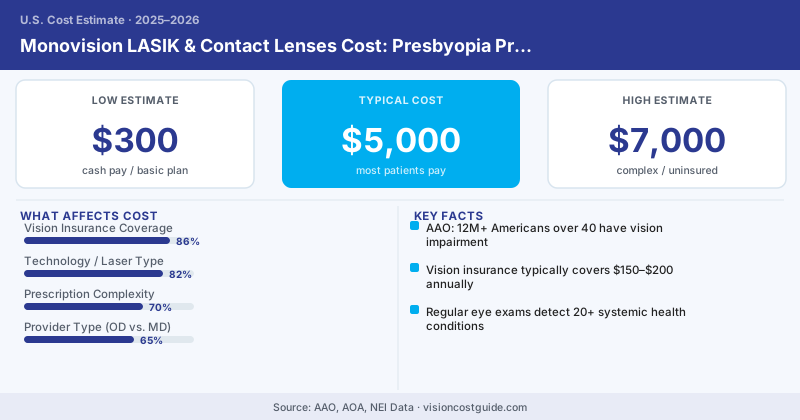
Monovision with contact lenses: $300–$800 per year. Monovision LASIK: $3,500–$7,000 once, no annual refills. Here’s how to think through both.
The Presbyopia Problem — And Why It’s Growing
Presbyopia is the gradual loss of near-focusing ability that hits virtually every adult by their mid-40s. The AAO estimates that by 2050, more than 1.8 billion people worldwide will be affected. In the US alone, that translates to roughly 128 million adults needing reading correction today.
Traditional solutions — reading glasses, progressive lenses — work fine but frustrate active adults who don’t want to constantly manage glasses. Monovision sidesteps that by using your two eyes differently: one sees clearly far away, one sees clearly up close. Your brain blends the images. With good candidate selection, the AOA reports that 70–80% of monovision users adapt well enough for daily activities.
Monovision Contact Lenses: Costs
| Contact Type | Annual Cost (Both Eyes) |
|---|---|
| Daily disposable monovision lenses | $400–$900 |
| Monthly disposable monovision lenses | $180–$400 (lenses) + $100–$200 solution |
| Toric monovision lenses (with astigmatism) | $500–$1,200 |
| Monovision contact lens fitting exam | $80–$200 (one-time) |
| Annual contact lens exam | $100–$200 |
The fitting exam for monovision is slightly more involved than a standard contact lens fitting because your eye doctor needs to determine which eye should be the dominant (distance) eye and which the non-dominant (near) eye. Getting that wrong makes monovision intolerable — so don’t skip the proper fitting.
Expect to try 2–4 pairs of trial lenses over 2–3 visits before the prescription is finalized. Most eye doctors include trial lens costs in the fitting fee, but confirm this upfront.
Monovision LASIK: Costs
Monovision LASIK corrects one eye for distance and intentionally leaves the other slightly nearsighted for near vision — permanently, with a laser. No lenses needed.
| Procedure | Estimated Cost |
|---|---|
| Monovision LASIK (both eyes treated) | $3,500–$7,000 total |
| Standard LASIK candidacy exam | $100–$250 (often credited toward surgery) |
| Monovision trial with contact lenses (required pre-LASIK) | $80–$200 |
| Enhancement procedure (if needed, within warranty) | Often included or $500–$1,500 |
| PRK monovision (surface ablation alternative) | $3,000–$6,500 |
One important rule most LASIK surgeons enforce: you must successfully wear monovision contact lenses for at least 1–2 weeks before getting monovision LASIK. This proves you can neurologically adapt. If you hate the contacts, you’ll hate the surgery — and LASIK is much harder to undo.
Multifocal or extended-depth-of-focus (EDOF) laser treatments promise clear vision at multiple distances without the “one eye near, one eye far” compromise of monovision. But they cost more — typically $500–$1,000 per eye more than standard LASIK — and can cause halo, glare, and contrast sensitivity issues at night. For most people in their 40s and early 50s, monovision LASIK at a lower price point and better night vision is the smarter financial and visual choice. Discuss both with your surgeon.
Breaking Even: Contacts vs. LASIK
If monovision contacts cost you $600/year in total, and monovision LASIK costs $5,000:
- Break-even point: 8.3 years
- If you’re 47 and will need reading correction for 35+ more years, LASIK saves money long-term
- If you’re 58 and may need cataract surgery with a premium IOL within 10–15 years, the calculus is different (cataract surgery replaces the lens and may re-address presbyopia, potentially rendering LASIK redundant)
Your ophthalmologist can factor your age, prescription trajectory, and expected timeline to cataract surgery into the recommendation. This is a legitimate clinical calculation, not just a preference.
Insurance Coverage
Neither monovision contact lenses nor monovision LASIK are covered by medical insurance (both are elective). However:
- Vision insurance (VSP, EyeMed, Humana Vision, etc.) typically covers the contact lens exam and provides an annual contact lens allowance of $100–$200
- FSA/HSA funds can pay for both contacts and LASIK — monovision LASIK qualifies as a vision correction procedure
- Employer LASIK discounts through VSP/EyeMed networks often reduce monovision LASIK by $200–$600 per eye
Don’t assume your vision plan’s LASIK discount applies to monovision specifically — verify with the provider, since some networks only discount standard bilateral correction.
If you have more than 1.0 diopters of astigmatism in either eye, standard monovision may not give sharp enough near or distance vision. Wavefront-guided monovision or toric monovision contact lenses may be needed — both cost more. Always discuss astigmatism correction options at your candidacy evaluation. Overlooking astigmatism is the most common reason monovision patients end up dissatisfied.
The Bottom Line
Monovision contacts at $500–$700/year work well for people who want flexibility and the ability to reverse course. Monovision LASIK at $4,000–$6,000 makes sense if you’re in your 40s or 50s, can’t stand wearing any lenses, and have confirmed you adapt well to the monovision effect. The trial period with contacts isn’t just recommended — it’s the single best predictor of whether you’ll be happy with the surgical result.