42% of Americans are myopic — and that figure has nearly doubled since the 1970s, according to data from the National Eye Institute. More troubling: children are progressing faster and to higher prescriptions than previous generations, and high myopia (above -6.00D) significantly increases lifetime risk of retinal detachment, glaucoma, and macular degeneration. Myopia control isn’t about vanity. It’s about keeping your child’s lifetime prescription manageable.
Three options dominate the US market. Here’s an honest cost comparison of all three.
Side-by-Side Cost Summary
| Option | Year 1 Cost | Annual Ongoing Cost | Insurance Coverage |
|---|---|---|---|
| Orthokeratology (Ortho-K) | $1,500–$2,500 | $400–$800 (lens replacements + visits) | Rarely covered |
| MiSight 1-day contact lenses | $600–$1,200 | $600–$1,200 | Rarely covered |
| Low-dose atropine (0.025%–0.05%) | $200–$600 | $200–$600 | Rarely covered |
| Stellest glasses (Hoya) | $400–$800 | $400–$800 (new frames as child grows) | Sometimes covered (frames portion) |
| MyoVision / Defocus glasses | $200–$600 | $200–$600 | Sometimes covered |
None of these treatments are covered by standard vision insurance as myopia control interventions — they’re considered elective management, not medical necessity. Some plans cover the hardware (contact lenses, glasses frames) but not the myopia-control premium. HSA and FSA funds can be used for all three options since they qualify as vision care expenses.
Orthokeratology (Ortho-K): The Overnight Lens
Ortho-K uses gas-permeable lenses worn during sleep to temporarily reshape the cornea. Children remove them in the morning and see clearly throughout the day without glasses or daytime contacts. It’s particularly attractive for kids in sports or activities where contacts or glasses are inconvenient.
How it works: Lenses apply gentle, controlled pressure to flatten the central cornea and steepen the periphery. The peripheral myopic defocus signal is what drives the myopia-control effect — the same optical principle MiSight uses but achieved mechanically overnight rather than optically during the day.
Efficacy: A 2021 meta-analysis published in Ophthalmology found Ortho-K slows axial length elongation (the true measure of myopia progression) by approximately 45–51% compared to single-vision correction in children.
Costs in detail:
- Initial fitting and lens set: $1,200–$2,000
- Annual follow-up visits (typically 3–4/year): $200–$500
- Lens replacement (lenses typically last 1–2 years): $300–$600/pair
- Cleaning solutions: $80–$120/year
Year-one cost is highest because of the fitting fee and first lens set. Ongoing costs drop significantly once the prescription stabilizes.
Best candidates for Ortho-K:
- Ages 8–16 (prescription still actively changing)
- Myopia of -1.00D to -6.00D (outside this range, fit is more complex)
- Responsible about lens hygiene — ortho-k has a higher infection risk than daily disposables
- Active in sports or activities where daytime glasses/contacts are problematic
- Parents willing to supervise the nightly lens care routine
Not ideal for children with severe dry eye, irregular corneas, or hygiene compliance concerns.
MiSight 1-Day Contacts: The Proven Daily Disposable
MiSight (CooperVision) is the only FDA-approved soft contact lens specifically indicated for myopia control in children ages 8–15. It uses a dual-focus optical design — central correction for clear vision, peripheral defocus rings to slow axial elongation.
Efficacy: The MiSight clinical trial, which ran 6 years (the longest myopia control contact lens trial to date), showed 59% slower myopia progression compared to single-vision daily disposable contacts. That’s strong data by the standards of this field.
Costs in detail:
- Annual supply: $600–$1,200 depending on retailer and prescription
- Fitting and follow-up visits: $150–$300/year
- No lens maintenance costs (daily disposable — discard each evening)
MiSight tends to cost more per year than Ortho-K in the long run because replacement lenses are consumed daily. But the daily disposable format eliminates infection risk from overnight wear and is often easier for younger children to manage.
Low-Dose Atropine: The Drop Option
Atropine eye drops — at concentrations of 0.01%, 0.025%, or 0.05% — are the most studied pharmacological myopia control intervention globally. They’ve been standard of care in Singapore and parts of Asia for years. In the US, no atropine formulation is FDA-approved specifically for myopia control (it’s prescribed off-label), but many pediatric ophthalmologists and optometrists offer it.
Efficacy: The LAMP study (2019, published in Ophthalmology) found 0.05% atropine reduced myopia progression by 67% and axial elongation by 51% compared to placebo at 2 years — the strongest effect among commonly prescribed concentrations. Lower doses (0.01%) have less efficacy but also less rebound when stopped and fewer side effects.
Costs in detail:
- Compounded atropine drops: $50–$150/bottle (typically lasts 3–6 months at once-nightly dosing)
- Annual drop cost: $200–$600
- Annual monitoring visits (typically 2–3/year): $150–$350
Atropine must be compounded (mixed at a specialty pharmacy) since commercial formulations aren’t standardized for myopia control doses. Quality and stability vary between compounding pharmacies — your prescriber’s recommended pharmacy matters.
Rebound is a real consideration with atropine. When children stop the drops (typically after age 14–16 when progression slows), myopia can accelerate temporarily. The higher the atropine concentration, the greater the potential rebound. Most practitioners use a gradual taper or switch to a lower concentration before stopping. Don’t stop abruptly — discuss a tapering plan with your eye doctor.
Which Option Is Actually Best?
There’s no universal answer — the “best” option depends on your child’s age, prescription, activity level, and your family’s tolerance for complexity. That said, a few practical guidelines apply:
Combine options for the fastest progressors. Children progressing more than -1.00D per year or with early onset myopia (before age 8) are the highest-risk group. Some practitioners combine low-dose atropine with Ortho-K or MiSight for additive effect — combinations appear more effective than either alone in emerging studies.
MiSight is the lowest-friction option for children new to contact lenses and parents who want FDA-approval backing their choice.
Ortho-K suits active kids and families willing to invest more upfront for the convenience of glasses-free daytime vision.
Atropine is the easiest to start and stop, works without contact lenses (appealing for younger children not ready for contacts), and costs the least — but requires a compliant pharmacy and consistent nightly drop use.
Five-Year Cost Comparison
At 5 years of treatment (roughly ages 9–14, a typical high-progression window):
- Ortho-K: $1,800–$2,500 (yr1) + $600–$800/yr x 4 = ~$4,200–$5,700
- MiSight: $800–$1,200/yr x 5 = ~$4,000–$6,000
- Atropine: $350–$900/yr x 5 = ~$1,750–$4,500
Atropine wins on cost. MiSight and Ortho-K are comparable over 5 years. The decision ultimately comes down to lifestyle fit and your child’s compliance profile more than cost alone.
Bottom Line
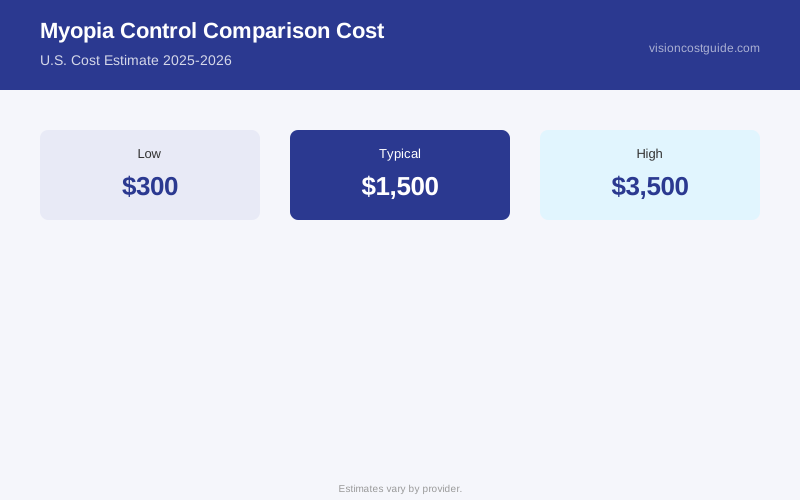
Myopia control costs $200–$2,500 per year depending on the method. Atropine drops are the most affordable; Ortho-K has the highest upfront cost but delivers daytime glasses freedom; MiSight offers the strongest clinical trial evidence with the most convenient format. None are covered by standard vision insurance. The NEI and AAO both recognize all three as evidence-based approaches — discuss your child’s specific progression rate and lifestyle with a myopia management specialist to choose the right fit.