Every day, your eyes produce tears that drain through a tiny canal into your nose — that’s why crying makes your nose run. When that canal gets blocked, tears spill over your eyelid (epiphora), pool on your cheek, and invite chronic infection. According to the American Academy of Ophthalmology, nasolacrimal duct obstruction (NLDO) is one of the most common lacrimal system disorders affecting adults, and it’s the leading cause of watery eyes in both infants and older adults.
Treatment ranges from simple probing in a pediatric office visit to a full surgical reconstruction called dacryocystorhinostomy (DCR). The cost difference between those two endpoints is enormous — and knowing which one you actually need is where informed patients save thousands.
Why the Tear Duct Gets Blocked
The nasolacrimal duct runs from the medial corner of the eye (the inner canthus) through the lacrimal sac and down into the nasal cavity beneath the inferior turbinate. It’s narrow, it runs through bone, and it’s vulnerable to:
- Congenital membrane: In infants, a thin membrane at the duct’s lower end (Hasner’s valve) fails to open. About 6% of all newborns have a blocked tear duct at birth, per NIH data — the vast majority open spontaneously by 12 months.
- Acquired stenosis in adults: Chronic inflammation, nasal polyps, sinus disease, prior trauma, or dacryocystitis (lacrimal sac infection) can scar the duct shut.
- Age-related changes: Post-menopausal women are disproportionately affected — hormonal changes thin the mucosal lining of the duct.
Cost Overview by Treatment Level
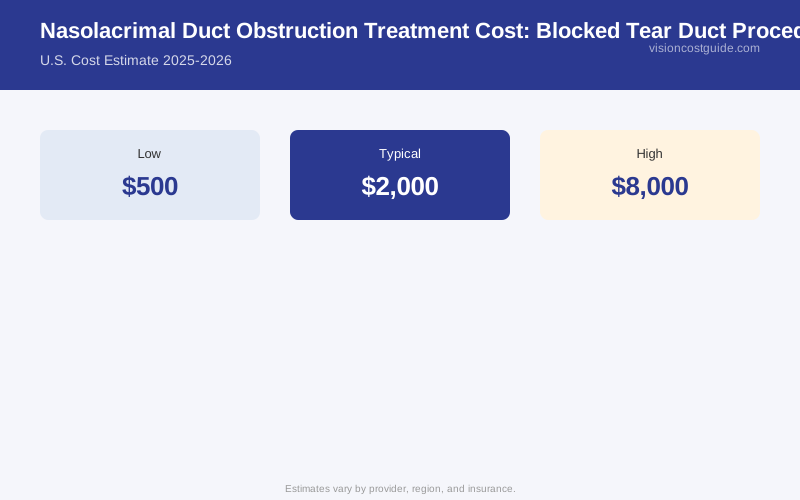
| Treatment | Low | Typical | High |
|---|---|---|---|
| Nasolacrimal massage (home self-care, infant) | $0 | $0 | $50 (OT instruction) |
| In-office probing (infant, under 1 yr) | $300 | $600 | $1,200 |
| Probing under general anesthesia (infant/toddler) | $1,500 | $2,800 | $4,500 |
| Balloon catheter dilation (adult) | $2,000 | $3,500 | $5,500 |
| External DCR surgery (adult) | $3,500 | $5,500 | $8,000 |
| Endoscopic (endonasal) DCR | $3,000 | $5,000 | $7,500 |
| Conjunctivodacryocystorhinostomy (CDCR) | $5,000 | $7,500 | $12,000 |
Infant Blocked Tear Duct: The Lowest-Cost Path
If your infant has a watery eye from birth, don’t assume surgery. The first-line treatment is Crigler massage — gentle downward pressure on the lacrimal sac to build hydrostatic pressure that ruptures the membranous obstruction naturally. A 2020 study published in the Journal of AAPOS found that massage plus topical antibiotic drops resolved obstruction in 64% of infants before 12 months, with no procedure needed.
When massage fails, office probing is the next step. For infants under 12–18 months, probing can often be performed in-office with topical anesthesia, costing $300–$1,200 — typically a covered medical procedure under health insurance, not vision insurance.
After 18 months, probing usually requires general anesthesia (in an ASC or hospital), which adds $1,500–$3,000 in facility and anesthesia fees on top of the surgeon’s fee. Success rates for probing decline with age: roughly 90% success under 12 months, dropping to 70–80% at 18–24 months.
Adult NLDO: When You Need More Than Probing
Adult acquired NLDO rarely responds to simple probing. The stenosis involves scarred tissue — not a thin membrane — and probing typically fails. Adults generally need one of the following:
Balloon catheter dilation (Lacriflow or similar): A thin catheter is threaded through the duct and a small balloon inflated to dilate the stenotic segment. This is less invasive than DCR, performed under local or light sedation, and costs $2,000–$5,500. Success rates vary: studies report 60–80% patency at 1 year for partial obstructions, lower for complete obstructions.
External DCR (dacryocystorhinostomy): The gold standard for complete adult NLDO. A small incision near the inner canthus allows the surgeon to create a new bony opening directly from the lacrimal sac into the nasal cavity, bypassing the obstructed duct entirely. A silicone tube (Crawford tube) is placed for 6–12 weeks to stent the new opening. Success rates exceed 90% for primary external DCR. Cost: $3,500–$8,000 all-in.
Endoscopic (endonasal) DCR: Same result as external DCR, but performed through the nose with no external incision. Increasingly preferred by oculoplastic surgeons who are trained in nasal endoscopy. Slightly lower success rates (85–92%) compared to external DCR in most studies, but no visible scar.
NLDO treatment is a medical condition, not a routine vision benefit. Claims should be filed under medical insurance (health insurance), not VSP or EyeMed vision plans. Use ICD-10 code H04.5x for acquired NLDO, or Q10.5 for congenital. Prior authorization is required for DCR at most major insurers; your surgeon’s office should handle this with documentation of failed conservative treatment. Medicare covers DCR under facility and physician fee schedules when medically necessary — typically Part B for the surgeon, Part A or Part B for the facility depending on setting.
What the Out-of-Pocket Costs Look Like
If you have commercial insurance with a $2,000 deductible and 20% coinsurance:
- Infant office probing at $600: you pay $600 (applies to deductible)
- Adult DCR billed at $6,000: you pay $2,000 deductible + 20% of remaining $4,000 = $2,800 total exposure
- Without insurance: $3,500–$8,000 out of pocket depending on provider and region
Surgery centers and academic medical centers generally charge 30–50% less than hospital outpatient departments for DCR — always ask for the ASC option if your surgeon has privileges at one.
Choosing the Right Surgeon
NLDO procedures should be performed by an oculoplastic surgeon (ophthalmologist subspecialty-trained in the eyelids, orbit, and lacrimal system) or an otolaryngologist (ENT) with lacrimal subspecialty experience. Look for:
- ASOPRS (American Society of Ophthalmic Plastic and Reconstructive Surgery) fellowship training
- Volume: at least 50 DCR procedures per year
- Access to both external and endoscopic approaches — so they can choose based on your anatomy
Beware of practices that perform DCR primarily to address tearing without a confirmed anatomic diagnosis. A Jones dye test and nasolacrimal irrigation (probing with saline flush) should confirm complete vs. partial obstruction before scheduling DCR. Some cases of overflow tearing are caused by punctal stenosis or lid laxity — problems that are far simpler and cheaper to correct. Get a confirmed diagnosis before committing to a major procedure.
Recovery and Follow-Up Costs
After DCR, expect 1–2 weeks of mild bruising and swelling around the nasal bridge. The silicone Crawford tube is removed in office at 6–12 weeks (a simple, covered follow-up visit). Patients may need nasal saline irrigation for 4–6 weeks. Follow-up appointments typically run 2–4 visits over the first year: budget $150–$300 per visit if not fully covered.
Successful DCR is durable — most patients have a functioning new drainage pathway for life. Failure rates are approximately 8–10% for primary external DCR; revision DCR or CDCR (which uses a glass Jones tube bypass) is an option, though more expensive ($5,000–$12,000).