When David, 44, noticed halos around streetlights and started avoiding highway driving after dark, he assumed he just needed a stronger prescription. His optometrist disagreed — and ordered an electroretinogram. That test, not a simple refraction, revealed early retinitis pigmentosa. The cost of that workup: $340 out of pocket after insurance. It was the most important $340 he’d ever spent.
Night blindness — the medical term is nyctalopia — isn’t a diagnosis in itself. It’s a symptom. And what’s causing it determines everything about your treatment costs, from $0 (vitamin A supplements) to well over $10,000 for retinal disease management.
What Causes Night Blindness?
Before you can price the treatment, you need the diagnosis. Night blindness has several distinct causes:
- Uncorrected refractive error: The most common and cheapest fix — glasses or contacts improve low-light contrast sensitivity.
- Vitamin A deficiency: Rare in the U.S. but possible in people with certain GI conditions, strict vegan diets, or bariatric surgery history. Inexpensive blood test plus supplements can resolve it.
- Cataracts: The lens scatters light, worsening contrast at night. Surgery ($3,500–$7,000/eye) corrects it.
- Glaucoma: Peripheral vision loss affects night navigation before central vision.
- Retinitis pigmentosa (RP): A hereditary retinal degeneration affecting rod photoreceptors first. Night blindness is often the earliest symptom.
- Myopia (nearsightedness): High myopia patients frequently report night vision complaints.
The Diagnosis Workup and Its Costs
| Test | Typical Cost | What It Finds |
|---|---|---|
| Comprehensive eye exam | $100–$250 | Refraction, IOP, lens clarity |
| Dilated fundus exam | Included or +$30–$60 | Retinal condition, disc health |
| Electroretinogram (ERG) | $200–$600 | Rod/cone function (RP, congenital) |
| Visual field test | $50–$150 | Glaucoma, peripheral loss |
| Vitamin A blood panel | $30–$100 | Deficiency identification |
| OCT retinal imaging | $75–$200 | Retinal layer detail |
| Genetic testing for RP | $250–$2,000 | Mutation identification |
A routine optometrist visit with a dilated exam catches the most common causes — bad prescription, early cataracts, obvious retinal changes. If something looks abnormal, you’ll be referred to an ophthalmologist or retinal specialist, which is where the costs climb.
The electroretinogram (ERG) is the key test for retinal causes. It measures the electrical response of rods and cones to light stimuli. For anyone with unexplained night blindness plus a family history of vision problems, this test is essential — and it’s often performed in a hospital outpatient setting with separate facility fees.
What You’ll Actually Pay
According to the National Eye Institute (NEI), retinitis pigmentosa affects approximately 1 in 4,000 people in the United States — meaning roughly 100,000 Americans live with RP. But the vast majority of night blindness cases have simpler, cheaper explanations.
If your night blindness is from uncorrected myopia, expect to pay $100–$250 for the exam and $150–$400 for glasses. Total: under $650.
If vitamin A deficiency is the cause, a $30–$100 blood test confirms it, and supplements cost $10–$20/month. For most people, improvement is noticeable within weeks.
If cataracts are causing night glare and contrast loss, you’re looking at $3,500–$7,000 per eye — but Medicare covers cataract surgery when it meets medical necessity thresholds.
Retinitis pigmentosa management is ongoing. There’s no cure for most forms, though Luxturna gene therapy (for RPE65 mutation-associated RP) was approved by the FDA in 2017 — at a list price of $425,000 for both eyes. Insurance coverage varies significantly.
Standard vision insurance (VSP, EyeMed, etc.) typically covers a comprehensive exam and refraction. It does NOT cover diagnostic testing like ERG, genetic panels, or OCT for retinal disease — those are billed to your medical insurance. Make sure you’re presenting under the right insurance for each service. An ophthalmologist visit for a medical eye condition (retinal disease, glaucoma) should go through medical insurance, not vision insurance.
Treatment Costs by Cause
Myopia correction: Glasses $150–$400, contacts $200–$600/year, LASIK $2,000–$3,000/eye (permanent).
Vitamin A deficiency: Supplements $10–$20/month. If due to malabsorption, working with a gastroenterologist adds costs.
Cataracts: $3,500–$7,000/eye with standard IOL, more with premium lenses. Medicare Part B covers 80% after deductible for medically necessary surgery.
Glaucoma: Eye drops $20–$200/month, laser procedures $400–$1,500, surgery $5,000–$15,000 if advanced.
Retinitis pigmentosa: No standard cure. Vision aids, orientation/mobility training ($100–$300/session), and low-vision devices ($200–$5,000) are the current tools. Luxturna eligibility requires specific gene mutation testing.
Practical Steps if Night Vision Is Getting Worse
The American Academy of Ophthalmology (AAO) recommends adults over 40 get a comprehensive dilated eye exam every 1–2 years, and immediately for sudden vision changes. Night vision that worsens progressively — not just “hard to see in the rain” but actually getting worse month to month — warrants an urgent appointment, not a wait-and-see approach.
Bring your full medication list. Several common medications affect night vision: antihistamines (dry eyes), some blood pressure drugs, and high-dose vitamin E supplements can all interfere with rod function. Your doctor needs this context.
If night blindness onset is sudden — meaning it developed over days or weeks rather than years — see an ophthalmologist promptly. Sudden onset can indicate acute vitamin A deficiency (rare), a retinal detachment developing in the periphery, or medication toxicity. Don’t wait for an annual exam for new sudden symptoms.
The Bottom Line on Cost
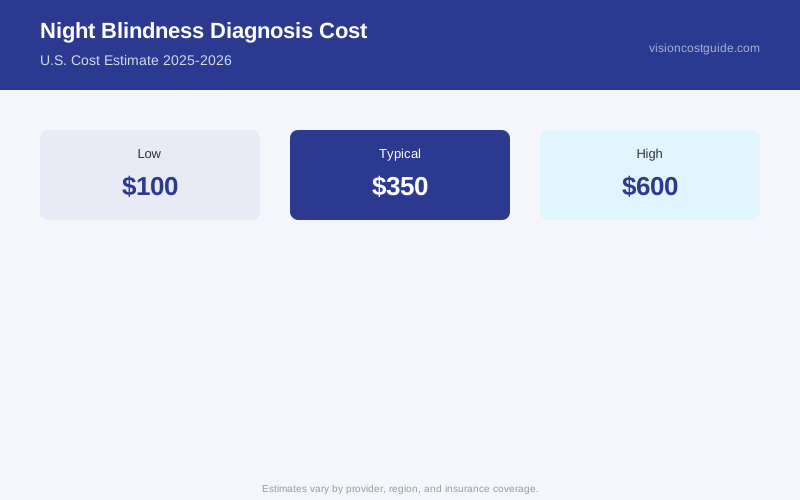
Night blindness diagnosis costs $100–$600 for most people, depending on how much testing is needed. Don’t skip the full dilated exam to save $30 — the dilated fundus view is what catches retinal disease early. If you’re referred for an ERG, go. It’s the only objective test that tells your doctor how your rods are actually functioning.
The difference between catching early RP at 44 versus discovering it at 58 when you’ve lost significant peripheral vision isn’t just about money. It’s about planning, adaptation, and quality of life. The workup is worth it.