There’s a reason people with nystagmus often become experts at explaining their condition before anyone else asks: the involuntary eye movements are visible, the diagnosis is uncommon, and the treatment options aren’t well-known even among primary care doctors. If you or your child has been diagnosed, you’re probably navigating a mix of specialist referrals and uncertain cost estimates.
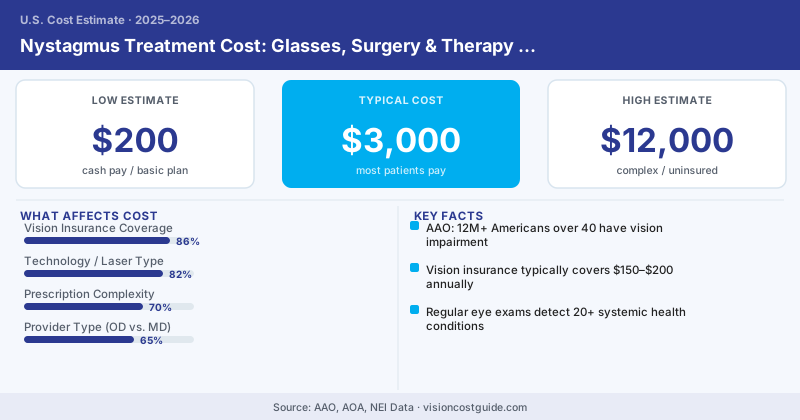
The honest summary: mild nystagmus managed with glasses and monitoring costs $200–$600/year. Significant cases involving surgery for a compensatory head position can run $5,000–$12,000. Here’s what drives those numbers.
What Is Nystagmus?
Nystagmus is rhythmic, involuntary eye movement — the eyes oscillate repeatedly in a horizontal, vertical, or rotary pattern. Congenital nystagmus (infantile nystagmus syndrome) is typically present from birth or appears in the first few months of life. Acquired nystagmus develops later, often from neurological causes, medications, or vestibular disorders.
The NEI estimates that nystagmus affects approximately 1 in 1,000 people in the United States. In congenital cases, many individuals develop a “null zone” — a gaze direction where the eye oscillation is minimized. Turning the head to maintain this null zone is called a compensatory head position, and it’s one of the main reasons surgery is considered.
Costs by Treatment Type
| Treatment | Typical Cost |
|---|---|
| Annual eye exam + monitoring (low vision specialist) | $200–$450 |
| Prism glasses (to shift null zone forward) | $250–$600 for frames + lenses |
| Contact lenses (soft or rigid, for visual acuity) | $300–$900/year |
| Vision therapy | $1,500–$5,000 per course |
| Kestenbaum-Anderson eye muscle surgery | $5,000–$12,000 |
| Baclofen or memantine (for acquired nystagmus) | $30–$200/month |
| Low vision aids and magnification devices | $200–$2,000 |
Non-Surgical Management
Prism glasses: Prism lenses shift the apparent direction of images so that the person can use their null zone while looking straight ahead — reducing the need to tilt the head. This is often the first intervention offered. An ophthalmologist measures the magnitude of the preferred head position, and a low vision optometrist or ophthalmic optician grinds prism into the prescription. Cost: $100–$200 for the lenses above standard prescription pricing, plus frame cost.
Contact lenses: Many adults with nystagmus find that contact lenses — particularly rigid gas-permeable lenses — provide better visual acuity than glasses by maintaining a stable optical correction regardless of eye position. Cost: $300–$900 annually depending on lens type.
Medications for acquired nystagmus: Baclofen, memantine, gabapentin, and clonazepam have shown benefit in certain forms of acquired nystagmus (particularly periodic alternating nystagmus and downbeat nystagmus). These are generic medications costing $30–$200/month with insurance. The efficacy varies enormously by nystagmus type — a neuro-ophthalmologist’s input is essential before trying these.
Yes, when it’s medically necessary. Nystagmus is a medical diagnosis (ICD-10 H55.xx), and treatments for it fall under medical insurance, not vision insurance. Prism glasses for nystagmus management may get partial coverage under some medical plans. Surgery (Kestenbaum procedure) is typically covered for congenital nystagmus with a documented compensatory head position, since the head turn causes musculoskeletal strain and reduces quality of life. Always use your medical plan for specialist visits; use your vision plan only for the glasses or contacts themselves.
Eye Muscle Surgery: When and What It Costs
The Kestenbaum-Anderson procedure moves all four horizontal rectus muscles to shift the null zone from an eccentric gaze direction to straight-ahead. The result: the person looks straight at things instead of turning their head. Approximately 60–70% of patients achieve meaningful reduction in head position after one procedure, according to published outcomes data in ophthalmology literature.
Surgery is typically outpatient, done under general anesthesia (especially in children), and takes 1–2 hours. Total cost including surgeon, anesthesia, and facility: $5,000–$12,000.
With insurance after deductible: $1,000–$3,500 typical.
Some patients require adjustment surgery — one set of muscles is recessed/resected in a first procedure, then tweaked in a second. Budget for this possibility, particularly in cases with larger compensatory head positions.
Anderson’s modification and graded approaches: Surgeons tailor the amount of muscle shift to the measured head position. More precise planning reduces the need for revision. Surgeons with experience in nystagmus surgery (rather than general strabismus surgeons) tend to have better outcome rates. Ask specifically about their experience with Kestenbaum-type procedures.
Vision therapy claims for nystagmus should be evaluated carefully. There’s no strong peer-reviewed evidence that behavioral vision therapy reduces nystagmus amplitude or improves acuity in congenital nystagmus. Some providers charge $2,000–$5,000 for vision therapy programs with uncertain benefit for this specific diagnosis. If vision therapy is recommended, ask for the specific published evidence supporting its use for nystagmus — and get a second opinion from a neuro-ophthalmologist before committing.
Pediatric Nystagmus: The School and Low Vision Piece
Children with nystagmus often qualify for accommodations under IDEA (Individuals with Disabilities Education Act) as a visual impairment. Low vision evaluations for school-age children — provided through the public school system or a pediatric low vision specialist — may be available at no cost. Private low vision evaluation costs $250–$600.
Low vision aids including monoculars, tablet magnification software, and anti-glare screen filters can meaningfully improve educational function. Budget $200–$800 for aids, though some may be covered by Medicaid or low vision assistance programs.
Finding the Right Specialist
The American Nystagmus Network (nystagmus.org) maintains a specialist directory and patient resources. Neuro-ophthalmologists and pediatric ophthalmologists with subspecialty interest in nystagmus are the right first specialists. General ophthalmologists see nystagmus infrequently and may not be current on the latest management options.
For surgical candidates, look for a pediatric ophthalmologist or strabismus subspecialist who can document experience with Kestenbaum procedures specifically — not just general eye muscle surgery. Outcomes depend significantly on surgical experience with this particular disorder.