No dye. No needle. No waiting 20 minutes in a darkened room while contrast circulates through your bloodstream. OCT angiography — OCT-A — maps the blood vessels in your retina using motion contrast from light waves alone. For patients who’ve had traditional fluorescein angiography before, the difference feels remarkable. For everyone else, OCT-A is simply how modern retinal imaging increasingly gets done.
The catch? It’s newer technology, and insurance coverage hasn’t caught up with its clinical adoption.
What OCT-A Actually Costs
Pricing varies significantly depending on whether the test is billed as a covered diagnostic service or as an advanced imaging upgrade.
| Setting | Typical Cost (Per Eye) | Insurance Status |
|---|---|---|
| Retina specialist office (medically necessary) | $0–$150 copay | Often covered by Medicare/commercial |
| Ophthalmology office (routine monitoring) | $150–$350 | Variable — may require prior auth |
| Optometry practice (wellness/screening) | $50–$150 | Usually not covered (elective) |
| Academic medical center / hospital outpatient | $200–$500 | Covered if ordered for specific condition |
The key variable: why the test is ordered. Medicare and most commercial insurers cover OCT-A when it’s ordered to evaluate a specific retinal condition — wet age-related macular degeneration (AMD), diabetic retinopathy, retinal vein occlusion, or glaucoma progression. Wellness screening or “baseline imaging” typically doesn’t qualify for coverage.
How OCT-A Differs from Regular OCT and Fluorescein Angiography
Understanding the difference matters when your bill arrives and you’re wondering why there are two imaging charges.
Standard optical coherence tomography (OCT) produces cross-sectional structural images of retinal layers — it shows thickening, atrophy, and fluid. It’s the workhorse of retinal monitoring and is very well reimbursed.
OCT-A adds functional information about blood flow. It shows which capillary networks are patent (open) and which are non-perfused (blocked or absent). This matters enormously for conditions like diabetic macular ischemia, where the macular capillaries are dropping out even before significant edema appears.
Traditional fluorescein angiography (FA) uses intravenous dye and takes 20–30 minutes. It shows leakage patterns over time — something OCT-A currently can’t replicate. FA remains the gold standard for detecting active neovascularization and assessing peripheral retinal non-perfusion. The two tests are often complementary, not interchangeable.
- Wet AMD: Detects choroidal neovascular membranes (CNV) without dye — useful for monitoring between FA studies
- Diabetic retinopathy: Maps foveal avascular zone (FAZ) enlargement and capillary dropout, which predicts visual decline
- Retinal vein occlusion: Quantifies ischemic index and guides laser vs. injection decisions
- Glaucoma: Evaluates optic disc vessel density as a structural biomarker for progression
- Early AMD / geographic atrophy: Detects CNV before it’s visible on standard OCT
Insurance Coverage: The Billing Reality
OCT-A is billed under CPT code 92133 or 92134 (which cover OCT optic nerve and macula, respectively) — there isn’t a dedicated CPT code specifically for OCT-A yet. This creates a billing gray zone: some practices bill standard OCT codes and absorb the cost difference, others bill it as an advanced imaging service and pass the patient-pay portion through.
Medicare Part B covers OCT (92133/92134) when medically indicated for a documented condition. If your practice bundles OCT-A under those codes for an appropriate diagnosis, your cost is a standard Part B copay (20% after deductible, or ~$30–$50 if you have a Medigap plan).
If your practice bills it as an unlisted code or elective service, you may get a balance-bill notice for the difference. Ask your provider how they bill OCT-A before the test if you want to avoid a surprise.
Some optometry practices charge an “ocular wellness scan” or “retinal imaging fee” of $30–$75 that includes OCT-A as a screening tool. These fees are almost always out-of-pocket because they’re ordered as preventive screening rather than diagnostic evaluation. If your optometrist or ophthalmologist recommends OCT-A imaging at a routine visit, ask whether there’s a separate patient-pay charge — and whether the test is clinically indicated given your specific history.
When You Should Expect to Pay Out of Pocket
Even with good insurance, a few scenarios reliably generate out-of-pocket OCT-A costs:
High-deductible plans early in the year. If your annual deductible isn’t met, imaging charges count against it. An OCT-A session with a retina specialist may run $300–$500 on the full allowed amount before your deductible kicks in.
Frequency limitations. Medicare allows OCT for the same eye no more than once per year for some diagnoses. If you need monitoring more frequently (every 3 months is common for active wet AMD), the second annual exam’s imaging costs may not be fully covered.
Dry AMD monitoring. Dry AMD patients increasingly receive OCT-A to detect early conversion to wet AMD, but some insurers still classify this as investigational for pure dry AMD monitoring. Know your plan’s policies if you’re in this category.
The Bottom Line
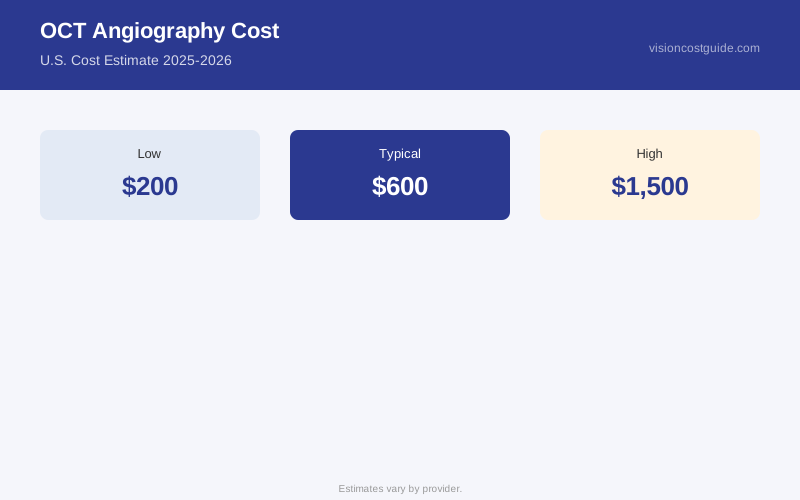
OCT-A costs $150–$500 out of pocket when not covered, but is usually included in a standard copay when ordered for a covered diagnosis like wet AMD, diabetic retinopathy, or glaucoma. It’s not a replacement for fluorescein angiography in all situations — it complements FA by providing rapid, dye-free vascular mapping between more comprehensive dye studies. If your retina specialist is recommending it, ask how it’s being billed and what condition it’s being ordered for — that one question can clarify your out-of-pocket exposure before the test is done.