Your eye pressure is high—but you don’t have glaucoma yet. Welcome to the confusing middle ground of ocular hypertension. Your ophthalmologist says you need treatment, but your vision plan says it’s not covered. What does this actually cost you?
More than you’d expect. Less than ignoring it.
What Is Ocular Hypertension?
Ocular hypertension (OHT) means intraocular pressure (IOP) above 21 mmHg without detectable optic nerve damage or visual field loss. About 3–6 million Americans have OHT, according to NEI estimates. Roughly 10% of untreated OHT patients develop glaucoma within 5 years.
That’s why treatment matters. The Ocular Hypertension Treatment Study (OHTS), funded by the NEI, found that topical medication reduced the risk of glaucoma development by 60% over 5 years.
Treatment Cost Breakdown
| Treatment | Cost Per Year (Uninsured) |
|---|---|
| Annual monitoring visits (2x/year) | $200–$600 |
| Visual field testing | $75–$200 per test |
| OCT nerve fiber layer scan | $100–$300 per scan |
| Generic latanoprost drops | $15–$40/month |
| Brand-name drops (Lumigan, Travatan Z) | $150–$350/month |
| Selective Laser Trabeculoplasty (SLT) | $1,000–$2,500 per eye |
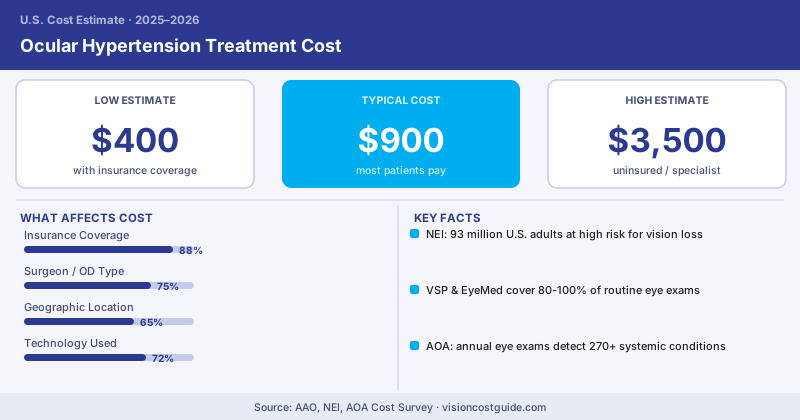
Total annual cost for monitored but untreated OHT: $400–$1,000. For OHT managed with generic drops: $600–$1,500. For patients who opt for SLT laser as first-line treatment: $1,500–$3,500 upfront, then lower ongoing costs.
Drops vs. Laser: The Cost Comparison
Prostaglandin analog drops (latanoprost, bimatoprost, travoprost) are the most prescribed first-line treatment. Generic latanoprost is $15–$40/month—roughly $180–$480/year. It’s effective, once-daily, and well tolerated by most patients.
Brand-name drops cost dramatically more. Lumigan (bimatoprost 0.01%) runs $200–$350/month without insurance—nearly $3,000/year. Most insurers cover generics at a $10–$30 tier-1 copay.
SLT laser has become a compelling first-line alternative. A single SLT session costs $1,000–$2,500 per eye but can lower pressure for 3–5 years, eliminating daily drops. The LiGHT trial, published in The Lancet in 2019, found that SLT achieved target IOP in 74% of patients and was more cost-effective than drops over a 3-year period.
Many vision insurance plans (VSP, EyeMed) do NOT cover ocular hypertension treatment because it’s classified as a medical—not routine vision—condition. Use your medical insurance instead. If you’re uninsured, ask about GoodRx for drops (latanoprost often drops to $10–$15) and community health centers for monitoring visits.
What Affects Your Cost
Your risk profile. Low-risk OHT patients (IOP 22–24 mmHg, thick corneas, normal optic nerves) may only need monitoring twice a year—minimal cost. High-risk patients (IOP 28+ mmHg, thin corneas, suspicious discs) need treatment immediately.
Corneal thickness. A pachymetry test ($75–$150) is essential—thin corneas inflate true pressure readings, meaning your “high” pressure might actually be normal. This one test can save you years of unnecessary medication.
Drug coverage. If your health insurer covers glaucoma medications, most OHT drops fall under the same formulary. Ask your prescriber to write for generic latanoprost—it’s identical clinically and 80–90% cheaper than brand names.
Drop adherence. Adherence is the silent cost driver. Studies show up to 50% of glaucoma/OHT patients are non-adherent within one year—often leading to progression that requires more aggressive (and expensive) treatment. Set a phone alarm. Use the bedtime routine hack: drops go in when you brush your teeth.
Insurance Coverage Reality
Medical insurance typically covers OHT treatment under preventive and ophthalmology benefits. Expect:
- With commercial insurance: $20–$50 specialist copay per visit, $10–$30 for generic drops
- With Medicare: OHT treatment is covered under Part B (if medically necessary) and Part D (drops)
- Uninsured: Use GoodRx, NeedyMeds, or manufacturer patient assistance programs for drops
The Long View
Treating OHT now costs a few hundred dollars a year. Treating glaucoma—once it develops—costs $1,000–$10,000+ annually in drops, laser, and potentially surgery. The math is straightforward.
If your ophthalmologist has flagged your eye pressure, don’t let cost be the reason you skip treatment. Generic drops are genuinely cheap. The monitoring is the bigger expense—but it’s also what keeps you out of the surgical suite later.