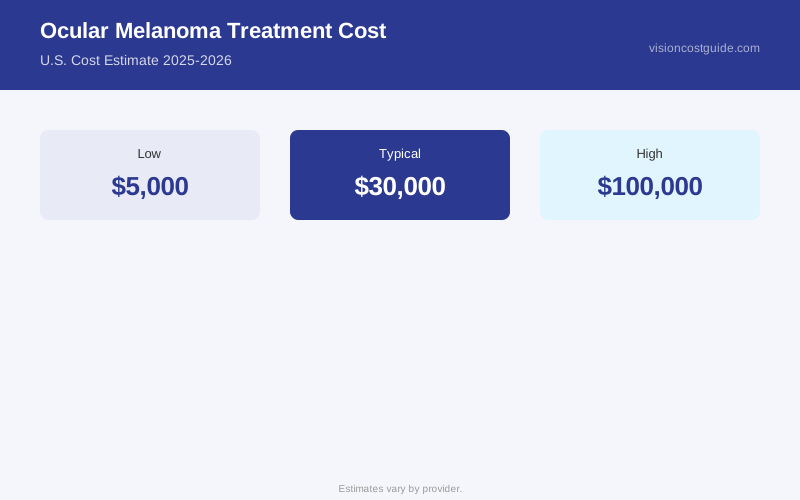
About 2,500 Americans are diagnosed with uveal melanoma each year — making it the most common primary intraocular malignancy in adults, according to the American Cancer Society. It’s rare in absolute terms. But for the patients facing it, nothing about the diagnosis or its costs is abstract. Treatment options range from eye-preserving radiation to surgical removal of the entire eye, and the costs span a staggering range depending on method, institution, and insurance.
Here’s what you need to know.
Treatment Options and Their Cost Ranges
Uveal melanoma arises from pigment cells in the uveal tract (iris, ciliary body, or choroid). Conjunctival melanoma, which appears on the eye’s surface, follows a different treatment pathway. Both require specialists — typically a trained ocular oncologist — and both carry significant treatment costs.
| Treatment Type | Where Performed | Total Cost Range | Eye Preservation |
|---|---|---|---|
| I-125 plaque brachytherapy | Ocular oncology center or major hospital | $30,000–$80,000 | Yes (most cases) |
| Proton beam radiation | Specialized proton center (10 US sites) | $40,000–$100,000 | Yes (most cases) |
| Enucleation (eye removal) | Ophthalmology/oculoplastics | $15,000–$40,000 | No |
| Transpupillary thermotherapy (TTT) | Retina/oncology specialist | $5,000–$15,000 | Yes (small tumors only) |
| Resection (local excision) | Ocular oncology | $20,000–$60,000 | Yes (selected cases) |
| Conjunctival melanoma excision + cryo | Ocular oncology | $5,000–$25,000 | Yes |
| Adjuvant immunotherapy (metastatic disease) | Oncology center | $100,000–$300,000+/year | N/A |
The COMS (Collaborative Ocular Melanoma Study), a landmark NIH-funded clinical trial, established that I-125 plaque brachytherapy produces equivalent mortality outcomes to enucleation for medium-sized uveal melanomas. That finding effectively made plaque brachytherapy the standard of care in the US for preserving the eye without compromising survival — though it requires access to a trained ocular oncologist.
Plaque Brachytherapy: The Most Common Eye-Preserving Treatment
I-125 plaque brachytherapy involves surgically suturing a small radioactive gold plaque to the outside of the eye over the tumor. The patient is hospitalized (typically 3–7 days) while the plaque delivers targeted radiation to the tumor. The plaque is then surgically removed. Most patients retain the eye with varying degrees of preserved vision.
Cost breakdown:
- Surgical placement and removal of plaque: $10,000–$20,000
- Hospital stay: $8,000–$25,000
- Radiation oncology / plaque preparation: $8,000–$15,000
- Follow-up imaging (OCT, ultrasound, fluorescein angiography): $1,000–$4,000
- Cataract surgery post-radiation (develops in majority of patients): $3,000–$8,000
Radiation-induced cataract is nearly universal after plaque brachytherapy — expect this as a downstream cost within 2–5 years of treatment.
Proton Beam Radiation
Proton beam therapy uses charged particles instead of photons to deliver highly targeted radiation. It’s the treatment of choice for anterior uveal tumors (iris and ciliary body melanomas) where plaque placement is technically difficult, and for tumors near the optic nerve or macula where radiation precision is critical.
The cost is high and access is limited. There are only about 10 proton centers in the US equipped to treat ocular tumors, and not all proton centers have the specialized ocular oncology team needed. The facilities with the most experience — Massachusetts Eye and Ear, UCSF, the Proton Therapy Center Houston — attract patients from across the country, adding travel and lodging to treatment costs.
Major cost factors for ocular melanoma treatment:
- Your insurer: Uveal melanoma treatment is covered as a cancer treatment — but prior authorization and network status matter. Out-of-network specialist costs can be massive.
- Institution: Academic medical centers typically have higher facility fees but more experience with rare tumors.
- Travel: If you need proton therapy or a specialist center not in your region, travel and lodging add $2,000–$10,000+ for patients traveling from distant states.
- Metastatic disease: Approximately 50% of uveal melanoma patients eventually develop metastasis — primarily to the liver. Treating metastatic disease with immunotherapy (tebentafusp, approved 2022) or liver-directed therapies can cost $100,000+ annually.
- Secondary complications: Radiation retinopathy, neovascular glaucoma, and cataract are common after radiation treatment and generate additional downstream treatment costs.
Insurance Coverage
Ocular melanoma treatment is covered by Medicare and commercial insurance as cancer treatment. This is medically necessary care — not elective. The major coverage battles tend to arise around:
Proton therapy authorization. Some commercial insurers require documentation that proton’s dosimetric advantages are clinically necessary over IMRT or plaque brachytherapy. Your ocular oncologist’s team should provide this documentation proactively.
Out-of-network specialists. Because the disease is rare, your in-network options may be limited. If the nearest experienced ocular oncologist is out-of-network, request an exception based on medical necessity — the lack of in-network specialists with equivalent expertise is a documented legitimate basis for out-of-network authorization.
Genetic testing. Tumor biopsy with chromosome 3 analysis (BAP1, GNA11, GNAQ testing) is standard of care for prognosis. This may face prior authorization from some insurers despite its clinical importance. The Oncotype DX Uveal Melanoma test is one commonly used assay — it carries its own billing pathway.
Uveal melanoma surveillance is lifelong. Even after successful local treatment, metastatic surveillance imaging (liver ultrasound every 6–12 months, or MRI) is recommended indefinitely — or more frequently in high-risk patients. These imaging costs ($200–$1,500 per session without insurance) add up over decades. Enroll in a systematic surveillance program through your ocular oncologist or a liver cancer team experienced with uveal melanoma metastasis — early detection of hepatic metastasis improves outcomes with locoregional therapy.
Enucleation: When It’s the Right Choice
Despite advances in eye-sparing treatment, enucleation (surgical removal of the eye) remains appropriate for very large tumors that have destroyed functional vision, tumors with extrascleral extension, or patients who prefer surgical certainty over radiation-related risks. Cost is lower than radiation treatments ($15,000–$40,000), and recovery is faster. An ocular prosthesis (artificial eye) is fitted 4–6 weeks after surgery at additional cost ($2,500–$8,000 for a custom prosthesis).
Finding an Ocular Oncologist
The Ocular Oncology Society maintains a directory of trained specialists. Major centers include Wills Eye Hospital (Philadelphia), Bascom Palmer Eye Institute (Miami), Massachusetts Eye and Ear (Boston), UCSF (San Francisco), and UT MD Anderson (Houston). For rare diseases, volume and experience matter profoundly — outcomes at high-volume centers consistently exceed those at general ophthalmology practices treating occasional ocular melanoma cases.
Bottom Line
Ocular melanoma treatment costs $30,000–$100,000+ for primary treatment and can escalate significantly if metastasis develops. It’s covered as cancer treatment by Medicare and commercial insurance, but out-of-pocket exposure depends heavily on network status, travel to specialist centers, and downstream complications. Plaque brachytherapy is the US standard for medium-sized tumors; proton beam is preferred for anterior tumors and those near critical structures. See an ocular oncologist — not a general ophthalmologist — for management of this disease.