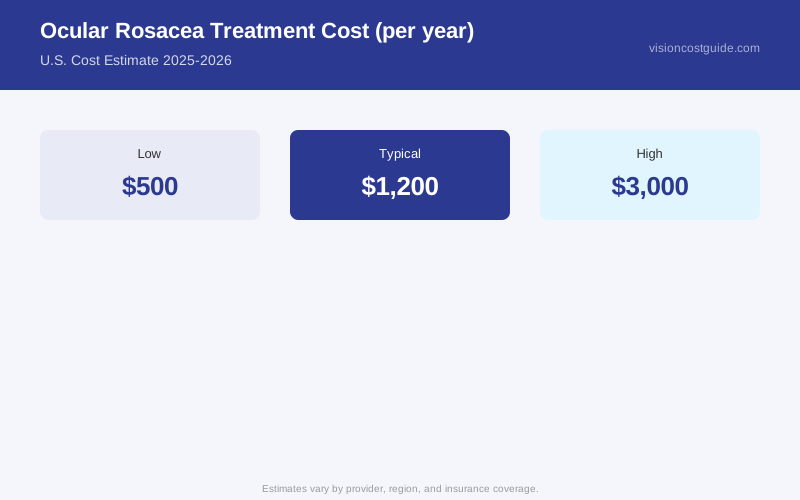
Most people think rosacea is a skin problem. It is — but in up to 58% of rosacea patients, the eyes are involved too, according to a study published in the American Journal of Ophthalmology. And unlike facial rosacea, ocular rosacea often goes undiagnosed for years because patients don’t connect their chronic eye irritation, styes, and light sensitivity to their skin condition. That delay costs them comfort and, eventually, money.
Here’s what ocular rosacea treatment actually costs — and why early, consistent management is far cheaper than the complications it prevents.
What You’re Dealing With
Ocular rosacea causes inflammation of the eyelid margins (blepharitis), meibomian gland dysfunction (blocked oil glands), chronic dry eye, and in severe cases, corneal inflammation (rosacea keratitis) that can threaten vision. It doesn’t resolve on its own. The eyelid hygiene and medical management that controls it are indefinite commitments.
The good news: most ocular rosacea is manageable with relatively low-cost interventions once you know what you’re treating.
Diagnosis Costs
| Service | Cost | Purpose |
|---|---|---|
| Comprehensive eye exam | $100–$250 | Initial evaluation, IOP, slit-lamp |
| Slit-lamp anterior segment exam | Included | Eyelid margin, meibomian gland assessment |
| Meibography | $75–$150 | Gland imaging to assess atrophy |
| Tear osmolarity test | $30–$75 | Dry eye severity quantification |
| Dermatology consult | $200–$400 | Facial rosacea confirmation and co-management |
Ocular rosacea is usually diagnosed clinically — an ophthalmologist or optometrist familiar with rosacea can identify the characteristic eyelid margin telangiectasias (tiny dilated blood vessels), foam in the tear film, and meibomian orifice plugging at the slit lamp. You don’t need extensive testing to start treatment.
The Treatment Hierarchy
Eyelid Hygiene: $10–$40/month
Daily warm compress plus lid scrubs is the foundation of ocular rosacea management. This isn’t optional — it’s the baseline that every other treatment builds on.
- Warm compress (Bruder mask): $25–$30 one-time cost, then $0/month
- Lid scrub wipes (OCuSOFT Lid Scrub Plus or similar): $15–$25/month
- Hypochlorous acid spray (Avenova, Heyedrate): $20–$35/month — particularly effective for rosacea-associated blepharitis
Many ophthalmologists recommend hypochlorous acid spray over traditional baby shampoo lid scrubs for rosacea patients. It’s gentle, antimicrobial, and doesn’t sting — and the evidence is stronger.
Artificial Tears: $15–$30/month
Preservative-free artificial tears address the dry eye component. Use them throughout the day — 4–6 times daily for moderate symptoms. Choose preservative-free unit-dose vials; rosacea-inflamed eyes are more reactive to preservatives.
Topical Treatments: $30–$150/month
Azithromycin ophthalmic solution (compounded, not commercially available as an eye drop): Used off-label for ocular rosacea. Compounded preparations from specialty pharmacies run $30–$80/month. Reduces meibomian gland inflammation and Demodex mite load.
Metronidazole eye gel (off-label, compounded): $40–$100/month. Applied to eyelid margins, not the eye itself.
Prescription eye drops for inflammation: Loteprednol (Lotemax), a mild topical steroid, $50–$150/month during flares. Not for continuous use due to IOP risk.
Oral Antibiotics: $20–$100/month
Low-dose doxycycline (40–100mg/day) is the most established systemic treatment for ocular rosacea. It’s not being used here as an antibiotic — at these doses it acts as an anti-inflammatory. Generic doxycycline is cheap: $20–$40/month. It’s often effective within 4–8 weeks.
Alternatively, low-dose minocycline or azithromycin pulses are used when doxycycline isn’t tolerated. Similarly priced.
For ocular rosacea, the standard-of-care dose is 40mg/day sustained-release (Oracea brand) or 50mg/day generic doxycycline — not the 100mg/day dose used for bacterial infections. Lower doses reduce anti-inflammatory effects without meaningful antibiotic effect, which matters for gut microbiome preservation and antibiotic resistance. The brand Oracea costs $300–$500/month; generic low-dose doxycycline from a compounding pharmacy or standard generic at 50mg/day runs $20–$50/month. Ask your doctor explicitly for the generic option.
In-Office Procedures: $400–$4,000
For patients with significant meibomian gland involvement, in-office procedures address what eyelid hygiene and oral meds can’t fully resolve:
Intense Pulsed Light (IPL): The strongest evidence-based procedure for rosacea-associated MGD. IPL reduces telangiectasias on the eyelid margins that drive meibomian gland inflammation. Typically 4 sessions spaced 3–4 weeks apart, at $300–$600/session — $1,200–$2,400 for a full course. Some patients need annual maintenance sessions ($300–$600/year). Not covered by insurance.
LipiFlow thermal pulsation: $1,500–$4,000 per treatment. Addresses gland obstruction; some ocular rosacea patients benefit, though IPL has stronger evidence for the rosacea-specific inflammatory driver.
Blephex (eyelid debridement): $150–$300 per treatment, sometimes covered by insurance. Mechanical removal of eyelid margin debris and biofilm — useful for cases with significant blepharitis buildup.
Demodex Management: $20–$100/month
Up to 45% of the general population has Demodex mite infestation, but rates are significantly higher in rosacea patients. Tea tree oil-based lid scrubs target Demodex colonization. Cliradex wipes ($60–$80/month) are the most studied product. Lotilaner (Xdemvy) eye drops were FDA-approved in 2023 for Demodex blepharitis — $730/course without insurance, though manufacturer assistance programs may reduce this.
Don’t use over-the-counter steroid eye drops for rosacea inflammation without a prescription and ophthalmologist monitoring. OTC “redness-relieving” drops (tetrahydrozoline, naphazoline) constrict blood vessels temporarily but worsen rosacea inflammation with regular use. True topical steroids require IOP monitoring — even mild steroids can raise eye pressure in steroid responders.
Monthly Management Costs at Different Levels
Mild ocular rosacea: Warm compress + hypochlorous acid spray + preservative-free tears: $40–$70/month
Moderate ocular rosacea: Add low-dose doxycycline + periodic Blephex: $70–$150/month
Severe ocular rosacea: Add IPL sessions + prescription anti-inflammatory drops + Demodex treatment: $200–$500+/month during active treatment, lower during maintenance
What Insurance Pays For
Eyelid hygiene products: not covered. Oral doxycycline: covered by medical insurance (Part D for Medicare). Prescription eye drops: covered with prior auth in many plans. IPL and LipiFlow: not covered by insurance. Blephex: sometimes covered as a medical procedure under medical insurance.
The Long-Term Perspective
Ocular rosacea is chronic. The patients who manage it well spend $40–$150/month consistently and rarely have severe flares. The patients who skip maintenance until symptoms are bad spend $300–$600 at the ophthalmologist, need prescription steroids, and in rare severe cases develop corneal scarring that’s expensive to treat and impossible to fully reverse.
The National Rosacea Society notes that the condition affects an estimated 16 million Americans — and the majority who have the ocular form don’t know it. If you have rosacea and experience frequent styes, chronic “tired” eyes, or eyelid irritation, ask your eye doctor to specifically evaluate for the ocular component. The diagnosis changes the treatment — and early treatment is cheaper than late treatment.