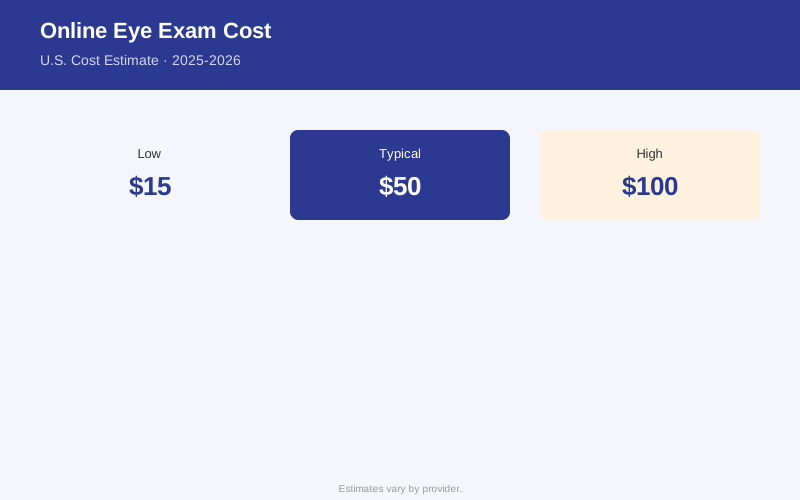
$15 for an eye exam. That’s what Warby Parker’s online prescription check costs. It sounds almost too good — and in some ways it is. But for the right patient in the right situation, a telehealth vision test is a legitimate, money-saving option. The key is understanding exactly what you’re buying.
What “Online Eye Exam” Actually Means
There’s no single product. The term covers at least three different services:
1. Prescription renewal apps — Apps like Warby Parker’s Prescription Check, 1-800 Contacts’ Express Exam, and Visibly let you renew an existing glasses or contact prescription using your smartphone. You’re presented with visual acuity charts and interactive tests. A licensed OD reviews the results remotely and issues (or declines to issue) a new prescription. Cost: $15–$35.
2. Asynchronous telehealth eye exams — You submit responses to visual tests and images of your eyes. A doctor reviews asynchronously (not in real time) and contacts you within 24–48 hours. Some can address minor red-eye complaints or prescription renewals. Cost: $25–$65.
3. Synchronous video telehealth with an OD — A live video appointment with a licensed optometrist who can discuss symptoms, review images of your eyes from your phone camera (external), and provide limited guidance. Can address pink eye, mild dry eye, medication questions. Cost: $40–$150 depending on platform and scope.
Online Eye Exam Cost Comparison
| Platform / Service | Cost | What You Get |
|---|---|---|
| Warby Parker Prescription Check | $15 | Prescription renewal (glasses only, app-based) |
| Visibly (formerly Opternative) | $25–$35 | Glasses or contact lens prescription renewal |
| 1-800 Contacts Express Exam | $20 | Contact lens prescription renewal |
| Simple Contacts | $20 | Contact lens prescription renewal |
| Teladoc, MDLive (eye-related visit) | $75–$150 | Video consult, minor eye complaints |
| GoodRx Care, Hims/Hers | $50–$75 | Minor eye conditions, limited prescription services |
| Traditional in-person OD exam | $80–$200 | Full comprehensive exam + prescription |
What Online Exams Can (and Can’t) Do
Can do:
- Renew a stable glasses prescription for a patient whose vision hasn’t changed much
- Renew a stable contact lens prescription (subject to state law and contact lens type)
- Evaluate symptoms of mild conjunctivitis (pink eye) or dry eyes via video
- Issue a prescription for basic antibiotic or lubricant eye drops in some states
- Save you time and money when you just need an updated prescription for glasses
Can’t do:
- Examine your retina, optic nerve, or internal eye structures
- Check intraocular pressure (critical for glaucoma screening)
- Diagnose glaucoma, macular degeneration, cataracts, or diabetic retinopathy
- Evaluate the anterior segment under a slit lamp
- Check for retinal holes, tears, or detachment
- Perform binocular vision testing (eye muscle coordination, convergence)
- Update a contact lens prescription for specialty lenses like torics or multifocals
The American Academy of Ophthalmology has repeatedly stated that app-based vision tests are not equivalent to comprehensive eye exams and should not replace them for patients over 40 or those with risk factors for eye disease.
Who Is a Good Candidate for an Online Exam?
You’re a reasonable candidate if you’re:
- Age 18–39 with a stable prescription (changed less than 0.50 diopters in the past year)
- No systemic health conditions — no diabetes, no hypertension, no autoimmune disease
- No symptoms beyond blurry distance or near vision — no pain, flashes, floaters, redness, or distortion
- Had a full in-person exam within the past 1–2 years
- Need glasses or soft spherical contact lenses — not specialty lenses
You’re NOT a good candidate if you:
- Are over 40 (glaucoma risk rises sharply; presbyopia adds complexity)
- Have diabetes or hypertension (annual dilated exams are medically necessary)
- Have any symptoms beyond blur — especially flashes, new floaters, pain, or vision distortion
- Haven’t had an in-person exam in more than 2 years
- Wear toric, multifocal, or specialty contact lenses
State Law Complications
Online prescription services are not legal in all 50 states. Several states — including New York, South Carolina, Georgia, and others — require an in-person exam to issue a new contact lens or glasses prescription. State optometry boards have varying positions on this. Before paying for an online exam service, verify it operates in your state.
If you use an online prescription service and your state doesn’t allow remote prescribing, you may pay for the exam and still not receive a valid prescription. Check the platform’s coverage map before purchasing. Apps that are unavailable in your state typically won’t take your payment — but confirm before you assume.
The Real Math: Is Online Worth It?
For a 28-year-old who had a comprehensive eye exam 14 months ago, has a stable prescription around −2.50, and just needs a new glasses prescription to order from an online retailer — yes, a $25 online exam makes complete sense. That’s $55–$175 saved versus an in-office visit.
But if you’re 47 years old with untreated hypertension, and your “just need glasses” check hasn’t included a dilated fundus exam in 3 years — that $25 exam is false economy. About 3 million Americans have glaucoma and don’t know it, according to the Glaucoma Research Foundation. Glaucoma is not detectable on a smartphone visual acuity test.
The CDC Vision Health Initiative reports that over half of people who experience severe vision loss from eye disease had no eye exam in the 12 months before vision impairment began. That’s the population that should not be relying on online exams.
Insurance Coverage for Online Eye Exams
Vision insurance plans (VSP, EyeMed, Spectera) typically do NOT cover app-based prescription renewals. These platforms are designed as low-cost direct-pay services — the $15–$35 fee reflects that they’re priced to be affordable without insurance involvement.
Some telehealth medical visits (Teladoc, MDLive) for eye-related complaints may qualify for medical insurance coverage under telehealth benefits. Check your plan, but don’t assume a vision complaint automatically routes to your vision benefits.
Bottom Line
Online eye exams cost $15–$65 and make genuine sense for healthy young adults with stable prescriptions who’ve had recent in-person exams. They’re a reasonable shortcut for prescription renewal, not a substitute for comprehensive eye care. If you have risk factors for eye disease, are over 40, or have any symptoms beyond stable blurry vision — book the real appointment. The comprehensive exam costs more, but it’s the only one that can actually check your eye health.