In 2010, buying glasses online meant trusting a blurry website and hoping the lenses arrived without scratches. In 2026, online optical has matured into a $5.4 billion US market — and for millions of Americans with straightforward prescriptions, it works exactly as well as the optical shop at a fraction of the price. But “online glasses are always cheaper” is too simple. There’s a version of this decision where buying in person saves you money, and there’s a type of prescription where online ordering creates more problems than it solves.
The Raw Price Gap
| Purchase Channel | Typical Complete Pair (frames + SV lenses) | Best For |
|---|---|---|
| Ultra-budget online (Zenni, Firmoo, Goggles4U) | $15–$50 | Backup pairs, low prescriptions, basic needs |
| Mid-tier online (EyeBuyDirect, Clearly, Payne Glasses) | $40–$130 | Daily wearers, moderate prescriptions |
| Premium online (Warby Parker, Felix + Iris) | $95–$200 | Style + quality, modern coatings, home try-on |
| Wholesale club in-person (Costco Optical) | $100–$250 | Value + professional service |
| Chain optical (LensCrafters, Visionworks, Target) | $150–$400 | Convenience, insurance processing |
| Independent optician | $200–$600+ | Complex prescriptions, premium lenses, full service |
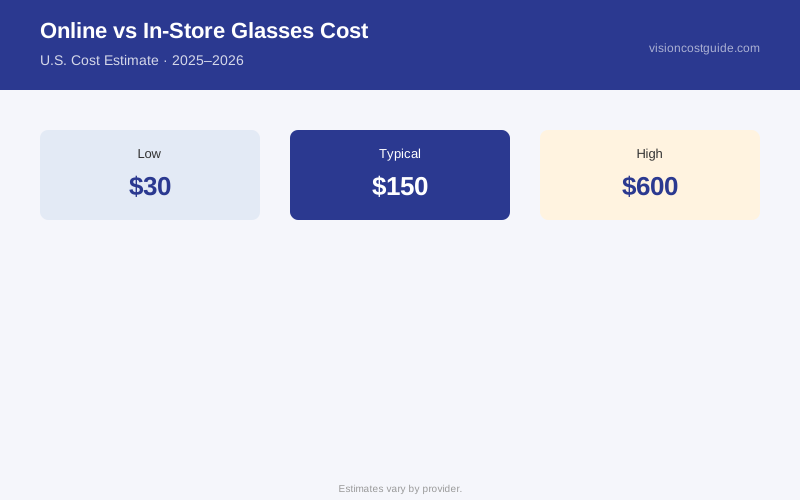
The price gap between ultra-budget online and a mid-tier chain optical can be $200–$400 for the same prescription. That’s real money — but understanding what you’re actually trading off matters.
What Online Retailers Do Well
Price. There’s no getting around it — the lack of retail overhead, in-house opticians, and physical try-on infrastructure means online retailers pass significant savings to buyers.
Volume and selection. Zenni alone offers 3,000+ frame styles. The frame variety at most in-person opticians is 200–500 pairs. If you have an unusual face shape, unusual style preferences, or want multiple pairs for different uses, online wins on selection.
Multiple pairs. A typical in-store pair costs $200–$350. At Zenni, you can buy five pairs — different styles, different tints, prescription sunglasses included — for the same total. For people who want prescription sunglasses plus reading glasses plus daily drivers, online ordering makes the math work.
Backup glasses. Everyone with a prescription should have a backup pair in case of loss, breakage, or damage. At $15–$50 online, that’s a defensible purchase. At $250+ in-store, many people skip it.
Where In-Person Is Worth More
Progressive lenses for first-time wearers. Progressive lenses require precise monocular PD (pupillary distance, each eye separately), segment height, pantoscopic tilt, and face form angle. These measurements affect whether the lens works correctly. In-person opticians take all of them. Online ordering typically captures only combined PD. For established progressive wearers who already know their measurements, online works. For first-timers, in-person is the safer and often cheaper-in-practice choice — because an online progressive that requires remake or return adds real cost and time.
High astigmatism. Cylinder corrections above −1.75, especially with axis angles that aren’t near 0, 90, or 180 degrees, are sensitive to axis alignment errors. A precise lab cuts to spec; an imprecise one introduces visual distortion. In-person opticians working with quality labs have lower error rates on high-cylinder prescriptions.
Strong prescriptions. At ±6.00 and beyond, lens edge thickness, centration, and fitting measurements significantly affect visual performance. An in-person optician fitting the lens to your specific frame and face geometry produces better outcomes for high prescriptions.
Children’s glasses. Kids need polycarbonate or Trivex lenses (not always the default online), proper fitting for face geometry, and professional adjustment when frames slip. In-person for children’s primary pairs is worth the cost premium.
Online returns aren’t free in time and inconvenience, even when they’re free in dollars. If a lens is wrong, you:
- Wait for original delivery (5–14 days)
- Discover the problem
- Initiate a return or remake request
- Wait for replacement (another 5–14 days)
- Possibly repeat if the second pair has issues
In total: 3–6 weeks without correct glasses. For a prescription you need daily, that’s a real cost. In-person optical shops typically offer same-day or one-hour service, and adjustment is immediate.
Estimate the “failure risk cost” before buying: if your prescription is simple and stable, the risk is low. If it’s complex, new, or you’ve had issues with past pairs, that risk is much higher.
The Warby Parker Middle Ground
Warby Parker’s home try-on program (five frames for five days, free) and their retail stores that offer in-person fitting bridge some of the in-store/online gap. Their pricing ($95–$195 for complete pairs) is meaningfully below chain optical while offering professional quality AR coating and reasonable service. For many moderately presbyopic adults, Warby Parker represents the best combination of value and reliability — especially for distance single-vision glasses.
Insurance: In-Store Wins, But Not Always
Most vision insurance plans process benefits directly with in-network optical shops — the billing is handled for you, and you pay only your copay and any overages. Using vision insurance online is possible but requires submitting reimbursement claims manually, which many people never do.
If you have vision insurance with an in-network allowance of $150+ toward frames and lenses, using it in-store often produces total costs competitive with online buying — especially for progressives or complex prescriptions.
If you don’t have vision insurance, or your benefits are limited, the online math is typically more favorable.
The biggest source of online glasses failures isn’t the lens quality — it’s incorrect PD (pupillary distance) measurement. PD determines where the optical center of the lens sits relative to your pupil. An error of even 2mm in a strong prescription produces eyestrain, headaches, or blurry vision. If you’re measuring PD yourself using an online tool or the “ruler method,” take three measurements and average them. Better yet, get it measured at your eye exam — most optometrists will measure it at your request even if they don’t write it on the prescription automatically.
The Practical Decision Guide
Buy online if:
- Stable prescription, straightforward (single vision, mild astigmatism)
- You’re buying backup pairs or prescription sunglasses
- You’ve successfully ordered online before with the same prescription
- You want multiple pairs on a budget
Buy in-store if:
- First-time progressive lenses
- Prescription change of more than ±0.75
- High astigmatism (beyond −1.75 cylinder)
- Strong prescription (beyond ±5.00)
- Buying glasses for a child
- You have usable vision insurance in-network benefits
The American Optometric Association found in its 2024 patient survey that 68% of adults with eyeglasses purchased their last pair in person — but that figure has been declining steadily as online options improve. There’s no universal right answer, but there is a right answer for your specific prescription and situation.