You wake up and your vision in one eye is blurry. Moving the eye hurts. Colors look washed out — a red coffee mug looks almost pink. Within hours you’re at urgent care, and within 24 hours you’re in an ophthalmologist’s chair being told you likely have optic neuritis. The next question in your head, after “what is that?”, is almost certainly “what’s this going to cost?”
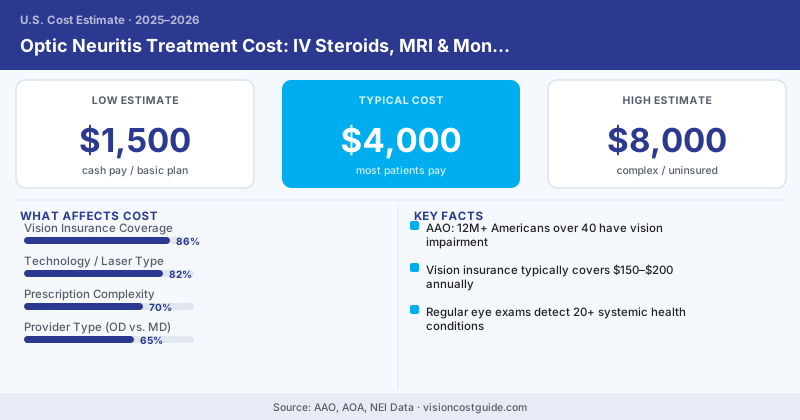
Here’s the honest picture: most acute treatment runs $1,500–$8,000, the imaging to check for underlying causes like multiple sclerosis (MS) is often more expensive than the treatment itself, and long-term monitoring depends almost entirely on what your MRI shows.
What Is Optic Neuritis?
Optic neuritis is inflammation of the optic nerve, usually causing sudden vision loss, eye pain with movement, and color desaturation in one eye. It affects approximately 1 in 30,000 people per year in the US, according to the NEI. It’s most common in adults ages 20–45, and women are affected about 3 times more often than men.
The big concern with optic neuritis isn’t just the episode itself — roughly 50% of people who experience optic neuritis will develop multiple sclerosis within 15 years, according to long-term Optic Neuritis Treatment Trial (ONTT) data published in the Archives of Ophthalmology. That’s why your neurologist and ophthalmologist will almost certainly want an MRI brain at diagnosis.
Treatment Cost Breakdown
| Service | Typical Cost |
|---|---|
| Emergency ophthalmology visit | $200–$450 |
| Optical coherence tomography (OCT) | $100–$300 |
| Visual field test | $75–$200 |
| MRI brain and/or orbits with contrast | $800–$2,500 |
| IV methylprednisolone (3-day course, hospital) | $1,500–$5,500 |
| Oral prednisone (rarely used, inexpensive) | $15–$40 for 11-day course |
| Neurology consultation | $200–$500 |
| Follow-up ophthalmology visits (3–6 months) | $100–$300 each |
The IV Steroid Decision
The ONTT definitively showed that IV methylprednisolone (1 gram/day for 3 days) speeds visual recovery by about 4 weeks compared to oral steroids or observation — but it doesn’t change the final visual outcome at 6 months or 1 year. Most patients recover good vision eventually regardless of treatment.
So why do doctors still recommend IV steroids for moderate-to-severe vision loss? Two reasons: faster recovery matters when you need to work, drive, or care for children, and there’s evidence the IV protocol may delay MS conversion in high-risk patients.
The cost of IV methylprednisolone depends almost entirely on where it’s administered. Hospital inpatient admission is most expensive ($3,500–$5,500 for the drug plus room/nursing). Hospital outpatient infusion center runs $2,000–$3,500. A freestanding infusion center or infusion-capable ophthalmology/neurology office is cheapest: $1,500–$2,500. Ask whether you can receive your infusions in an outpatient setting — the outcome is identical, and you save significantly.
Yes, optic neuritis is a medical diagnosis (ICD-10: H46.xx) covered under medical insurance, not vision insurance. Your medical plan handles it. The IV steroid course is typically covered after your deductible. MRI imaging is covered when ordered for acute vision loss or neurological symptoms — prior authorization may be required for elective follow-up imaging. If you haven’t met your deductible, expect to pay $1,500–$3,000 out-of-pocket for the first episode. After your deductible, coinsurance typically runs 10–20%.
MRI Costs and Why They Matter
Your MRI result is arguably the most cost-relevant test. If the MRI shows white matter lesions consistent with demyelinating disease, your neurologist will likely diagnose clinically isolated syndrome (CIS) — a first episode of MS — and recommend disease-modifying therapy (DMT). DMT drugs like Avonex, Copaxone, Tecfidera, or Ocrevus can cost $40,000–$90,000/year at list price, though most commercially insured patients pay $0–$2,000/year with manufacturer patient assistance.
If your MRI is clean — no lesions — your risk of MS conversion is around 25% over 15 years, versus 72% for those with lesions. A clean MRI is genuinely good news and means you likely won’t need ongoing immunotherapy.
MRI cost with insurance: After deductible, most patients pay $100–$500 for an MRI with contrast, assuming in-network imaging. Out-of-network or cash-pay: $800–$1,500 at imaging centers, $1,500–$2,500 at hospitals.
Monitoring and Follow-Up
At 1 month, 3 months, and 6 months post-episode, expect vision checks, OCT retinal nerve fiber layer analysis, and possibly repeat visual field testing. Each visit runs $100–$300 with insurance. Annual neuro-ophthalmology or neurology follow-up is recommended indefinitely if you had a high-risk MRI.
OCT serial imaging tracks optic nerve fiber thinning over time — it’s the most sensitive way to monitor for ongoing damage. Covered by medical insurance, typically $100–$250 per eye per visit after deductible.
Don’t use your vision insurance plan for optic neuritis — it’s the wrong benefit. Vision plans (VSP, EyeMed, etc.) cover routine eye exams and glasses. Optic neuritis is a neurological emergency billed under your medical plan. Presenting your vision card at an ER or ophthalmology office for acute vision loss could result in claim denials or out-of-network confusion. Always say “medical insurance” when checking in for acute vision problems.
What to Expect Cost-Wise If This Happens to You
For a typical first episode with mild-to-moderate vision loss, no hospital admission, and a clean MRI:
- Initial ophthalmology + imaging: $1,200–$3,000
- Treatment (if IV steroids chosen): $1,500–$3,500
- Follow-up care (6 months): $300–$800
- Total realistic range (with insurance, after deductible): $1,500–$4,000
If your MRI shows lesions and MS therapy starts, annual costs increase substantially but are largely managed through insurance and manufacturer copay programs. The initial episode cost is rarely the biggest financial story — it’s the downstream MS management that matters most.