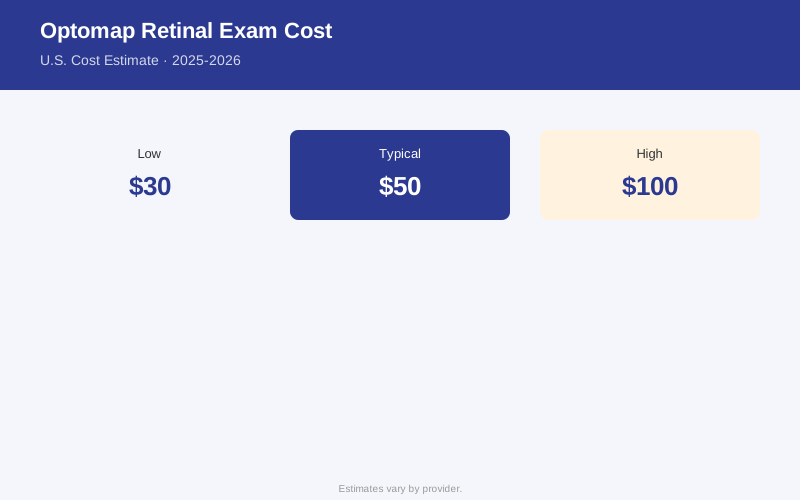
“Would you like to add the Optomap scan today for $45?” You’ve probably been asked this at your optometrist’s office. You might have said yes without fully knowing what you were paying for. Or said no out of habit. Either way, you deserve a straight answer on whether this is a genuine clinical tool worth the money or a routine upsell.
What Is Optomap?
Optomap is a brand name for ultra-widefield retinal imaging made by Optos. The device captures a single digital image of approximately 82% of the retina — about 200 degrees — in a single two-second exposure. By contrast, a standard fundus photograph captures roughly 45 degrees in one image; a dilated clinical exam with a hand-held lens covers about 60–80 degrees per view.
The wide-field coverage is the key advantage. Many retinal conditions — peripheral retinal tears, lattice degeneration, retinal detachments, certain tumors — originate in the far periphery of the retina. These areas are difficult to image with standard fundus cameras and require significant effort to examine even with dilation.
Optomap can be performed without dilation in many cases, using a low-powered 532-nm green laser and 633-nm red laser to illuminate the retina through an undilated or slightly dilated pupil. The image is captured and immediately available for review.
Optomap Cost
| Setting | Typical Optomap Cost |
|---|---|
| Retail optometry (LensCrafters, MyEyeDr, Visionworks) | $35–$75 |
| Independent optometrist practice | $39–$99 |
| Ophthalmology practice add-on | $50–$120 |
| With vision insurance (usually not covered separately) | $35–$99 out of pocket |
| With medical insurance + valid diagnosis code | $10–$40 (20% coinsurance) |
What You’re Actually Getting
A single Optomap image gives your eye doctor a widefield view they wouldn’t get from a standard 45-degree fundus photograph. The image is:
- Stored permanently as a baseline in your patient record
- Compared year to year to detect interval changes
- Shareable electronically with retinal specialists if a referral is needed
- Immediately reviewable at the time of your appointment
The technology is legitimate and used by ophthalmologists worldwide. It’s not a gimmick. The question is whether it adds diagnostic value over a dilated exam for your specific situation.
Optomap vs. Dilation: Which Is Better?
This comparison is more nuanced than “one is better.” Here’s the honest breakdown:
Optomap advantages over dilation:
- No drops required in most cases → no blurry near vision for 3–6 hours afterward
- Takes 2 seconds, no waiting for dilation to take effect
- Creates a permanent, reviewable, shareable image
- Captures far peripheral retina in a way difficult to achieve clinically
- Better for documenting and tracking peripheral lesions over time
Dilation advantages over Optomap:
- Standard of care for comprehensive retinal evaluation in patients with disease
- Allows 3D examination of the optic nerve and macular layers (stereoscopic view)
- Required for accurate interpretation of the vitreous (gel inside the eye)
- More detail in the central macula when combined with OCT
- Most insurers cover dilation as part of a comprehensive exam; Optomap often isn’t covered separately
The AAO states that dilation remains the gold standard for comprehensive eye exams, particularly for disease management. Optomap is a supplementary tool — excellent for screening peripheral pathology, but not a complete replacement for a dilated exam in patients with known eye disease.
Optomap adds real value if you:
- Are highly myopic (−3.00 or higher) — increased risk of peripheral retinal tears
- Have a personal or family history of retinal detachment
- Need to drive immediately after your appointment (no dilation effects)
- Have a history of retinal lesions being monitored
- Are a diabetic patient who needs peripheral retinal documentation
- Are having your first comprehensive exam at a new practice (baseline imaging)
Optomap may be unnecessary if:
- You’re a low-risk patient under 40 with a mild prescription and no systemic disease
- Your practice plans to dilate you anyway (then you have both covered)
- You’re having the exam primarily to update a contact lens or glasses prescription
Does Insurance Cover Optomap?
As a self-pay preventive add-on, Optomap is not covered by vision insurance. Most vision plans pay for the comprehensive eye exam itself; the Optomap scan is an additional charge billed directly to you.
If there’s a medical diagnosis attached — diabetic retinopathy screening, glaucoma monitoring, retinal detachment follow-up, high myopia evaluation — the retinal imaging can potentially be billed to medical insurance using CPT code 92250 (fundus photography with interpretation) or 92227/92228 (diabetic retinal screening codes). In that case, your 20% Medicare coinsurance or commercial insurance coinsurance applies, dropping your out-of-pocket to $10–$40 range.
If you have diabetes, ask your optometrist or ophthalmologist whether the imaging will be billed to your medical insurance rather than charged as an out-of-pocket add-on. Many practices do this automatically for diabetic patients — but not all.
The High Myopia Argument
If you wear glasses or contacts with a prescription of −3.00 or higher, you’re in a group where Optomap earns its fee. The American Optometric Association notes that high myopes have a 5–10 times greater risk of retinal detachment than the general population. The lattice degeneration, retinal thinning, and peripheral atrophic holes that precede detachment sit in the far peripheral retina — exactly the zone that Optomap captures best.
A peripheral retinal tear caught before symptoms appear can be sealed with a 10-minute laser procedure (roughly $300–$800 at an ophthalmologist). A missed tear that progresses to retinal detachment requires surgery costing $8,000–$20,000. The $45–$75 annual Optomap cost looks different in that context.
Saving Money on Optomap
If you pay out of pocket:
- Ask whether dilation can replace it for your visit today — if your practice will dilate you with a broad fundus exam, you get excellent clinical coverage without the extra fee
- Use FSA/HSA funds — Optomap fees qualify as a medical expense
- At diabetic annual exams, ask whether the retinal image will be submitted to your medical insurance (not vision insurance) before you pay
Bottom Line
Optomap ultra-widefield retinal imaging costs $35–$99 as a self-pay add-on at most optometry and ophthalmology practices. For low-risk healthy patients with mild prescriptions, it’s a nice-to-have that you can decline without significant clinical concern — a standard dilated exam is sufficient. For high myopes, diabetics, and patients with retinal risk factors, it’s worth every dollar: the peripheral coverage is genuinely superior, the image becomes a permanent baseline, and it takes two seconds with no dilation side effects. When in doubt, ask your OD to explain specifically why they’re recommending it for you today — that conversation tells you whether it’s a clinical recommendation or a routine add-on prompt.