Orbital decompression is one of the more technically complex eye surgeries performed today. It involves removing bone and sometimes fat from the eye socket to give the swollen tissue behind the eye more room — reducing proptosis (eye bulging), relieving pressure on the optic nerve, and restoring a more normal appearance. It’s most commonly done for thyroid eye disease (TED), though trauma and orbital tumors are other indications.
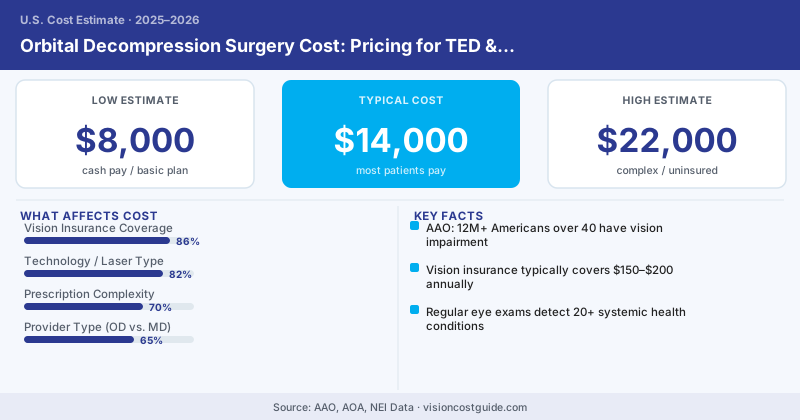
The cost? $8,000–$22,000 in most US markets, with insurance often covering the bulk of it when medical necessity is established. Here’s the breakdown.
Quick Cost Summary
| Procedure Scope | Estimated Total Cost |
|---|---|
| Unilateral (one eye), one-wall decompression | $8,000–$12,000 |
| Bilateral (both eyes), one-wall | $14,000–$18,000 |
| Two-wall or three-wall decompression (complex) | $16,000–$25,000+ |
| With insurance (commercial, after deductible) | $1,500–$5,000 typical |
| With Medicare (after Part B deductible + 20%) | $800–$3,500 |
| Anesthesia fees | $1,200–$2,500 |
| Surgical facility fee | $3,000–$7,000 |
What Drives the Cost
Number of walls removed. The orbit (eye socket) is a bony cavity with four walls. Surgeons remove one, two, or three walls depending on how much space is needed. More walls = longer surgery, more complexity, higher cost.
- One-wall (medial or floor): most common for mild-moderate proptosis reduction
- Two-wall (medial + floor): adds more reduction, often used for TED rehabilitation
- Three-wall: reserved for severe cases or optic nerve compression emergencies
Bilateral vs. unilateral. TED usually affects both eyes, so bilateral decompression is common. When both eyes are done in the same surgical session, anesthesia and facility costs are shared — cheaper than two separate procedures, but still significantly more than one-eye surgery.
Fat vs. bony decompression. Some surgeons offer fat-only decompression, which removes orbital fat without touching bone. It’s less invasive, reduces recovery time, and costs somewhat less — typically $7,000–$12,000 for bilateral procedures. It’s appropriate for mild proptosis reduction but doesn’t provide as much volume reduction as bony decompression.
Surgeon’s expertise. Orbital decompression is performed by oculoplastic surgeons — a highly subspecialized group. There are fewer than 700 ASOPRS-certified oculoplastic surgeons in the US, and their fees reflect specialized training. Surgeon fees vary from $2,500 to $6,000+ depending on the complexity and region.
Hospital vs. ambulatory surgery center. Hospital outpatient departments charge significantly higher facility fees than freestanding ASCs. If your surgeon has privileges at an ASC, request it — facility fees can be 30–50% lower.
Orbital decompression for thyroid eye disease is medically necessary and covered by most commercial insurers and Medicare when properly documented. Key CPT codes include 67414 (orbital decompression), 67445, and related codes. Your oculoplastic surgeon will submit documentation of proptosis measurements, vision changes, corneal exposure, or optic nerve compression. Pre-authorization is required — get it before scheduling. Most patients with commercial insurance pay $1,500–$4,000 after deductibles and coinsurance. Without insurance, cash-pay packages at ASCs run $10,000–$16,000 for bilateral procedures.
The Surgical Rehabilitation Sequence
Orbital decompression is almost never the only surgery TED patients need. The standard sequence — and its estimated costs — looks like this:
- Orbital decompression: Reduces proptosis and eye socket pressure. $8,000–$22,000.
- Strabismus surgery (if double vision persists after decompression): Adjusts eye muscles. $4,000–$10,000.
- Eyelid retraction repair: Lowers retracted upper/lower lids for better closure and appearance. $2,500–$6,500.
The AAO TED guidelines recommend waiting 3–6 months between each stage to allow healing and tissue stabilization. Rushing any step increases the risk of needing revision surgery.
Total surgical rehabilitation costs for a full sequence: $15,000–$40,000 across 1–2 years, though insurance coverage typically reduces patient out-of-pocket costs to $3,000–$10,000 depending on the plan.
Recovery Costs to Budget For
Hospital or ASC stay is usually same-day (outpatient). After surgery:
- Antibiotic + steroid eye drops: $30–$75 for the post-op course
- Oral steroids (prednisone taper): $10–$25
- Cold compresses, gauze, supplies: $20–$40
- Post-op visits (typically 1 week, 1 month, 3 months): $100–$250 each with insurance
- Time off work: 1–2 weeks typical; plan for this in your budget
Total out-of-pocket recovery costs beyond the surgery itself: roughly $200–$600.
Orbital decompression significantly changes the structure around the eye. In approximately 15–30% of TED cases, new or worsened double vision (strabismus) appears after bony decompression — even in patients who had no double vision before surgery. This is why strabismus surgery always comes after decompression, never before. Discuss this risk in detail with your oculoplastic surgeon before proceeding. It’s predictable and correctable, but it does mean additional cost and surgery in many cases.
Finding a Surgeon
Not every ophthalmologist performs orbital decompression — it requires oculoplastic subspecialty training. Use the ASOPRS surgeon finder at asoprs.org. Academic medical centers with oculoplastic programs (e.g., Wilmer Eye Institute at Johns Hopkins, Wills Eye Hospital, Bascom Palmer Eye Institute) offer experienced teams, though their facility fees may be higher than private ASCs.
Many TED patients connect with TED-specialist oculoplastic surgeons through their endocrinologist’s referral network or via the Graves’ Disease and Thyroid Foundation (gdatf.org), which maintains patient resources and specialist lists.
Is It Worth It?
For patients with significant proptosis affecting vision, appearance, or corneal health — the answer is almost always yes. The NEI notes that untreated compressive optic neuropathy in TED can cause permanent vision loss in a small but meaningful percentage of patients. Decompression is the definitive treatment. When insurance is involved and the documentation is solid, the out-of-pocket cost is rarely the barrier it initially appears to be.