Ortho-K isn’t a new technology — it’s been FDA-approved since 2002. What’s newer is the evidence that it slows myopia progression in children by 30–60%, which has driven a significant surge in prescribing over the past decade.
That myopia control data changes the conversation entirely. This isn’t just about convenient daytime freedom from glasses or contacts. Multiple randomized controlled trials published in Ophthalmology and Investigative Ophthalmology & Visual Science (IOVS) show 30–63% slowing of axial elongation — the structural change driving myopia — compared to single-vision correction. For parents watching a child’s prescription climb by -0.50D to -1.00D every year, that’s a clinically significant number.
Here’s what it costs and what you actually get.
How Ortho-K Works
Orthokeratology uses rigid gas-permeable contact lenses with a reverse-geometry design — a central zone that’s flatter than the cornea’s natural curve, creating a controlled reshaping effect while you sleep. You insert the lenses at bedtime, wear them for 6–8 hours, remove them in the morning, and see clearly all day without glasses or daytime contacts.
The reshaping effect lasts 1–2 days. Miss a night, and your vision will start to blur the following day. The cornea returns fully to its original shape within 1–3 days of stopping lens wear — complete reversibility.
Who it works for:
- Myopia up to -6.00 diopters (lower prescriptions respond fastest and most completely)
- Low-to-moderate astigmatism (under -1.75D cylinder)
- Children aged 8 and up
- Adults wanting daytime freedom without permanent surgery
- Anyone not yet a LASIK candidate (under 21, unstable prescription)
Full Cost Breakdown
| Option | Annual Cost | Permanent Correction | Myopia Control Benefit |
|---|---|---|---|
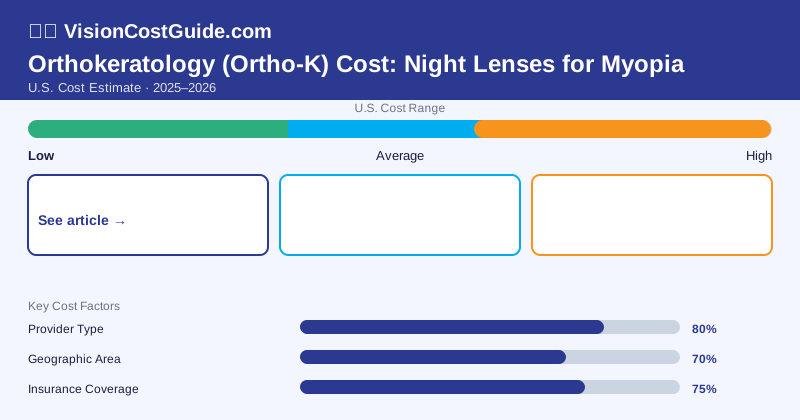
| Ortho-K (year 1, initial fitting) | $1,500–$2,500 | No | Yes (30–63% slowing) |
| Ortho-K (year 2+, maintenance) | $400–$800/year | No | Yes |
| Daily disposable soft contacts | $900–$1,100/year | No | Minimal |
| Regular RGP contacts | $500–$900/year | No | Minimal |
| LASIK (one-time, adults only) | $4,000–$6,000 total | Yes | No (adults) |
The first-year cost is highest because it includes corneal topography mapping, custom lens design, the initial lens pair, and multiple fitting follow-up visits. Subsequent years are primarily lens replacement and annual monitoring.
What’s in the First-Year Package
The $1,500–$2,500 first-year range covers a complete treatment package. What’s bundled varies by practice, so always ask for an itemized breakdown before committing:
- Corneal topography mapping (determines if you’re a candidate, guides lens design): included or $100–$200
- Initial lens pair (custom-designed for your corneal shape): $300–$800
- Fitting fee and chair time: $400–$800
- Follow-up visits for first 3–6 months: included or $50–$150 each
Annual replacement lenses: $300–$600 per pair. Lenses typically last 1–2 years with proper care before replacement is needed.
Good candidates for pediatric ortho-K:
- Age 8–18 with documented myopia progression (prescription increasing each year)
- Myopia of -0.50D to -6.00D
- Motivated to wear lenses every night and follow hygiene protocols
- Parents committed to annual follow-up and lens monitoring
The AOA’s myopia management guidelines recognize ortho-K as an evidence-based option. The American Academy of Optometry has similarly endorsed it based on multiple published clinical trials showing meaningful slowing of axial elongation.
The 10-year math often surprises parents: Ortho-K at $1,800 year 1 + $600/year × 9 years = approximately $7,200. Daily disposable soft contacts at $1,000/year × 10 years = $10,000. Ortho-K frequently comes in at or below the cost of daily disposables — with myopia control added at no extra charge.
Insurance and Payment Options
Most standard vision insurance plans don’t cover ortho-K. The contact lens benefit, if your plan has one, typically applies to conventional soft lenses.
What does help:
- HSA/FSA: Ortho-K qualifies as a medically necessary vision correction expense — both lenses and fitting fees are eligible
- Specialized pediatric vision plans: Some include partial coverage; read the contact lens benefit language carefully
- CareCredit and medical financing: Most ortho-K practices accept these, which spreads the first-year cost over 12–24 months
Comparing Ortho-K to LASIK for Adults
For adults over 21 with a stable prescription, LASIK ($4,000–$6,000 one-time) offers permanent correction. Ortho-K costs less in year one and continues as an ongoing expense, but it’s reversible — useful if your prescription continues to change or you’re not ready for surgery.
One practical advantage: adults who use ortho-K into their early 20s and later pursue LASIK may end up with a lower final prescription than if they’d used single-vision correction throughout. Smaller LASIK corrections typically have better outcomes with more tissue reserve. There’s no clinical guarantee, but the arithmetic makes intuitive sense.
Ortho-K lenses are worn overnight — the highest-risk contact lens modality for eye infections. Corneal ulcers have been reported with improper ortho-K lens care. Hydrogen peroxide cleaning systems (Clear Care, PeroxiClear) are strongly preferred over multipurpose solutions because they provide a fully sterile soak every night. Cases must be replaced regularly, no water exposure during handling, and hands must be washed thoroughly before insertion and removal. Annual follow-up visits are non-negotiable even after vision stabilizes — the optometrist checks for subtle corneal changes that may not produce symptoms early on.
Frequently Asked Questions
No. Ortho-K temporarily reshapes the cornea while you sleep. The effect reverses if you stop wearing the lenses — your cornea gradually returns to its original shape over 1–3 days. This makes it fully reversible, which is an advantage for children whose prescriptions are still changing and who aren't candidates for permanent surgical correction.
Most eye doctors begin ortho-K at age 8–9, when children are mature enough to handle lens care consistently. It's most commonly prescribed between ages 8–18 during the years of active myopia progression. Adult candidates exist too, though the myopia control benefit is primarily relevant for developing eyes that haven't stabilized.
Most standard vision insurance plans don't specifically cover ortho-K lenses or fitting fees. However, FSA and HSA funds can be used since ortho-K qualifies as a medically necessary vision correction. Some specialized pediatric vision plans include partial coverage — read your contact lens benefit language carefully before assuming you're not covered.