The $3,800 LASIK quote was already printed. Then the surgeon’s pachymetry scan came back at 480 microns — thin enough to disqualify Marcus from the procedure entirely. Twenty minutes and one inexpensive test saved him from a surgery that could have permanently weakened his corneas. That’s exactly what pachymetry is for.
What Pachymetry Measures
Pachymetry is the measurement of corneal thickness. The cornea — the clear dome at the front of your eye — averages about 540–545 microns in the central zone (roughly half a millimeter). Variation from that norm matters enormously in two specific contexts: LASIK candidacy and glaucoma evaluation.
For LASIK and refractive surgery: Every laser correction removes corneal tissue. Too little thickness to start with, and you don’t have enough residual stroma to support safe ablation. Most surgeons require a minimum of 450–500 microns central thickness, and a minimum residual stromal bed of 250–300 microns after the ablation. If you don’t have enough to work with, LASIK isn’t safe — period.
For glaucoma: Intraocular pressure (IOP) readings from standard tonometry are affected by corneal thickness. A thick cornea artificially elevates measured IOP; a thin cornea makes it read low. The correction factor is roughly 0.7 mmHg per 10 microns of deviation from average. Someone with corneas 50 microns thinner than average has a true IOP roughly 3.5 mmHg higher than their tonometer reading suggests — which can mean the difference between treatment and no treatment.
Methods of Pachymetry
| Method | Accuracy | Speed | Common Use |
|---|---|---|---|
| Ultrasound pachymetry | ±2–3 microns | 30 seconds | Surgical planning (gold standard) |
| Optical (Scheimpflug/Pentacam) | ±3–5 microns | 2–3 minutes | LASIK evaluation, full corneal mapping |
| OCT-based pachymetry | ±4–5 microns | 2 minutes | Glaucoma monitoring, bundled with OCT |
| Specular microscopy | ±5–10 microns | 2–3 minutes | Combined with endothelial cell count |
Ultrasound pachymetry requires a topical anesthetic drop and a small probe that touches the corneal surface. Optical methods (Scheimpflug imaging, OCT) are non-contact and can map the entire corneal thickness profile — not just the center — giving far more information for keratoconus evaluation and LASIK planning.
Cost Breakdown
| Setting | Standalone Cost | Notes |
|---|---|---|
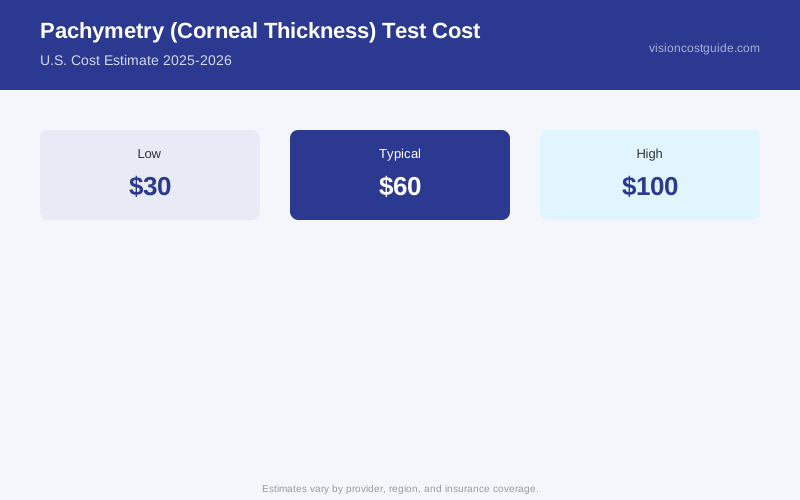
| Ophthalmology practice (ultrasound) | $30–$75 | Simple add-on to exam |
| LASIK evaluation (bundled) | Included in consult fee | Usually part of $0–$250 consult |
| Glaucoma monitoring (bundled with OCT) | Included in OCT billing | Not separately billed |
| Academic/hospital eye center | $50–$100 | May bill CPT 76514 separately |
| Standalone optometry | $40–$80 | Less common than ophthalmology |
When pachymetry is performed as part of a LASIK candidacy evaluation, it’s almost always bundled — you won’t see a separate line item. When ordered for glaucoma management, it’s typically a one-time measurement (not repeated at every visit) and may be bundled into the glaucoma testing fee or billed under CPT code 76514.
Insurance Coverage
The American Glaucoma Society and the AAO both include pachymetry in the workup for glaucoma suspects and newly diagnosed patients. Medicare Part B covers pachymetry (CPT 76514) when ordered as part of a medically necessary evaluation — typically for glaucoma or keratoconus. Patient cost after 80% Part B coverage is usually $6–$15 per eye.
Pachymetry for LASIK evaluation is elective — not covered by medical insurance. It’s part of the refractive surgery workup you pay for yourself.
Vision insurance (VSP, EyeMed, Davis Vision) typically doesn’t cover pachymetry as a standalone benefit. It may be covered under medical insurance if ordered for a qualifying diagnosis.
When Is Pachymetry Actually Required
You need pachymetry if:
You’re considering LASIK, PRK, or SMILE — every reputable surgeon will measure corneal thickness before operating. If a surgeon offers you refractive surgery without pachymetry, that’s a red flag.
You’re diagnosed with or suspected of glaucoma — a one-time baseline measurement helps interpret IOP readings throughout your life.
You have ocular hypertension — elevated IOP without other signs of glaucoma. The Ocular Hypertension Treatment Study (OHTS), published in JAMA in 2002, identified thin central corneal thickness (less than 555 microns) as a significant independent risk factor for glaucoma conversion. That finding made pachymetry a standard part of ocular hypertension management.
You have suspected keratoconus — pachymetry shows characteristic thinning in the cone location, and the inferior-superior asymmetry pattern is diagnostic.
Normal central corneal thickness ranges from about 500 to 600 microns, with a mean around 540–545 microns. Thin corneas (below 500 microns) have several implications:
- LASIK may not be safe — consider PRK (which doesn’t create a flap) if there’s adequate thickness
- IOP readings are likely underestimated — your true pressure is higher than measured
- Risk of glaucoma development from ocular hypertension is higher
Thick corneas (above 600 microns) have the opposite effect on IOP — measured pressure reads higher than true IOP — which occasionally leads to unnecessary glaucoma evaluation in people who don’t actually have elevated true IOP.
What Happens if You’re Too Thin for LASIK
Don’t panic. You have options:
- PRK (photorefractive keratectomy): No flap means no flap thickness requirement. PRK removes less total tissue to achieve the same correction, making it feasible for thinner corneas that aren’t candidates for LASIK. The PRK surgery cost is comparable to LASIK.
- SMILE: Creates a smaller lenticule than LASIK’s flap, with some corneal thickness advantages for mild cases
- ICL (Implantable Collamer Lens): An implanted lens doesn’t touch the cornea at all — corneal thickness is irrelevant. The ICL cost is higher than LASIK but appropriate for thin corneas or high prescriptions.
Not all LASIK centers perform full corneal mapping (Scheimpflug/Pentacam) — some do ultrasound pachymetry of just the central point. For keratoconus screening, a full topographic thickness map is more informative than a single central reading. If you’re concerned about keratoconus or have a family history, ask specifically whether your evaluation includes corneal topography and a full pachymetry map, not just a central measurement.
Bottom Line
Pachymetry costs $30–$100 as a standalone test — and most people getting LASIK won’t pay separately since it’s bundled into the pre-op evaluation. For glaucoma monitoring, it’s a one-time baseline test usually covered by Medicare or medical insurance at minimal out-of-pocket cost. The measurement takes 30 seconds to 3 minutes depending on the method. It’s not dramatic, but the information it provides — corneal thickness to within a few microns — is foundational for safe refractive surgery decisions and accurate glaucoma pressure interpretation.